The Hungarian government has ordered the immediate construction of a submerged weir on the Danube between the Paks nuclear power plant and the village of Dunaszentbenedek in response to record-low water levels, Prime Minister Péter Magyar said on Wednesday.
As a temporary measure, two 80-metre barges will also be placed on standby near Paks. If necessary, they could be deliberately sunk in a controlled operation to raise the Danube’s water level by around 20 centimetres in the short term.
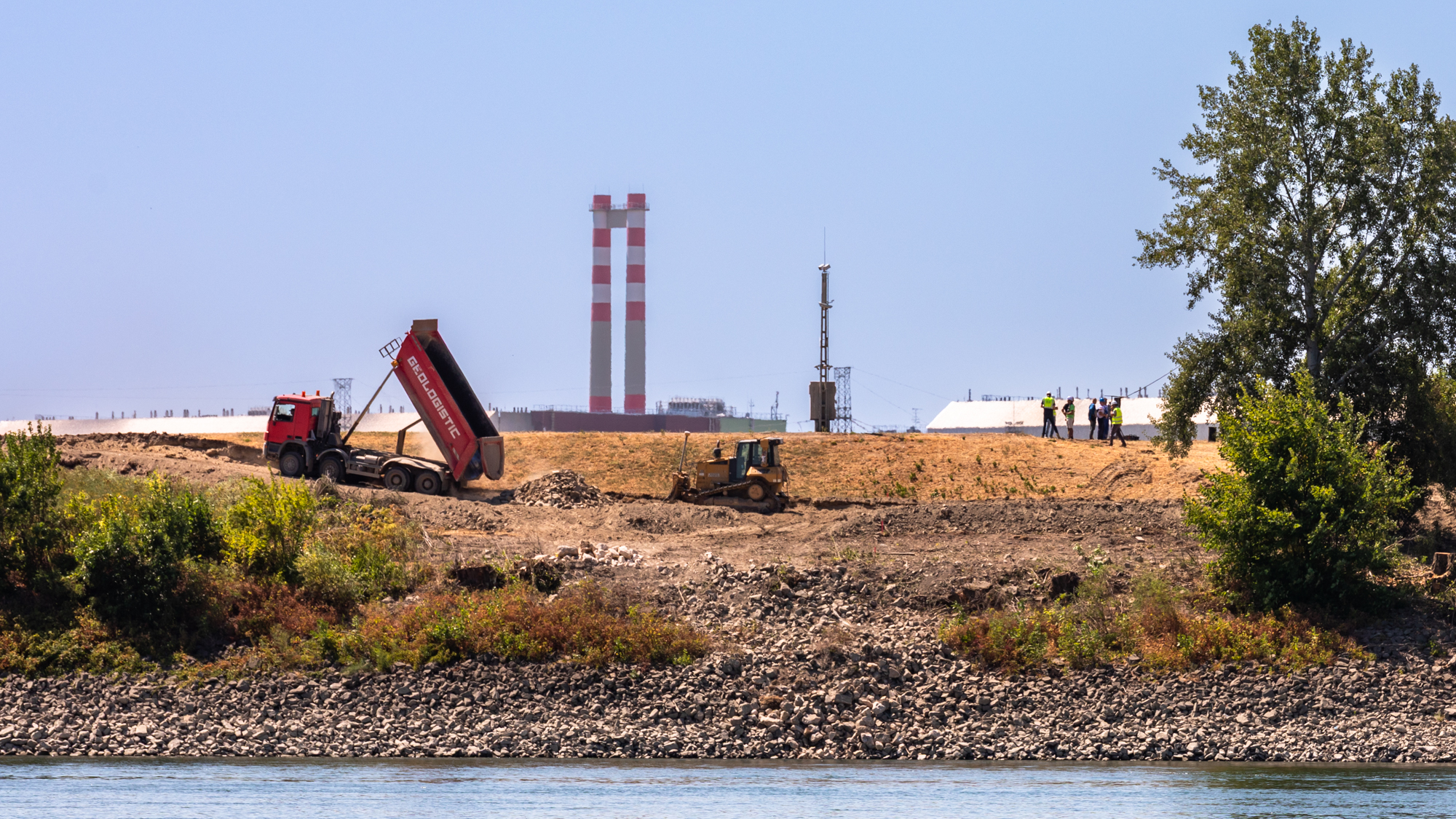
Magyar said the decision to begin construction of the weir was made after an on-site inspection and based on the unanimous recommendation of water management, energy, and defence experts. Work will begin on Thursday, initially using 35,000 cubic metres of rock, followed by a further 110,000 cubic metres.
According to the prime minister, the project should ensure within a few weeks that the Danube’s water level at the nuclear plant’s cooling channel does not fall below minus 90 centimetres, allowing the plant to operate at full capacity.
He said the prolonged low water level was causing significant damage to Hungary’s economy and state budget. A complete shutdown of the Paks plant would cost the budget at least 50 billion forints per month, while the emergency interventions now ordered will cost around 6 billion forints, he said.
Magyar blamed previous governments for failing to respond to warnings from researchers and water management experts about the risks of low water levels. He said no adequate contingency plans or investment programmes had been prepared, while necessary projects such as a pumping station and an alternative heating system at the plant had not been launched.
The two barges are intended to protect until the permanent weir is completed and could help prevent a complete shutdown of the nuclear plant if water levels fall rapidly again.
Water management experts and military personnel have already begun preparing the construction site. The design of the structure is being handled by Hungarian engineers with the involvement of the Budapest University of Technology and Economics. General Pál Kádár, head of the Defence Administration Office, has been appointed to coordinate and direct the defence and construction operations. One of the barges needed for the temporary solution is due to arrive in Paks from Mohács on Wednesday evening, while the second is expected on Thursday. Preparations for storing materials, securing the riverbank and transporting the required rock to the site are also being launched immediately.
The government has ordered round-the-clock work, with lighting and safety measures provided. Defence Minister has deployed around 100 soldiers from Budapest and Szentes to support the operation.
Once completed, the weir will be capable of raising the Danube’s water level by up to one metre, Magyar said, adding that it would not pose a danger in the event of a future flood. Construction on the Paks side will take place within the nuclear plant’s area.
The mayors of Paks and Dunaszentbenedek attended the government meeting and were assured that construction would cause minimal disruption to the settlements. The government also pledged to compensate for any damage caused by the works. Both mayors expressed their support for the project, Magyar said. In Dunaszentbenedek, the government also agreed to seek a solution that would leave the local riverbank in better condition than it is now once the weir is completed. Given the urgency, the government has classified both the construction project and the use of the barges as priority investments.
Magyar said the construction would begin with a wide layer of rock being placed on the riverbed to prevent the strong current from eroding the bed beneath and around the structure. Large rocks weighing several tonnes will then be placed layer by layer from both banks to form the weir. He stressed that the project had been designed so that nuclear safety standards would not be compromised in any way.
According to Magyar, the construction of the weir will be the most significant intervention on the Danube since a similar structure was completed at Dunakiliti in 1995. The project requires tens of thousands of tonnes of rock to be extracted and transported to Paks within a very short period, roads to be reinforced, and the structure to be built underwater from both banks. If necessary, the barges will also have to be positioned across the river, secured and potentially sunk in a controlled operation so that they can withstand the pressure of the Danube over an extended period.
Magyar acknowledged that such a project would normally take considerable time to design and implement, but said the current situation allowed only days rather than months. The necessary permitting procedures will therefore run in parallel with construction, while every stage will be carried out according to plans prepared by water management and nuclear safety experts.
The Danube’s water level has temporarily risen in recent days. Still, water management forecasts indicate that it could fall again to around minus 136 to minus 137 centimetres within four to five days. Without external intervention, it could drop below minus 140 centimetres next week, potentially forcing another complete shutdown of the plant, Magyar said. He added that water levels were dramatically low along the entire Danube and that no significant rainfall was expected in the river’s catchment areas in the coming days and weeks. The situation could therefore persist for months, while historical data suggested that water levels could fall again in the autumn. ‘The failures of previous governments that we now have to make up for are enormous, while the time available is short,’ Magyar said. A final decision on the controlled sinking of the barges is expected on Friday, while preparatory work is already under way. At the same time, construction of the permanent solution, the submerged weir, will begin immediately.
Magyar said the government had made the necessary decisions and completed the legal and administrative preparations, while water management authorities, the Paks plant, the armed forces, and Hungary’s leading technical experts were now working on what he described as the country’s most important joint investment.
He said the government had received a mandate in April to address the country’s problems responsibly and proactively, with Hungarian interests in mind. ‘There can be no more cases where politics abandons the country in times of trouble,’ Magyar said, adding that the government would remain involved throughout the operation and take whatever responsibility was required to protect Hungary’s security.
He also called for greater national cooperation in the coming days and weeks.
Related articles:
At a time when public debate is increasingly polarized and superficial, Hungarian Conservative remains committed to depth, intellectual honesty, and independent conservative thought.
Producing high-quality journalism requires resources. Your contribution helps us expand our coverage, reach new audiences, and keep our content accessible.

Please consider supporting our mission.