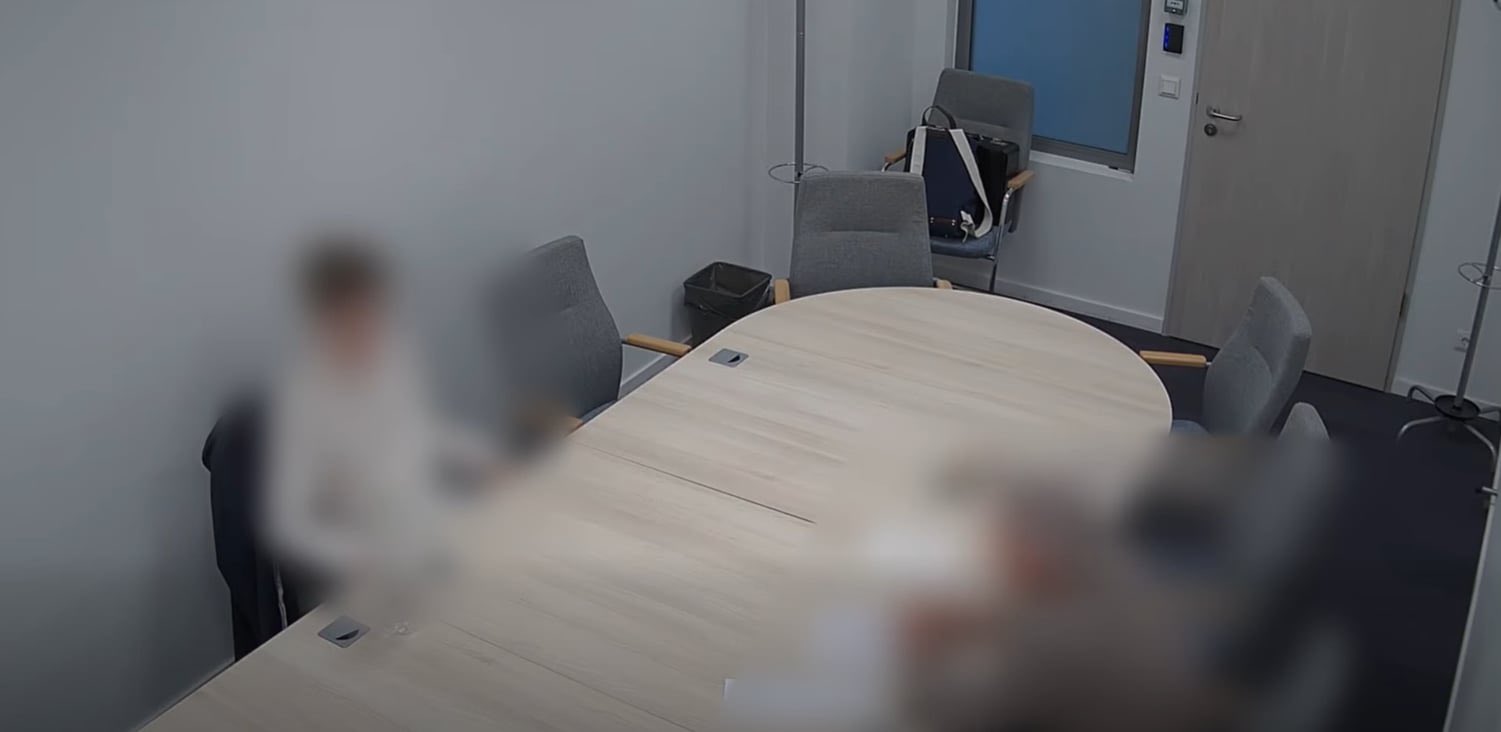
Hungary’s government has released a declassified video showing the interrogation of a former IT specialist linked to the opposition Tisza Party, in which the individual suggests he may have been unknowingly recruited by foreign intelligence actors.
The footage, published on Saturday, 28 March, captures questioning conducted by the Constitution Protection Office (AH). In the recording, the man—identified as H D—states that, in retrospect, his earlier international contacts may have formed part of a structured recruitment effort by a foreign intelligence service.
‘I’ve thought a lot about what was said…and unfortunately I’m leaning toward the conclusion that this was some kind of recruitment, preparing me for an operation,’ he told investigators.
The release comes just over two weeks ahead of Hungary’s parliamentary elections and follows competing narratives about the same case. Earlier this week, Hungarian outlet Direkt36 reported that two IT specialists linked to Tisza were themselves targets of an attempted infiltration operation.
‘I’m leaning toward the conclusion that this was some kind of recruitment, preparing me for an operation’
According to documents cited by the outlet, an unidentified individual known as ‘Henry’ allegedly sought to recruit one of them in early 2025 to gain access to the party’s internal systems, including the Tisza World application, and to influence its operations ahead of the vote.
The report also claimed that the two individuals later became subjects of a police investigation based on a tip-off alleging child exploitation. While authorities reportedly seized multiple data carriers during house searches, no such material was found. Direkt36 suggested that the Constitution Protection Office may have influenced the direction of the investigation and noted that the identity of ‘Henry’ was not pursued. However, the report relied partly on indirect evidence, including statements by investigator Bence Szabó, who even acknowledged the lack of definitive proof. Szabó was subsequently dismissed from the force with immediate effect, and an investigation was launched against him on charges of abuse of office.
Government officials argue that the newly released recording challenges this interpretation, instead indicating that the individuals in question may have been exposed to foreign recruitment attempts. Government spokesman Zoltán Kovács said the testimony supports the position that the case is a national security matter rather than a politically motivated action.
Separately, Hungary’s parliamentary National Security Committee has declassified elements of an intelligence briefing stating that the individuals maintained contacts with representatives of the so-called IT Army of Ukraine, as well as with the Ukrainian embassy in Budapest, and were at one point ‘directed by a foreign intelligence operative’. According to the document, counterintelligence had been monitoring the individuals since 2023, before the Tisza Party was established.
The video provides further detail on these contacts. According to H D, his involvement began through what was presented as an international cyber defence training programme linked to Estonia and described as NATO-accredited. Investigators, however, identified multiple inconsistencies: the organization lacked a verifiable physical presence, its documentation could not be authenticated, and participants had limited contact with identifiable institutional structures.
‘He described one contact as a liaison linked to Ukrainian state-affiliated cyber defence activities’
H D said his participation increasingly involved international travel after the outbreak of the war in Ukraine. One such trip took him to Kyiv, where he met individuals connected to Ukrainian cyber networks through an Estonian intermediary. He described one contact as a liaison linked to Ukrainian state-affiliated cyber defence activities.
While the programme was initially presented as defensive—focused on countering Russian cyber operations—H D told investigators that its nature later shifted. ‘At first it was defensive…but later it became more offensive in nature,’ he said, referring to discussions about potential cyberattacks. He added that he was not involved in operations targeting critical infrastructure.
He also described the use of encrypted communication channels, pseudonyms, and frequently changing identities—patterns Hungarian authorities say are consistent with intelligence-linked coordination. According to his account, some individuals within these networks expressed hostility towards Hungary, particularly over its refusal to supply weapons to Ukraine.
Opposition leader Péter Magyar rejected the government’s interpretation, describing the broader case as ‘Orbán-gate’ and comparing it to Watergate. He accused Hungary’s intelligence services of acting on political orders and said those responsible would face legal consequences if his party comes to power.
The developments highlight an escalating clash of narratives ahead of the election. Prime Minister Viktor Orbán has repeatedly claimed that Ukrainian intelligence is attempting to influence Hungarian politics, while opposition figures argue that the government is instrumentalizing national security institutions for political purposes. At the same time, Western media and some European intelligence services, alongside Hungarian opposition-linked figures, continue to point to alleged Russian interference in support of Viktor Orbán’s campaign—further intensifying what has become a multi-layered information and intelligence dispute surrounding the vote.
Watch the full declassified video recording here:
Related articles:
At a time when public debate is increasingly polarized and superficial, Hungarian Conservative remains committed to depth, intellectual honesty, and independent conservative thought.
Producing high-quality journalism requires resources. Your contribution helps us expand our coverage, reach new audiences, and keep our content accessible.

Please consider supporting our mission.