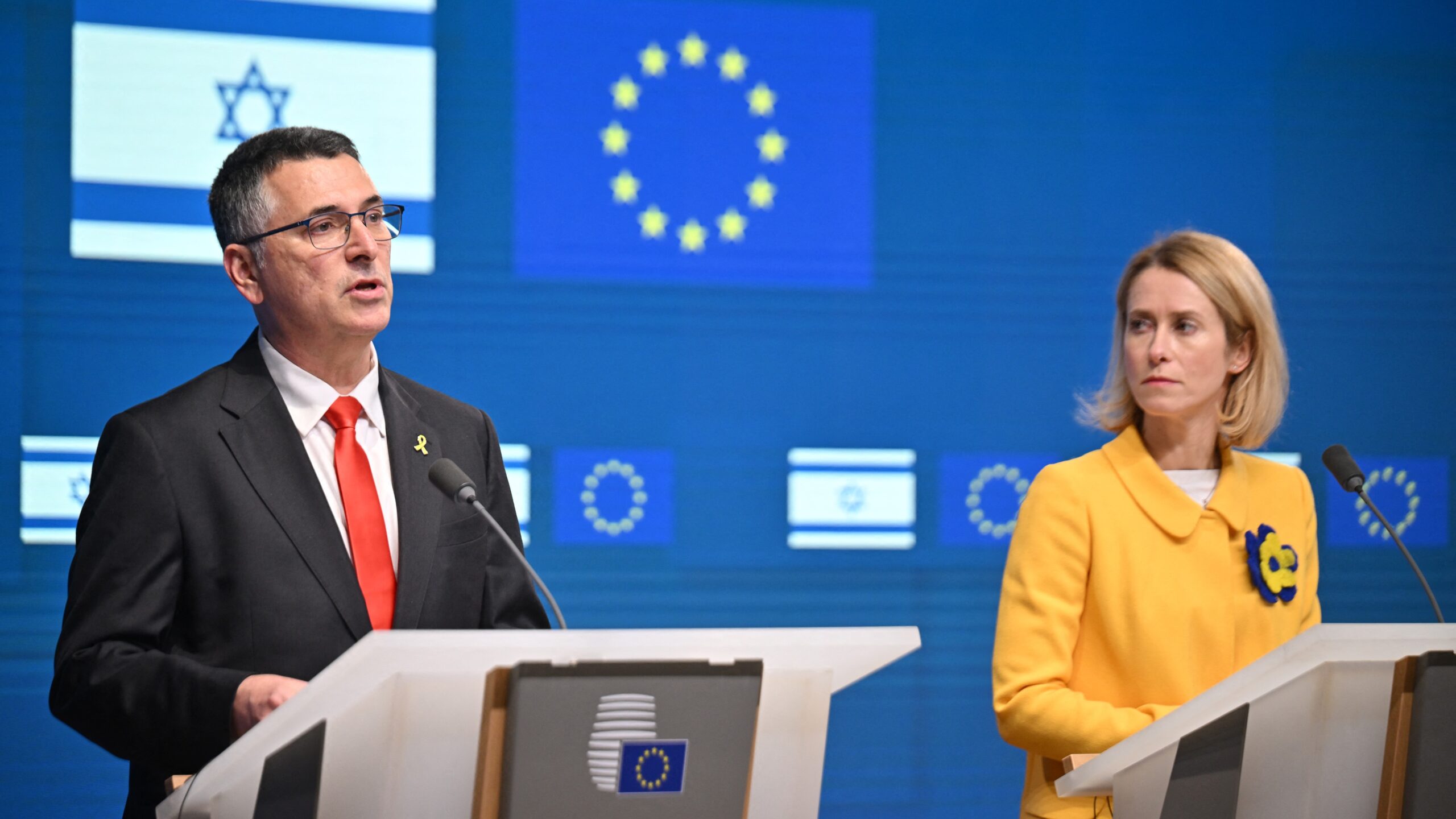
Israeli Foreign Minister Gideon Sa’ar announced on Thursday that he is cutting off all contact with Kaja Kallas, the European Union’s High Representative for Foreign Affairs and Security Policy, after she reportedly likened Israel to apartheid-era South Africa during closed-door meetings.
The controversy originates from a report by EURACTIV, which revealed that during a working visit to Mexico City between 20–22 May, Kallas privately drew comparisons between Israel’s treatment of Palestinians in Gaza and the West Bank and the racial segregation system that existed in South Africa until the early 1990s.
The comparisons were made during closed meetings with senior Mexican government officials, and were not part of any public statement or press conference.
When asked to respond to the report, the EU’s foreign affairs spokesman, Anwar al-Anuni, stopped short of an outright denial. He stated that he did not intend to address claims originating from anonymous sources, adding that Kallas’s publicly known position on the conflict had been presented at a number of press conferences in recent weeks.
That non-denial proved to be the breaking point for the Israeli FM. In a post published on his X account, the Israeli foreign minister described Kallas’s conduct toward Israel as marked by ‘obsessive and deeply dishonest hostility.’ Sa’ar wrote:
‘…However, Kallas has thus far refrained from any denial, response, or clarification regarding these statements. Therefore, as Israel’s Foreign Minister, I have no choice but to sever all ties with Ms. Kallas until she retracts the blood libel she has leveled at the only Jewish state, which is also the only democracy in the Middle East.’
Kallas herself still declined to deny or retract the remarks. Instead, she responded to the Israeli FM on X, arguing that: ‘I value our dialogue and engagement, and I’m open to continue in that spirit, respectfully and constructively. Dialogue is the foundation of diplomacy, especially when differences arise. The EU is always committed to a constructive relationship with Israel.’
However, according to the Israeli foreign minister’s response, as long as Kallas does not clarify her position regarding the statement, Israel’s decision will remain unchanged.
The fallout has also reverberated within European institutions. While Kallas has stayed silent, at least one unnamed EU diplomat expressed discomfort with the comparison, telling reporters that while the EU maintains a critical stance toward Israel and supports a two-state solution, likening the country to an apartheid regime goes well beyond established EU policy.
As the diplomat put it: ‘The apartheid comparison is unacceptable and does not reflect EU policy. It is a serious problem if the High Representative makes such statements while officially representing the EU on the world stage.’
‘The apartheid comparison is unacceptable and does not reflect EU policy’
When Kallas was appointed in 2024, Jerusalem had hoped she would strike a different tone than her predecessor, Josep Borrell of Spain, whose tenure was defined by sharp and frequent criticism of Israel. Initial signs were cautiously encouraging. But in recent months, under mounting pressure from EU member states, Kallas oversaw a series of measures critical of Israel—including pushing for sanctions against Israeli ministers and settlers, and exploring a partial suspension of the EU–Israel trade association agreement.
Ireland and Slovenia joined Spain in leading the early push to suspend the agreement, with Belgium, the Netherlands, and Sweden later lending their support—though a bloc of countries including Germany, Italy, Austria, the Czech Republic, Hungary, and Cyprus have consistently opposed collective EU action on the matter.
Israel has faced a series of diplomatic confrontations with international institutions in recent months—in May, Jerusalem similarly froze ties with UN Secretary-General António Guterres—reflecting a broader pattern of tension with multilateral bodies over the Gaza conflict.
Related articles:
At a time when public debate is increasingly polarized and superficial, Hungarian Conservative remains committed to depth, intellectual honesty, and independent conservative thought.
Producing high-quality journalism requires resources. Your contribution helps us expand our coverage, reach new audiences, and keep our content accessible.

Please consider supporting our mission.