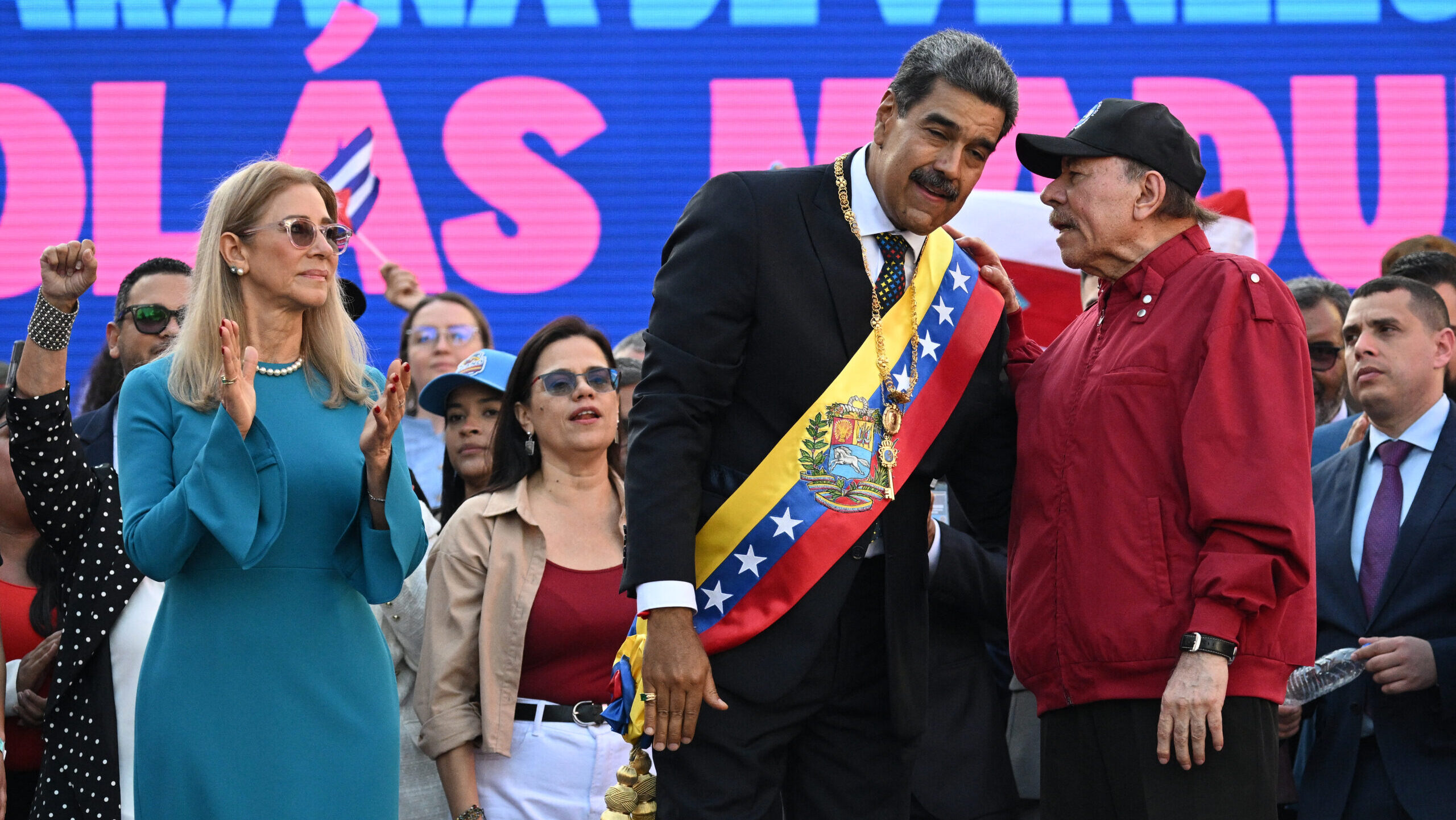
In a 2018 speech, John Bolton, then National Security Adviser to US President Donald Trump, branded Cuba, Venezuela and Nicaragua the ‘Troika of Tyranny’, declaring that their rule in the Western Hemisphere ‘will not endure forever’. Almost a decade later, Daniel Ortega has answered Bolton and the ‘Yankees’ with open defiance: on 19 July, during celebrations marking the 47th anniversary of the Sandinista revolution, Nicaragua’s long-serving ruler declared that the country would no longer hold elections.
‘There won’t be any more elections here for them to try to seize the government and seize power,’ Ortega said, adding that US-backed parties and the heirs of the Somoza order would ‘never again’ return to government. He offered no explanation of whether the 2027 election would be formally cancelled, voting abolished altogether or controlled contests retained without any possibility of alternation.
Ortega Has Avoided Trump’s Full Wrath So Far
In practical terms, the announcement changes less than its drama suggests. Nicaragua’s opposition has already been dismantled, its viable candidates imprisoned or exiled, and its electoral institutions absorbed by the ruling family. Politically, however, it crosses an important threshold: Ortega is no longer merely manipulating elections, but rejecting the principle that power can change hands through them.
That could make Nicaragua the next test of Trump’s Latin American doctrine. Bolton’s troika has already been badly weakened. The year began with a US military operation capturing Venezuelan President Nicolás Maduro and his wife, Cilia Flores, who are awaiting trial in New York on narcoterrorism, cocaine-trafficking and weapons charges. Cuba, meanwhile, has entered direct talks with Washington, announced an amnesty covering more than 2,000 prisoners and approved reforms permitting private banks, broader private ownership and the sale of state assets. Havana’s communist regime survives, but its economic foundations are under exceptional pressure.
‘That could make Nicaragua the next test of Trump’s Latin American doctrine’
Nicaragua remains the most rhetorically defiant member of the trio, although Washington has paid it less attention than during Trump’s first term. The country became central after the Ortega government violently suppressed the 2018 protests; Trump created the sanctions framework still used today, while Vice President Mike Pence accused Managua of waging war on the Catholic Church. The administration cast Nicaragua primarily as an ideological enemy of democracy, human rights and religious freedom.
The present hemispheric approach is more transactional. Democracy promotion remains part of US policy, but migration, organized crime, strategic resources and Chinese or Russian influence now carry greater weight. Nicaragua has consequently remained a file handled mainly by Secretary of State Marco Rubio, Treasury and the US Trade Representative rather than a cause repeatedly elevated by Trump himself, in contrast to Cuba and Venezuela.
That lower profile, however, is not reconciliation. Washington has imposed travel restrictions on more than 2,350 officials and relatives, sanctioned members of the Ortega–Murillo family and targeted companies linked to Nicaragua’s gold industry. USTR has also established a phased tariff mechanism that can be intensified. The current approach is more calibrated economic and targeted personal pressure rather than an openly declared democratic liberation effort.
Revolutions Devour Their Own Children
The caution also reflects the unusual system Ortega has built. The Sandinista National Liberation Front (FSLN) emerged in the 1960s as a Marxist-influenced guerrilla movement named after Augusto César Sandino, the nationalist rebel who resisted US intervention in the 1920s. It led the broad uprising that overthrew Washington-backed dictator Anastasio Somoza Debayle in 1979. Ortega was not its founder, but rose through its leadership, headed the revolutionary government, and won the 1984 election.
At the time, while clear authoritarian tendencies were present, the party itself was considerably more democratic than it is today. That changed in 1990, when Ortega lost the election: from that point onwards, he gradually converted the FSLN into his personal machine.
Since returning to office in 2007, he has subordinated the courts, legislature and electoral authorities while elevating his wife, Rosario Murillo, to co-president in 2025.
‘The regime is better understood as personalist, dynastic Sandinismo than traditional communism’
The resulting ideology is no longer conventionally Marxist. It combines Sandinista nationalism, anti-US ‘anti-imperialism’ and state-directed social programmes with a mixed economy and socially conservative rhetoric centred on religion, family and sovereignty. Nicaragua’s constitution invokes ‘Christian values, socialist ideals and practices of solidarity’. In practice, Christianity is only a facade, while independent churches are persecuted; socialism legitimizes executive control without abolishing private capital; and sovereignty is used to brand domestic opponents as foreign agents. The regime is better understood as personalist, dynastic Sandinismo than traditional communism.
Ortega nevertheless retains a genuine voter base among committed Sandinistas, public employees, patronage beneficiaries and citizens who associate his rule with stability or social welfare programmes. A January 2025 CID Gallup survey placed his approval at 39.3 per cent and disapproval at 49.1 per cent, while only 12.8 per cent identified with the FSLN. In contrast, pro-government surveys claim approval is usually above 80 per cent.
Abolishing even controlled competition, however, looks less like confidence than insurance against opposition unity—a reading reinforced by exiled opposition figure Félix Maradiaga, who described the announcement as a ‘confession of fear’.
A Potential Turning Point
Yet that opposition remains a major weakness in any American intervention strategy. Ortega prevented a challenger from securing a national mandate by arresting seven potential presidential candidates before the 2021 election and dismantling several parties.
Currently, Maradiaga is perhaps the opposition’s most visible representative in Washington, having ties to the Trump administration and reportedly engaging in talks with it. Yet there is no clear transition plan in the event of the regime’s potential collapse; none of the opposition figures controls a functioning nationwide party or possesses the ability to prepare a credible transfer of power.
This vacuum helps explain both Ortega’s defiance and Washington’s restraint. His announcement eliminates the last theoretical democratic exit while linking electoral closure to the destruction of autonomous institutions. Since Catholic clergy sheltered protesters and denounced the 2018 violence, churches and religious organizations have faced surveillance, expulsions, confiscations and closures. For Washington, Nicaragua now combines three potent grievances: revolutionary anti-Americanism, persecution of Christians and the explicit rejection of democratic elections.
Meanwhile, the regional balance has also turned sharply against Managua. Conservative victories by Keiko Fujimori in Peru and Abelardo de la Espriella in Colombia have extended a broader rightward shift, aligned with America. The alignment is neither complete nor permanent, but Ortega now faces fewer sympathetic governments and more states willing to cooperate with Washington on diplomatic isolation, migration control and security.
Even so, a harsher policy carries significant risks. Nicaragua lacks an obvious insider capable of preserving control over the army, police and bureaucracy after Ortega and Murillo. Unlike Venezuela, it offers no readily identifiable continuity figure who could keep the state functioning while accommodating Washington.
‘Wider trade sanctions, therefore, might weaken the ruling family, but it could also destroy export employment and trigger another exodus’
Migration is the second constraint. More than 342,000 Nicaraguans sought asylum abroad between 2018 and mid-2025, while Costa Rica alone has received more than 300,000 Nicaraguan applications since the broader crisis began. Wider trade sanctions, therefore, might weaken the ruling family, but it could also destroy export employment and trigger another exodus before any credible successor is ready. Trump therefore has incentives to target gold, mining, family businesses and financial intermediaries while avoiding measures that collapse the wider economy.
That helps explain the absence of any reaction so far from Washington. Although the Trump administration is bogged down in Iran and the World Cup co-hosted by the United States has only just ended, some form of response might have been expected to such a development in its own neighbourhood. The White House is most likely waiting to see whether the threat is translated into law and whether stronger pressure can be applied without triggering a migration or succession crisis. Any intervention should also be considered against the backdrop of the looming US midterm elections in November.
Ortega has crossed a rhetorical threshold, but not yet one that has demonstrably changed American policy. The true turning point would come if Trump personally reclassified Nicaragua from a sanctions and human-rights problem into a central hemispheric security challenge—and paired that declaration with a credible transition plan. Until then, Washington’s silence suggests that it regards Ortega as dangerous, but perhaps still more manageable than the instability his sudden removal could unleash.
Related articles:
At a time when public debate is increasingly polarized and superficial, Hungarian Conservative remains committed to depth, intellectual honesty, and independent conservative thought.
Producing high-quality journalism requires resources. Your contribution helps us expand our coverage, reach new audiences, and keep our content accessible.

Please consider supporting our mission.