

As the Save Europe Act, a European Citizens’ Initiative demanding that the political elite halt ‘replacement migration’, secure Europe’s borders, protect the ethnocultural identity of European nations, and launch remigration as an EU-wide policy, steadily moves towards its next milestone of 500,000 signatures, some interesting patterns are emerging regarding the countries supporting the initiative most strongly.
The petition, launched at the beginning of June by Dutch right-wing political commentator Eva Vlaardingerbroek, had garnered more than 369,000 signatures at the time of writing, making it one of the fastest-growing European Citizens’ Initiatives in recent years.
The country breakdown reveals a geographical pattern that goes beyond simple migration statistics. In absolute numbers, the Netherlands is by far the initiative’s strongest supporter, contributing more than 62,000 signatures. Germany follows with 41,448 signatures, ahead of Italy (35,942), Spain (29,078), France (24,129), the United Kingdom (23,496), and Hungary (20,083).
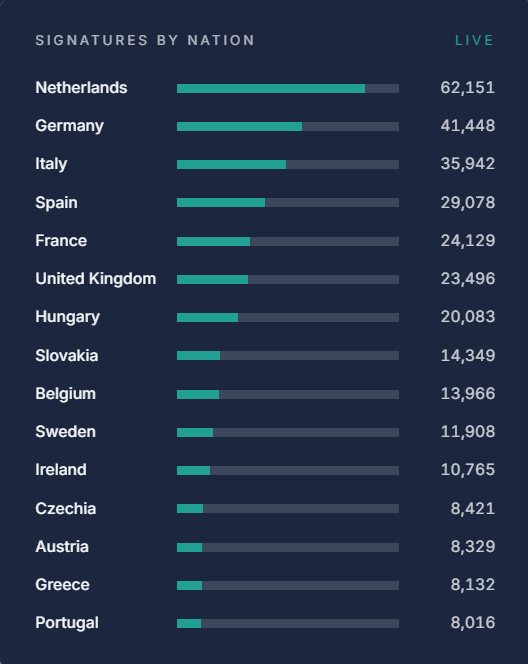
The Dutch dominance is hardly surprising. The initiative was launched by a Dutch activist and has benefited from extensive promotion through Dutch conservative and anti-immigration networks. Germany’s strong showing reflects its central role in Europe’s migration debate since 2015, while Italy and Spain remain on the frontline of Mediterranean migration routes. France and the United Kingdom similarly rank highly due to the continued prominence of migration and integration issues in national politics. The data also aligns with the subsequent rise of anti-immigration parties in the countries concerned.
However, the picture changes considerably when population size is taken into account.
Measured on a per-capita basis, the Netherlands remains the clear leader with roughly 3,400 signatures per million inhabitants. Slovakia ranks second, while Hungary occupies third place. Ireland, Belgium, and Sweden also perform strongly relative to their populations, while Germany, France, Italy, and Spain fall significantly lower once their much larger populations are taken into account.
‘Hungary’s position is particularly remarkable because it appears near the top of both rankings simultaneously’
Hungary’s position is particularly remarkable because it appears near the top of both rankings simultaneously. While many countries perform well either in absolute numbers or on a per-capita basis, Hungary is one of the few that excels in both. Despite having a population of fewer than ten million people, it ranks seventh overall while also placing among the strongest supporters relative to population size.
This unique position reflects the central role migration has played in Hungarian politics over the past decade. Since the 2015 migration crisis, former prime minister Viktor Orbán has made opposition to illegal migration one of the defining pillars of Hungarian domestic and foreign policy. Border protection, opposition to mandatory relocation quotas, and criticism of Brussels’ migration policies became recurring themes of both government communication and election campaigns.
Orbán himself publicly endorsed the Save Europe Act shortly after its launch, helping to boost the initiative’s visibility among Hungarian voters.
The strong, hard-line stance of Hungarian society on migration is also reflected in the rare continuity of migration policy under the new government led by Prime Minister Péter Magyar.
Magyar has repeatedly pledged to maintain the southern border fence, reject mandatory relocation schemes, oppose illegal migration, and preserve Hungary’s strict border protection regime. The government recently announced that it would not submit a national implementation plan for the EU Migration Pact and would reject the framework in its current form, mirroring the approach previously taken by Orbán on the issue.
Human rights organizations have recently criticized Magyar and several Tisza Party politicians for employing ‘exclusionary rhetoric’ on migration similar to that previously used by Fidesz. As a result, despite the dramatic political changes of 2026, migration remains one of the few issues commanding broad consensus across the Hungarian political spectrum.
If Hungary stands out for its overrepresentation, Poland stands out for the opposite reason.
Given its population of approximately 37 million, strong conservative electorate, and increasingly heated migration debate, Poland’s absence from the top ranks is one of the campaign’s biggest surprises. The country does not appear among the leading contributors despite possessing many of the characteristics that have driven high participation in Hungary and Slovakia: strong national-conservative political forces, scepticism towards Brussels’ migration policies, and widespread support for strict border controls.
‘Poland currently represents the initiative’s largest untapped reservoir of potential support’
One explanation may be that many of the policies advocated by the Save Europe Act are already present, at least in part, within the Polish system. The recent controversy surrounding migration in Lublin illustrated both the intensity of Poland’s domestic migration debate and the state’s comparatively robust deportation powers. Following a violent assault by a Zimbabwean national, authorities ultimately deported the perpetrator after significant public and political pressure, highlighting a legal framework that already allows for the relatively swift removal of foreigners deemed a threat to public order.
At the same time, disputes over rising numbers of foreign students and allegations that the student visa system is facilitating large-scale migration have become a major domestic political issue. As a result, Polish conservatives may view migration policy primarily through the lens of national politics rather than transnational campaigns such as the Save Europe Act.
Whatever the explanation, Poland currently represents the initiative’s largest untapped reservoir of potential support. Were Polish citizens to sign at rates comparable to those in Hungary or Slovakia, the country would immediately become one of the campaign’s largest contributors.
The campaign’s organizers are now focused on reaching the next major threshold of 500,000 signatures. To force the European Commission to formally examine the proposal, the Save Europe Act must ultimately collect at least one million verified signatures across a minimum of seven EU member states within one year. While still far from that target, the initiative’s rapid growth suggests that migration and remigration have become among the most politically mobilizing issues for a significant segment of the European electorate.
Related articles:
At a time when public debate is increasingly polarized and superficial, Hungarian Conservative remains committed to depth, intellectual honesty, and independent conservative thought.
Producing high-quality journalism requires resources. Your contribution helps us expand our coverage, reach new audiences, and keep our content accessible.

Please consider supporting our mission.