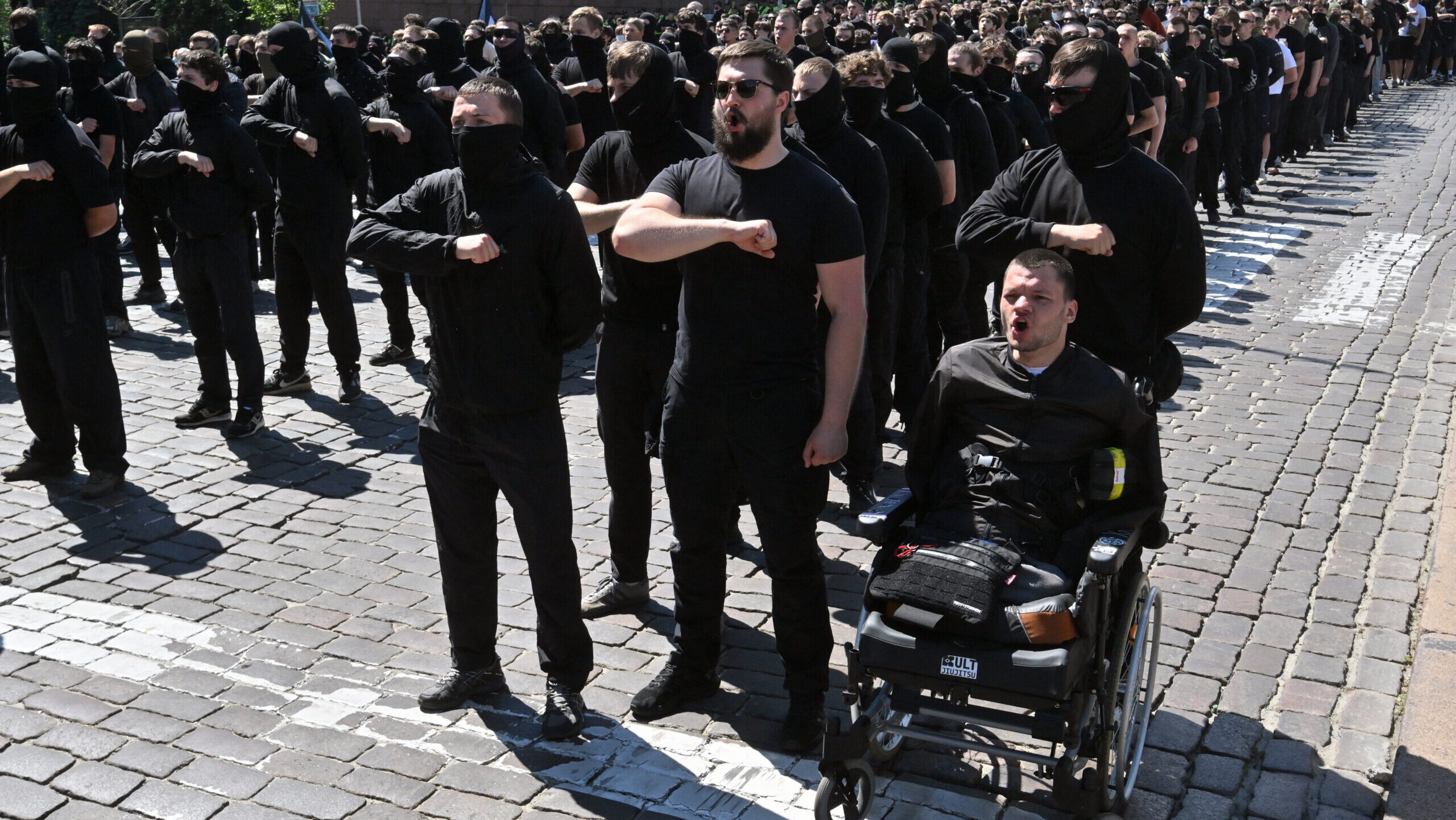
Around a thousand Ukrainian right-wing nationalist counter-protesters rallied in central Kyiv on Sunday, 21 June, during the overlapping Equality March organized by LGBT advocacy group KyivPride, producing a series of tense moments as the two crowds were separated by a heavy police presence.
Video footage circulating on social media showed anti-LGBTQ protesters dressed in black and carrying red-and-black flags associated with the Ukrainian Insurgent Army (UPA), the military wing of the fascist Organization of Ukrainian Nationalists (OUN) led by Stepan Bandera. According to reports, protesters chanted slogans about ‘Ukrainian supremacy’ and ‘preserving the Aryan race’, while wiping their feet on rainbow Pride flags.
One widely shared video featured a counter-protester shouting: ‘Putin is also a f*ggot, he’s proud of you,’ at participants in the Equality March, known also as the Kyiv Pride. While organizers presented the march as a demonstration in favour of ‘equality and legal recognition’ for same-sex couples and LGBT families, counter-protesters and many critics online argued that such efforts conflict with traditional Ukrainian culture, Christian values, and national identity, and are driven by Western NGOs.
The confrontation highlights a broader ideological divide that has existed in Ukraine for decades. Historically, the country has been among Europe’s most socially conservative societies regarding homosexuality and LGBT issues. According to a Pew Research Center survey conducted in 2015–2016, 86 per cent of Ukrainians believed homosexuality should not be accepted by society.
During the 2015 Equality March, anti-LGBT protesters attacked participants with smoke bombs and stones, injuring several police officers, while subsequent marches in 2017 and 2018 saw attempts by nationalist counter-protesters to break through police cordons protecting participants.
While the past decade may have shifted some public attitudes in a more positive direction, Russia’s full-scale invasion arguably deepened the divide between supporters and opponents of LGBT causes. Due to the war, many urban young people—among the strongest supporters of LGBT rights—left the country when they had the opportunity, while national sentiment and the influence of nationalist groups and movements have grown significantly. Groups such as the controversial Azov Brigade, Right Sector, and Tradition and Order have become increasingly powerful due to their role in Ukraine’s defence against Russia.
Legally, same-sex marriage remains prohibited in Ukraine, and same-sex couples cannot jointly adopt children. Sunday’s Equality March also took place as the Verkhovna Rada considers amendments to the Civil Code that would explicitly define marriage as a union between a man and a woman and exclude the legal recognition of same-sex partnerships. Held under the slogan ‘Our families are part of Ukraine’, organizers warned that the proposed changes could further entrench legal inequalities rather than address them. Activists have highlighted legal difficulties relating to inheritance, hospital visitation rights, next-of-kin status, and compensation for LGBT servicemembers and their partners.
According to critics, the proposed legislation could also complicate Ukraine’s alignment with European human rights standards and potentially affect its European Union accession ambitions.
On 15 June, Ukraine formally opened its first accession negotiation cluster with the European Union, moving the country into a new stage of the membership process. Although EU member states are not required to legalize same-sex marriage, candidate countries are expected to uphold anti-discrimination standards, protect minorities—especially sexual minorities—and combat hate crimes. LGBT rights, therefore, form part of the broader human rights and rule-of-law framework assessed during accession negotiations.
Related articles:
At a time when public debate is increasingly polarized and superficial, Hungarian Conservative remains committed to depth, intellectual honesty, and independent conservative thought.
Producing high-quality journalism requires resources. Your contribution helps us expand our coverage, reach new audiences, and keep our content accessible.

Please consider supporting our mission.