Ukraine carried out what appears to be the largest drone strike of the Russo–Ukrainian war on Thursday and Friday, with Russian authorities reporting that air defences intercepted 992 drones and four cruise missiles across the country within a 24-hour period. The scale of the attack exceeded all previous strikes recorded by either Moscow or Kyiv since the start of the conflict in February 2022.
According to the Russian Ministry of Defence, the attacks targeted dozens of regions across the country, with the Moscow area receiving the largest share of the strikes. Nearly 200 drones were reportedly intercepted around the Russian capital, making it the largest attack on Moscow since February 2022.
The figures are particularly notable because they include only drones officially reported as destroyed by Russian air defences. The total number launched may therefore have been even higher. The operation surpassed the previous known record set by Russia itself on 24 March 2026, when Moscow launched 948 drones against Ukraine in a single day.
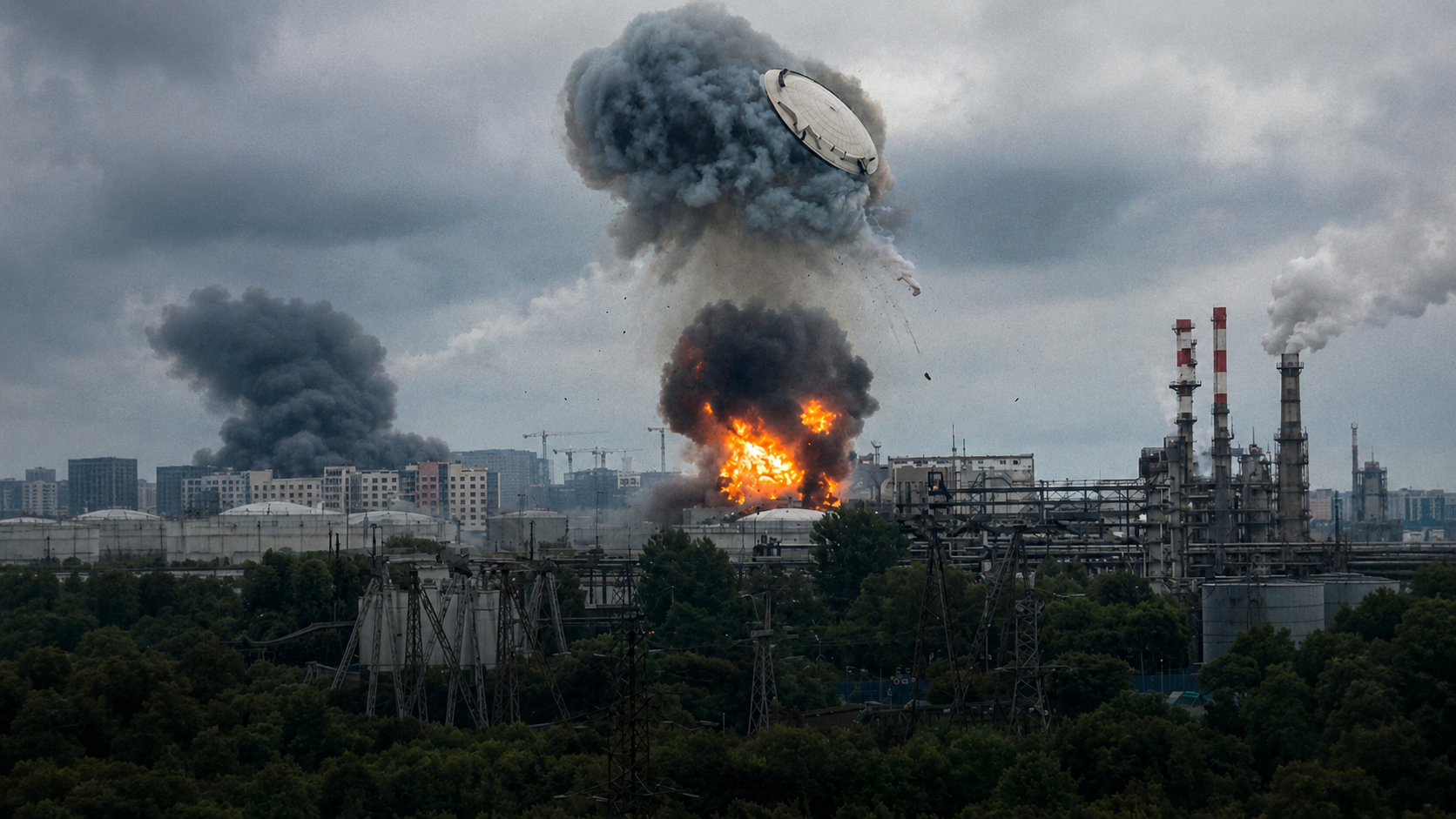
Several drones succeeded in penetrating Moscow’s air-defence network and struck the Moscow Oil Refinery in the Kapotnya district, one of Russia’s most important fuel-processing facilities and a key supplier to the capital region. The attack triggered large fires and caused damage to refining infrastructure, according to Russian officials and local reports.
The latest attack comes almost exactly one year after Operation Spiderweb, Ukraine’s most ambitious covert operation of the war. On 1 June 2025, Ukrainian intelligence services launched more than 100 FPV drones that had reportedly been smuggled into Russia in parts, assembled inside the country, and concealed in disguised civilian cargo containers. The drones simultaneously struck five strategic airbases across Russia, destroying or damaging a significant number of long-range bombers, including Tu-95 and Tu-22M aircraft.
Beyond the military losses, the operation shattered the Kremlin’s assumption that strategic assets deep inside Russian territory remained beyond Ukraine’s reach. Many analysts regard Operation Spiderweb as a turning point that demonstrated Russia’s strategic depth no longer guaranteed security.
The strike also highlights how dramatically the war has evolved since 2022. During the first years of the conflict, the Kremlin was largely able to maintain the narrative that the fighting was a limited ‘special military operation’ taking place far from the daily lives of ordinary Russians. While Ukrainian regions faced regular missile and drone alerts, most Russians experienced the war primarily through television coverage.
That reality has increasingly changed over the past year. Ukrainian long-range drones now regularly reach Moscow and other major Russian cities and regions, forcing authorities to impose airport closures, mobile internet restrictions, and heightened security measures. The growing threat became particularly visible ahead of Russia’s Victory Day celebrations in May, when authorities significantly scaled back parts of the traditional military display and implemented extensive security measures amid concerns over potential Ukrainian drone attacks.
‘Ukrainian long-range drones now regularly reach Moscow and other major Russian cities and regions’
The growing scale of Ukrainian strikes is also beginning to have economic consequences. Kyiv has increasingly focused on Russian oil refineries, fuel depots, and energy infrastructure, seeking to disrupt fuel supplies and raise the cost of the war effort. Independent Russian economic observers have reported fuel supply restrictions in a growing number of regions following repeated attacks on refining facilities.
More broadly, the latest operation illustrates the accelerating drone arms race between the two countries. What would have been considered an unprecedented attack only a year ago is now becoming increasingly common. Both Russia and Ukraine have rapidly expanded domestic drone production and are now capable of launching mass strikes involving hundreds of unmanned aircraft at a time.
Related articles:
At a time when public debate is increasingly polarized and superficial, Hungarian Conservative remains committed to depth, intellectual honesty, and independent conservative thought.
Producing high-quality journalism requires resources. Your contribution helps us expand our coverage, reach new audiences, and keep our content accessible.

Please consider supporting our mission.