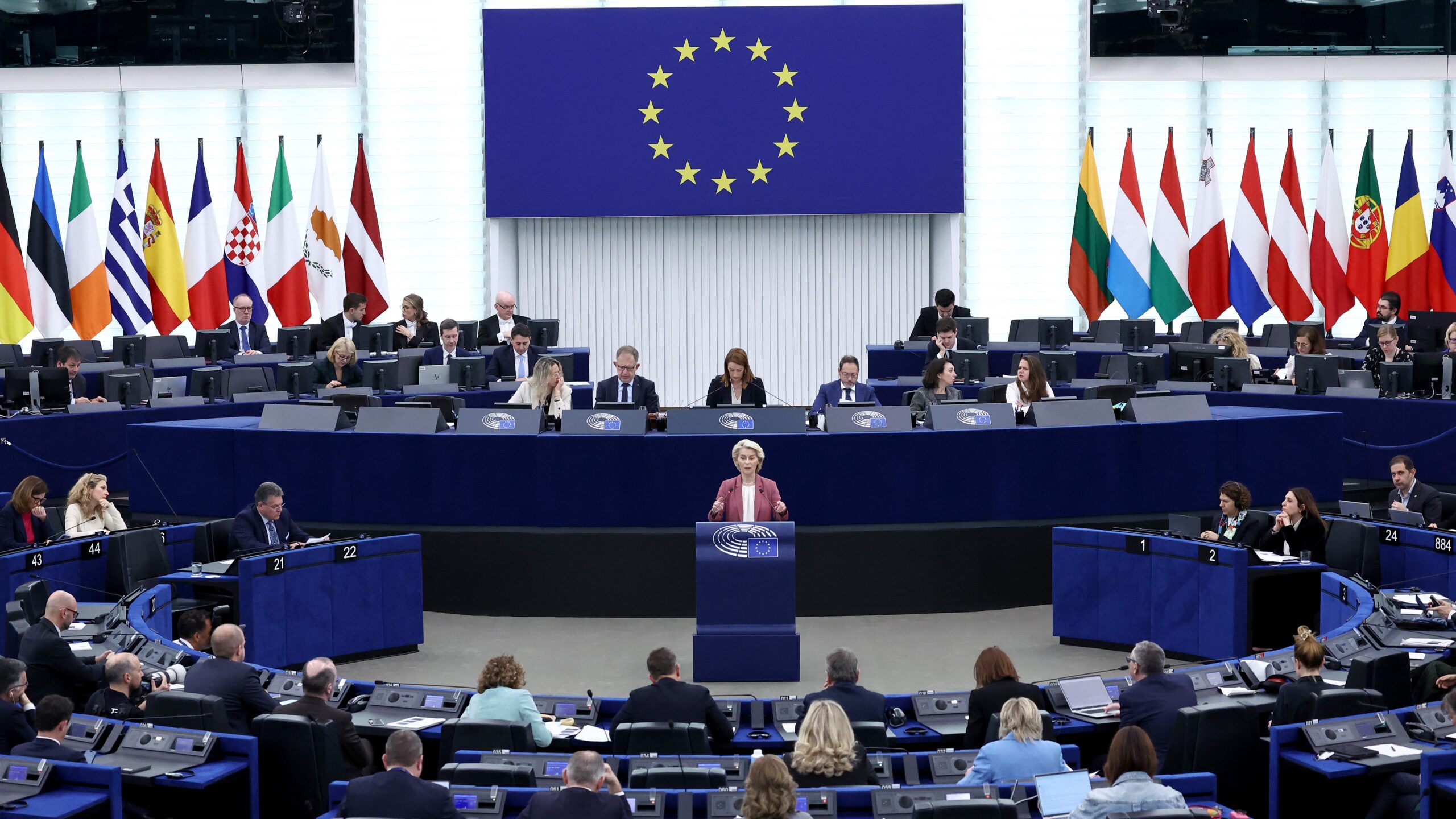
The crisis in the Middle East has quickly resulted in rising prices in Europe and global uncertainty about energy supply lines. Afraid of a backlash over unaffordable energy prices, some EU capitals have quietly begun urging the European Commission to back down from its draconian measures banning Russian energy imports from the European Union. Solely among EU leaders, Hungarian Prime Minister Viktor Orbán has openly called on the European Union to suspend its ban on Russian energy.
As of now the EU’s top leadership is, however, blind to the risks. On Friday at an emergency meeting of commissioners President of the European Commission Ursula von der Leyen reaffirmed the EU’s position on replacing Russian energy with ‘homegrown green energy’. According to Ursula von der Leyen, ‘Developments in the Middle East remind us once again of the risks of relying still too much on fossil fuels.’
The European Commission was so adamant about banning all Russian energy that it was willing to circumvent the EU Treaties to get the ban approved. Both Hungary and Slovakia understood the decision to ban Russian energy imports as an EU sanctions policy—sanctions require unanimous agreement in the European Council. The EU, however, treated the ban as a trade policy measure adopted by qualified majority, thereby circumventing the Member States’ ability to veto. Both countries vehemently objected to these measures, and Budapest and Bratislava are now suing the European Union for pushing through the ban in this way.
While the European Commission has already legislated to ban all types of Russian gas from the Union by 2027, it will introduce a bill attempting to ban all Russian oil from the bloc too merely three days after Hungary’s parliamentary election. According to Reuters, who was first to break the story, the Commission explicitly selected this schedule to prevent the ban from becoming politicized as part of the Hungarian election campaign.
‘The Commission explicitly selected this schedule to prevent the ban from becoming politicized as part of the Hungarian election campaign’
As Ursula von der Leyen’s statements suggest, despite the growing energy crisis, the Commission refuses to acknowledge that the ban on Russian energy is unsustainable and that Europe’s green energy sources cannot yet produce sufficient energy. As a result, energy prices in Europe were already significantly higher than in the United States or China even before the Iranian crisis escalated—placing additional strain on European households and the wider economy.
Gas
Amidst the crisis in the Middle East, gas prices in Europe have surged to their highest level since 2023. As the Hungarian Conservative has covered earlier, Europe is especially vulnerable to disruptions in global LNG supplies since it has already started to phase out Russian (pipeline) gas imports.
In addition to its self-imposed limitations on sellers, other circumstances have also put Europe’s gas security at risk: after an especially long and harsh winter, European gas storage facilities are only around 30 percent full.
Oil
The conflict in the Middle East added insult to injury, as Hungary’s and Slovakia’s oil supplies were already facing severe disruptions. Well before the blockade of the Strait of Hormuz, Ukraine halted the Druzhba pipeline in late January, cutting off Russian crude flows to Hungary and Slovakia. While Kyiv claims the pipeline was damaged by a Russian drone strike, Budapest has released satellite imagery indicating that the pipeline was not damaged and that the Zelensky administration’s political decision is keeping Druzhba offline.
As Kyiv was unwilling to restore the flow of oil or to even allow an independent group of experts to examine the pipeline, both Slovakia and Hungary have turned to the European Commission for help. Under the EU–Ukraine Association Agreement, Ukraine is obliged to ensure energy transit to EU Member States. Despite the two Member States’ call, however, the European Commission has not condemned Ukraine’s behaviour. That is, by the time seaborne oil shipments were disrupted globally, Hungary and Slovakia had already been struggling to secure pipeline supplies.
Ideology-Driven Energy Policy
Brussels’ ideology-driven energy ban that demonizes Russian energy and glorifies green solutions is having a profound negative impact on the EU’s global competitiveness.
While Europe is financially struggling from its own mistaken energy policies, the United States’ government is showing a remarkably flexible and practical approach to handle the situation. After his phone conservation with Russian President Vladimir Putin, Donald Trump floated the possibility of the US easing sanctions on Russian energy companies. That is, while Washing is willing to dynamically adjust its policy to the changing global circumstances, the European Union is so adamant about following an ideology-driven position that it is unable to react to the changing reality.
Related articles:
At a time when public debate is increasingly polarized and superficial, Hungarian Conservative remains committed to depth, intellectual honesty, and independent conservative thought.
Producing high-quality journalism requires resources. Your contribution helps us expand our coverage, reach new audiences, and keep our content accessible.

Please consider supporting our mission.