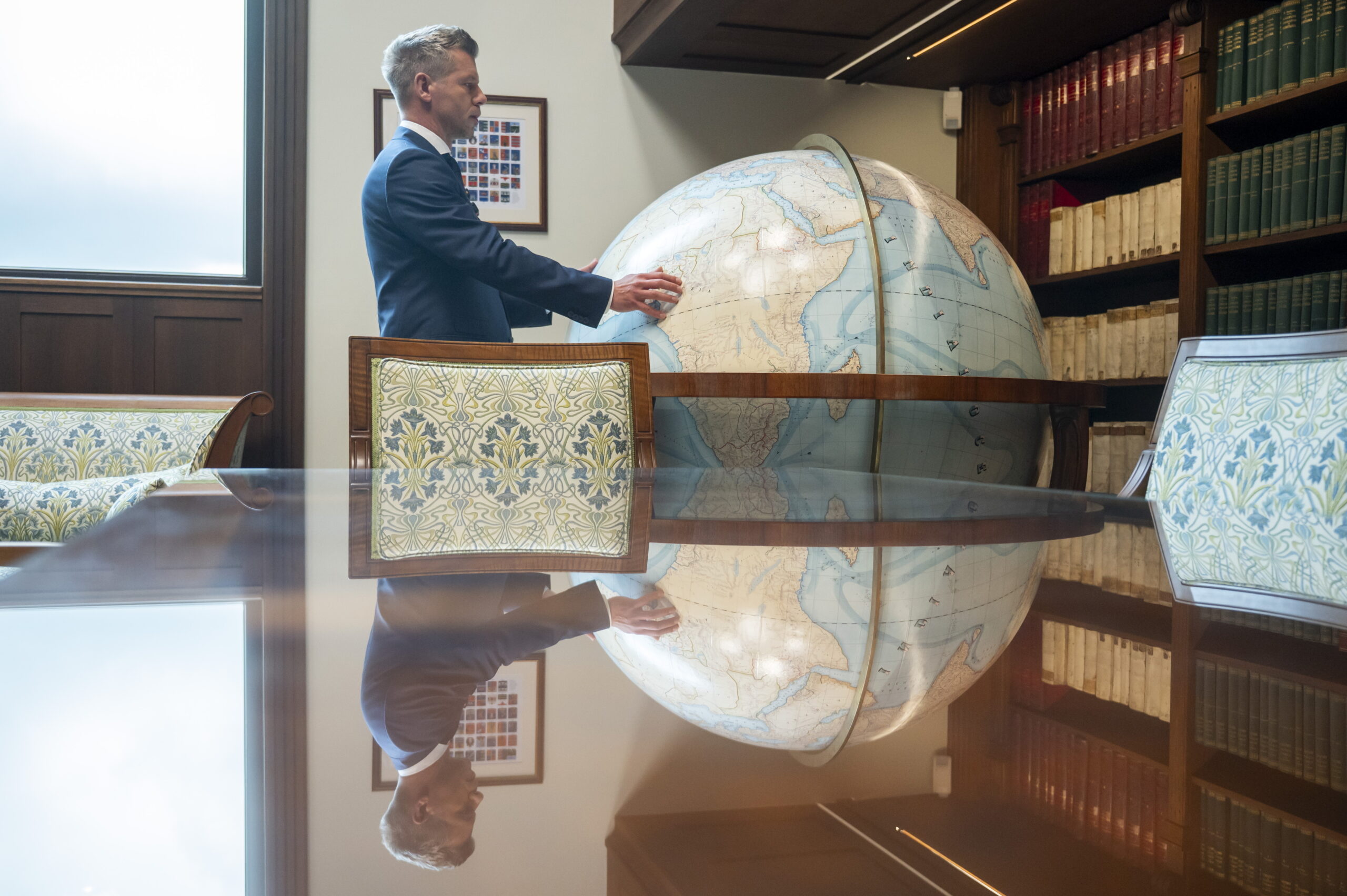
‘Life is the greatest director,’ Péter Magyar, the president of Tisza, said when he spontaneously (?) pointed to the Tisza Room in the Karmelita, the former prime minister’s office, which has become a symbol of absolute power. Besides life, there are, of course, other directors—for example, the conductors of the social media consciousness industry. According to them, if a joke is funny, it should be repeated and spread to the widest possible audience. And lo and behold, the prime minister repeated the joke verbatim in front of the cameras during the repeated tour of government facilities for the press, for greater effectiveness; and it worked.
The spontaneous (?) dance performed by health minister-expectant Zsolt Hegedűs on election night was well received by the mainstream foreign media, which could barely hide their joy at the fall of Viktor Orbán—the move was also repeated at the party following the inaugural session of the Parliament in front of the Kossuth Square crowd and, of course, the foreign media. And it worked again.
The impact is the point. There is little point in action without impact. Moreover, the most professional way is to achieve the greatest impact with as few actions as possible.
These are just two examples out of hundreds. Since taking office, the Tisza government has been producing dozens of pieces of content every day. The social media algorithm favoured the Tisza Party during the campaign, and it continues to favour it in government. In fact, this article itself was inspired by this ‘DoS attack’ of content.
Feel the (Algo)rhythm!
The third strongest parliamentary party, Mi Hazánk (Our Homeland Movement), congratulated ‘Meta’ on the victory after knowing the election results. While their podcast series called Bűnvadászok was made unavailable by Facebook at the end of the campaign—according to them, not by accident—the scandals that had a damaging effect on the government’s reputation (Göd pollution case, the interviews with Gundalf, Bence Szabó and Szilveszter Pálinkás, the Péter Szijjártó wiretapping case… etc), carried every day by the opposition press at the time—presumably pre-packaged—were quite visible on various social media platforms.
‘The impact is the point. There is little point in action without impact’
Based on the psychology of the mechanism of action, it does not matter whether the reality of the scandals is revealed or not after the information storm has subsided, because the goal is to achieve the desired result.
Fidesz also used this technique on a large scale, but Tisza finally pushed it to the limits. They were able to remain dominant in social media all the time, and they had an impressive reach. They bombarded consumers with coordinated and purposefully directed visual content dumping, and even the ruling party, which had an infrastructural and funding advantage, could not compete with this.
The Tisza Party’s campaign used technological and mass-psychology tools for consciousness formation, audiovisual techniques, and mechanisms of influence with calculated precision. The opposition movement conducted a grassroots campaign, with a lot of field work, personal meetings, and networking, all with tens of thousands of volunteers, in the shadow of the masses of supporters hoping for political change, yet their media strategy played a decisive role in reaching people, mobilizing, and the success of thematization.
Social media communication, publicity production, coordinated, megaphone-like amplification of the narratives, visual impact (and the content manipulation achieved with it) is a science. We experienced this again in the 2026 election campaign.
And we have been experiencing it continuously since then, as the new government is trying to extend its political honeymoon as much as possible, striving to maintain voters’ attention and dominate the moment—so that, from here on, something must happen every day of the government.
The Visual Self-Presentation of the Tisza Party
The one-bit message of the Tisza was ‘change’—this ‘programme’ was successfully carried out by hundreds of opposition parties in dozens of countries in recent political history. If there is already a protest mood against the tired governing forces, and if the challenging opposition group can offer a powerful, credible alternative, this is a winning recipe.
We know the facts: Péter Magyar’s appearance on the Partizán podcast caused a great response, and the commemoration he organized a month later on the national holiday clearly showed that there was a great voter demand for the emergence of a new opposition force, capable of replacing both the government that had ruled for 16 years and the ‘old’ opposition that had failed for 16 years at the same time.
To do this, it was necessary to simultaneously address the extremely heterogeneous opposition voter base, the socialist, liberal, bourgeois centre-right, disappointed conservative, rural, metropolitan, middle-class, impoverished, wage-earning, entrepreneur, in other words, citizens of all views and backgrounds. The common thread between them could be the hope of a better life, which Péter Magyar and his staff had to convey.
As for the content, the form could be a visual representation of a community that is humane, inclusive, forward-looking, attractive—in a word, one that has a vision. This new community was not allowed to resemble, in any way, the fruitless opposition attempts and methods of the past decade and a half, and at the same time, it had to capture the former sympathizers of these old forces and the previously undecided voters as effectively as possible.
To this end, the Orbán government had to be portrayed as a tired, worn-out, authoritarian, and corrupt power, the embodiment of the old order, both in the visual representations and in the content messages, while the Tisza Party had to be portrayed as fresh, youthful, creative, democratic, European, and as a group of people with a spotless past.
The campaign videos conveyed this as well; in most of them, we were introduced to the human side of the Tisza candidates, and their overall effect suggested that politics could really be different this time. Civilian faces (even if they are not), successful in their own fields, knowledgeable and ready to take action, greeted voters at markets, shook hands, took selfies and were always in a good mood. They spoke little, so as not to make mistakes, but through both their style and tone of voice, they presented a deliberate contrast to the colourless communication of government politicians and the raucous style of right-wing influencers.
‘The common thread between them could be the hope of a better life, which Péter Magyar and his staff had to convey’
Symbols played an important role in the videos made every day. The members of the Tisza parliament wore white shirts in their official photos, showing political purity; after the inaugural session, the cordons were opened on Kossuth Square by the signal of members of the installed government, and the celebrating crowd poured into the closed central square—everyone understood the symbolism: the power belongs to the people again. And so on.
However, the flurry of videos based on the panels amplified not only the good, but also the bad. In large quantities, they almost gave the appearance of artificiality and frills: in the majority of the videos, we see impeccably dressed people, men in slim-fit jackets, ladies in advantageous costumes, chatting casually, kissing everyone—this is a community where it’s good to be, where everyone loves everyone. The milieu is a bit like being at a multinational company’s team-building weekend in a mountain hotel, or at an MLM business conference, where a free buffet and welcome drink strengthen the feeling of belonging.
The other type of mood video shows grassroots groups of acquaintances; the 60+ activists, during pleasant potlucks, seem to relive the great social experiences of the pioneer camps and May Day festivals of their youth in the 1980s.
We didn’t learn much about Tisza’s political product during the campaign, but its packaging was impeccable. The clean, sterile sequences made with fast flashes, the monumental musical background—mostly electronic dance, TikTok-house and Phonk—gave the impression of a modern, action-ready movement.
‘The milieu is a bit like being at a multinational company’s team-building weekend in a mountain hotel, or at an MLM business conference’
The scenery of a ‘humane and functioning Hungary’ was erected, and the ‘show’ remained in this frame even after the inauguration of the government: the messages of the short videos are simple, explanatory and human: the representative runs into a civilian voter, who congratulates him, and this confirms to him that the people must be served; the minister reports on how his first committee meeting went and says that everything is going according to plan; the Speaker sums up the day’s events and reassures his viewers that he will restore the authority of democracy, faithful to the Tisza’s promises.
In the recordings, Márk Radnai’s face is smooth, his style is delicate, and his words are to the point. István Kapitány’s attribute is drinking coffee; this is what the bosses do at the multinational corporations, which indicates that professionals are in charge from here on. Anita Orbán is the lovable ‘human face’ of functioning democratic populism, Bálint Ruff is the belligerent technocrat/progressive bureaucrat, Zsolt Hegedűs has just returned from abroad, which means he must be a professional—but still laid-back—doctor, and András Kármán is the colourless and odourless but fine financier.
Built-up personalities who comment on the government’s decisions and actions on a daily basis, so that citizens are informed first-hand about the re-functioning of the democratic institutional system, and if they do not happen to encounter alternative analyses of the new government’s actual performance on the World Wide Web, cognitive dissonance can be avoided.
Prime Minister as an Influencer
We can see a new attitude of the prime minister since 12 April. Although the new leader often mentions his famous predecessor as a model, József Antall’s style, habitus, and relationship to public office were very different from Péter Magyar’s perception. The world of the new prime minister is spectacle politics.
Péter Magyar’s campaign was continuously filmed by a crew, and the sequel to the movie Spring Wind – The Awakening (Tavaszi szél – az ébredés), which was presented in Cannes, is already in production. The prime minister is being in ‘live’.
We see on reel videos that the prime minister is diverse and versatile. He talks to people, greets them with ‘ciao’ after making selfies, drinks beer, sometimes parties hard, but at the same time he is a proud former student from a Piarist school, whose role model is Pope John Paul II; he has a pretty girlfriend, he is relaxed, outspoken, but at the same time a measured public figure wearing a modern suit; he is humane, humorous, direct, while, of course, an excellent lawyer who also knows history, and confidently and willingly displays his wide-ranging knowledge.
‘The world of the new prime minister is spectacle politics’
The prime minister not only talks, but also acts: he brings home the EU funds, launches grandiose investments, introduces structural reforms in the fields of education, healthcare and the social sphere, restores democracy with dozens of laws, holds the corrupt elite accountable, makes public relations fairer, educates the representatives of Fidesz in the parliament, sends an ultimatum to the president of the republic, retaliates against the representatives of the ‘propaganda press’, and against those protesting against him, and so on.
The common feature of these events is a somewhat bizarre theatricality that has not been experienced in public life until now, and this cannot be a coincidence: these scenes, in their visuality and special setting, are all episodes of a movie being made—and the future overall picture formed by the parts is known only to the screenwriter, who is also the main character of the film, as well as the director.
Since the actor plays the scene, there is no particular need for episodic actors. The prime minister is also his own spokesperson and comments on his decisions. If he is Agent 007—as he poses in a photo—then his three pretty female spokespeople are ‘Charlie’s Angels’, and this is no accidental symbolism (what is accidental in cinema?), although for now they are only theatre sets with an aesthetic function in the big performance.
‘Absolute cinema,’ said the prime minister, preparing for his inauguration on the balcony of the Sándor Palace, and it really is. The reality is what we see. And we see what they show.
Populist Democracy: With the People for the People
It is quite clear that a serious staff is working to ensure that every government step and decision has a great impact, justifying the commitments made by the Tisza Party in the campaign. The government thematizes, moves, maintains attention at all costs; governance is the extension of the campaign by other means.
The ‘regime change’ model, with its full set of tools, has been available for two and a half years, and the experiences of the much-discussed change of government in Poland have been accumulated, so the Tisza government can choose from these tested tools in addition to its own ideas. And it does.
One example: Péter Magyar’s first trip as prime minister led to Poland; members of the government travelled by train instead of by aeroplane, as the other ‘regime changer’, Donald Tusk, did on several occasions—governance is ‘service’, and the much-emphasized ‘humility’ and ‘moderation’ pay off. The Tisza government started the same ‘programme’ in the same style and with the same methods (it is called ‘militant democracy’) that the Civic Coalition (KO) had already partially implemented in Poland: the dismantling of the political opponent’s hinterland, the redrawing of judicial and media relations, and alignment with the political expectations of the European Commission in order to bring EU funds home.
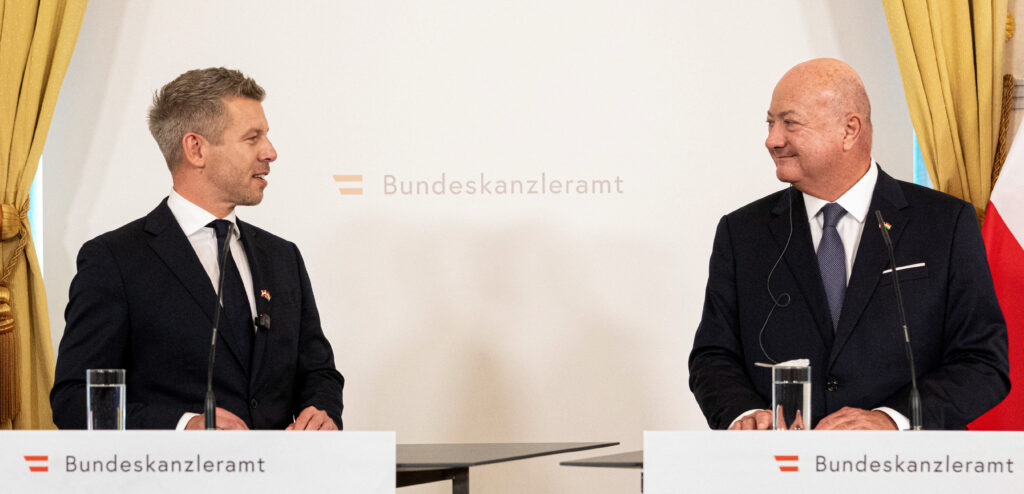
In addition to adopting the elements of substantive politics, it is also interesting how they copy the forms of foreign models. Foreign videos of Péter Magyar’s visit to Poland and Austria show a striking similarity to the media products of Tisza discussed above.
The prime minister’s negotiators, such as—though not exhaustively—the following Polish figures: Polish Minister of Economy and Finance Andrzej Domański; Mayor of Gdańsk Aleksandra Dulkiewicz; President of the Senate Małgorzata Kidawa-Błońska; Senator Agnieszka Gorgoń-Komor; and Maciej Wróbel and Aleksandra Gajewska, members of the Sejm (all of them members of the Polish governing Civic Coalition), or, on the Austrian side, Secretary General of the Austrian People’s Party (ÖVP) Alexander Pröll, and Claudia Bauer, Austrian Minister for European Affairs, Integration and Family Affairs, appear in videos on Facebook and other platforms that are produced with the same editing techniques, the same musical foundations, and the same dramaturgical elements as the videos of Tisza’s ministers and representatives.
There is no need to make a conspiracy theory out of this. The media teams of the various member states have probably learned a lot from the central media unit of their common party family, the European People’s Party (EPP) in Brussels; and in other, more progressive states, these professionally produced contents and uniform videos have been running well for a long time.
Every leg of the centrally planned pan-European media project reinforces the same pro-EU message: rule of law, equality of rights, democracy, unity in diversity. Now that Hungary has ‘returned to the heart of Europe’ (as Ursula von der Leyen and then Anita Orbán put it), the Hungarian government will fulfill the requests of the European Commission and honour the wide-ranging promises it made to almost every constituency during the campaign, in order to create a strange formation: less sovereign than the Orbán government, but even more populist as a democracy compared to the Orbán regime.
‘Every leg of the centrally planned pan-European media project reinforces the same pro-EU message: rule of law, equality of rights, democracy, unity in diversity’
Politics has become a mechanism of visual impact. It ‘plays out’ before our eyes. We watch how all information turns into a spectacle, how all content appears as a form, how quick, simple messages trigger the interpretation of the complex connections of life.
There are already signs of governance beyond the ‘cinema’, and there will be debates, results, mistakes, and political struggle here. The question is how long this communication rain curtain can cover the dry reality.
Related articles:
At a time when public debate is increasingly polarized and superficial, Hungarian Conservative remains committed to depth, intellectual honesty, and independent conservative thought.
Producing high-quality journalism requires resources. Your contribution helps us expand our coverage, reach new audiences, and keep our content accessible.

Please consider supporting our mission.