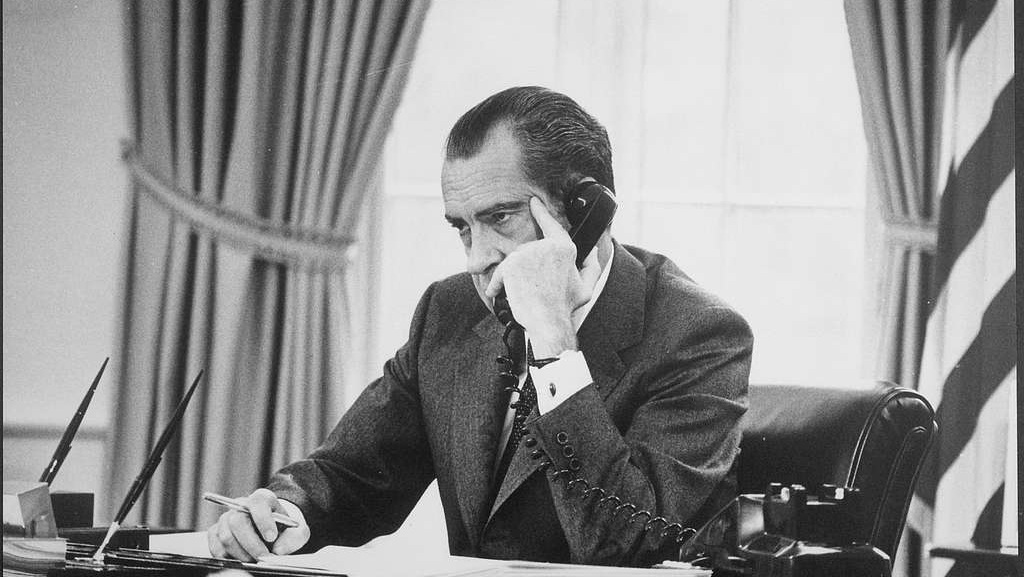
In the 52 years since Richard Nixon became the first and only President in US history to resign from office, we have really got used to any sort of political scandal being given the ‘gate’ suffix derived from ‘Watergate’, the popular name of the scandal that led to the downfall of President Nixon.
This time, the trend has made its way into Hungarian politics. MEP and Tisza Party prime ministerial candidate Péter Magyar has declared that the agents from the National Bureau of Investigation (NNI), supposedly due to pressure from the Constitution Protection Office, serving search warrants at the residences of two IT technicians working for the Tisza Party, is a scandal ‘more severe than Watergate’.
He actually applied this analogy back in November 2024. Then, he used the term ‘the Hungarian Watergate’ to describe his ex-girlfriend, Evelin Vogel, releasing secret recordings of him. That situation was quite ironic, given that one of Magyar’s first moves after entering national politics was to release secret recordings of his ex-wife, Former Minister of Justice Judit Varga. Needless to say, that case did not lead to the resignation of the head of the executive branch in the country—if anything, it hurt Magyar’s political standing.
However, is Magyar any closer to his comparison to Watergate this time?
If we take a look at the historical context, the Hungarian opposition already starts in a giant hole. Prime Minister Orbán’s Fidesz–KDNP coalition still holds a constitutional supermajority in the National Assembly of Hungary—something that the casual observer may be forgiven for forgetting, given the rhetoric coming out of Tisza about Fidesz’s impending doom.
Meanwhile, despite President Nixon winning 49 out of 50 states in an amazing feat for his re-election in 1972, his opposing Democratic Party actually held a majority in both chambers of Congress at the time when the Watergate scandal gained major national attention. Thus, impeachment, something that at the time had not happened to a US President in 106 years, was a very real possibility. This certainly was a major source of pressure for his administration in handling the turmoil.
Furthermore, we need to take a look at the ways the two scandals started.
In June 1972, Washington, DC police arrested five men for breaking and entering the Democratic National Convention Headquarters at the Watergate Hotel and Office Complex. At the time of the arrests, local law enforcement had no idea about the momentous political connotations of the event. To borrow a couple of terms from the communist era of Hungary, a ‘common law’ crime undoubtedly took place, as a prelude to a series of ‘political crimes’. With the NNI agents, that is absolutely not the case. No burglary, theft, assault, or any other ‘malum in se’ criminal conduct occurred, even if the allegation of political pressure is taken at face value. If anything, such a crime may have occurred on the part of Tisza’s IT workers, as the search warrants were issued on the suspicion of their possessing child pornography on their computers.
However, the most crucial point Péter Magyar is missing with his appeals to Watergate: Richard Nixon’s historic political scandal was a lot more about the cover-up than the underlying crime.
President Nixon not only did not order the Watergate break-in, but he most likely did not even have advance knowledge of the incident. Where he committed serious crimes was during his attempts to conceal the misdeeds of his surrogates. Nixon is on tape—recorded as all of his other Oval Office conversations, an initiative he started as a vanity project—suggesting bribing the Watergate perpetrators with $1 million each to keep quiet about their connections to the Committee for the Re-Election of the President. In October 1973, he ordered Attorney General Elliot Richardson to fire Special Prosecutor Archibald Cox in charge of investigating Watergate. Richardson refused and resigned instead, as did Deputy AG William Ruckelshaus upon receiving the same order from President Nixon.
No comparable conduct has ever occurred inside the Orbán administration.
The fact that all this is taking place at the same time as news broke that Foreign Minister Szijjártó of Hungary may have been illegally wiretapped—as Nixon’s Re-Election Committee was trying to do to their Democratic opponents in 1972—by European intelligence agencies with the help of Hungarian journalist Szabolcs Panyi, makes Magyar’s comparisons to Watergate an even weaker case.
Related articles:
At a time when public debate is increasingly polarized and superficial, Hungarian Conservative remains committed to depth, intellectual honesty, and independent conservative thought.
Producing high-quality journalism requires resources. Your contribution helps us expand our coverage, reach new audiences, and keep our content accessible.

Please consider supporting our mission.