The following is an adapted version of an article written by Laura Nyilas, a research fellow at the Europe Strategy Institute of the University of Public Service, originally published in Hungarian on the Five Minutes Europe blog of Ludovika.hu.
The G7 currently faces a dual challenge: on the one hand, it must respond to the political discourse of multipolarity, which is often presented as a critique of Western dominance; on the other hand, it must provide tangible responses to legitimate demands for a more just global power structure. Without this, the G7 could easily reinforce the image of a narrow, defensive coalition, while constructively addressing these issues could create an opportunity for elements of the rules-based order to survive in a multi-actor, competitive world order.
Although it has come under much criticism in recent years, the G7 is an intergovernmental political and economic forum that was established in 1975 as the G6 to find a solution to the oil crisis and subsequent recession, and has since become the most important summit of global powers as the informal strategic guide to the rules-based international order. Canada joined in 1976, and Russia in 1998. Russia’s membership was suspended after Russia annexed Crimea in 2014. The seven remaining countries—Canada, France, Germany, Italy, Japan, the United Kingdom, and the United States—meet annually to coordinate global economic policy and discuss the most important cross-border issues on the agenda. The European Union has been a full participant in the G7 since 1981 as a ‘non-enumerated’ member. The EU is represented at these meetings by the President of the European Council and the President of the European Commission. Although there are no formal criteria for membership, the participating member countries are considered to be among the world’s most advanced, wealthy democracies, and apart from the aforementioned exclusion of Russia, the composition of the group has not changed in the past five decades. The total population of the 7 members is only about 780 million, which is 10 per cent of the global population; however, the members account for about 50 per cent of the world’s nominal net worth and, according to 2024 data, about 30 per cent of the world’s GDP.
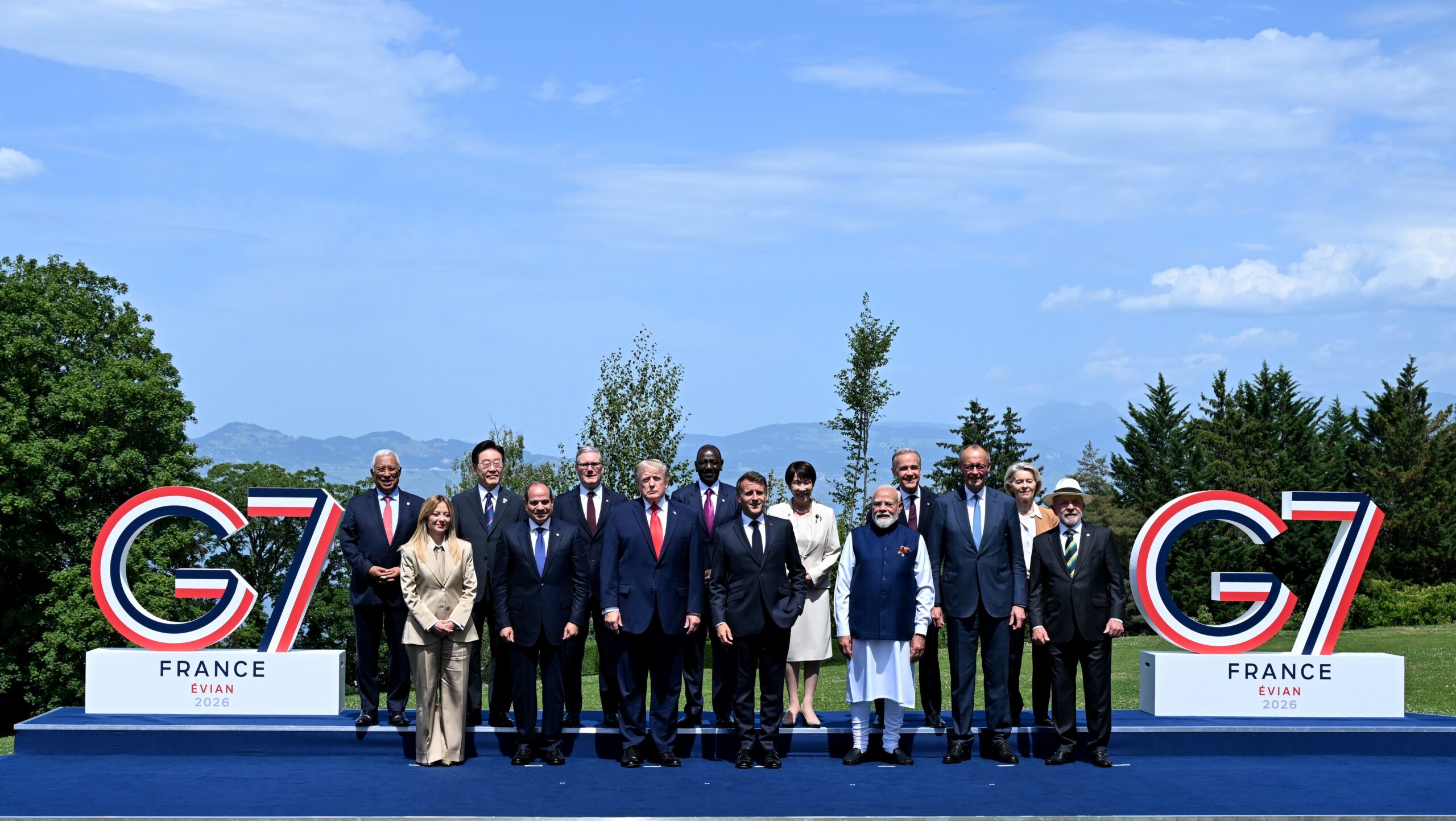
The 52nd G7 summit, held in Évian-les-Bains, France, from 15 to 17 June 2026, was important because the group showed its critics that it can still act as one, but also that there are limits that could weaken it. According to the assessment of the New York-based Council on Foreign Relations, one of the world’s most influential think tanks, transatlantic unity has been established on the issues of Iran and Ukraine, but it is still fragile, which only serves to justify Europe’s strengthening of its strategic autonomy in case the American consensus does not hold.
The fundamental question in assessing the meeting that took place is not whether the consensus will remain in the short term or whether it was just a lucky moment in view of the constantly fluctuating American opinion. It is much more important that the G7 can remain decisive in a changing world order in which its economic weight is relatively continuously, although not drastically, decreasing and in the newly emerging world, both global governance, institutions, and law are being eroded, and the G7 no longer necessarily has broad legitimacy to maintain this order.
After the Cold War, in the 1990s, the G7 still accounted for nearly 70 per cent of the world’s GDP, the centres of the global financial system were all in the G7 countries, a major part of technological innovations came from there, and the vast majority of military power was also concentrated in the NATO member G7 states. With these capabilities, the group could play a significant role in shaping the world’s global economic rules and in the informal management of the world order.
However, with the rise of China and India, and the independence of the Global South, the G7 also lost its relative weight in the world order. It is therefore no coincidence that India (along with Brazil, South Korea, and Ukraine) was invited to the 2026 summit as well. The invitation is also of strategic importance, since India, as the world’s most populous country, a significant economic power, and a country playing a decisive role in the Global South, will also play a predominant role in global governance.
‘India…will also play a predominant role in global governance’
The transformation of the G7, as well as its role in the world order, can also be observed within the group and in changes in the priority topics that appear at the summits. While in the past monetary policy was given greater emphasis in addition to the mitigation of inequalities, today the security of supply chains, the regulation of artificial intelligence, and the management of international conflicts are in focus. The group was thus transformed from a kind of economic coordination forum into a political one. The change in focus can lead to the conclusion that the questions of classical power politics have returned as shapers of the main agenda item, parallel to which economic and technological issues have increasingly become tools of geopolitical competition.
Although this year, 2026, the leaders adopted no fewer than nine declarations, US President Donald Trump saw the summit as a political stage rather than a forum for meaningful diplomacy. Of course, this also raised questions regarding the weight of the group, since how can a group be seen as an influencing factor in the world order, in which one of the most influential members does not take it seriously, see the sharp and personal exchange that unfolded on social media between Donald Trump and Italian Prime Minister Georgia Meloni.
In this context, the concept of multipolarity becomes particularly important and can no longer be treated as a purely theoretical category. Different states—be it the West, China, or actors from the Global South—give this concept different content, and these interpretations directly influence the possibilities and limitations of international cooperation. This poses a double challenge for the G7: on the one hand, it must respond to the political discourse of multipolarity, which often appears as a critique of Western dominance, and on the other hand, it must provide tangible answers to the legitimate demands aimed at making global power structures more just. Without this, the G7 can easily reinforce the image of a narrow, defensive coalition, while constructively addressing these issues can create an opportunity for elements of the rules-based order to survive in a multi-actor, competitive world order.
The G7, therefore, has the potential to play a significant role in steering the transformation of the world order. G7 members have made it clear that they are interested in addressing technological advances, public health, global conflicts, and other issues beyond the group’s traditional mandate. With today’s international cooperation negatively affected by geopolitical rivalries, we need coordinated action now more than ever.
However, for the G7 to truly become a group capable of upholding the rules-based order, its members need to strengthen the group’s legitimacy in the eyes of the world. If this transformation can be successful, the G7 could continue to play a leading role—and it could be a comprehensive project that would appeal to Trump.
Read more:
Click here to read the original article.
At a time when public debate is increasingly polarized and superficial, Hungarian Conservative remains committed to depth, intellectual honesty, and independent conservative thought.
Producing high-quality journalism requires resources. Your contribution helps us expand our coverage, reach new audiences, and keep our content accessible.

Please consider supporting our mission.