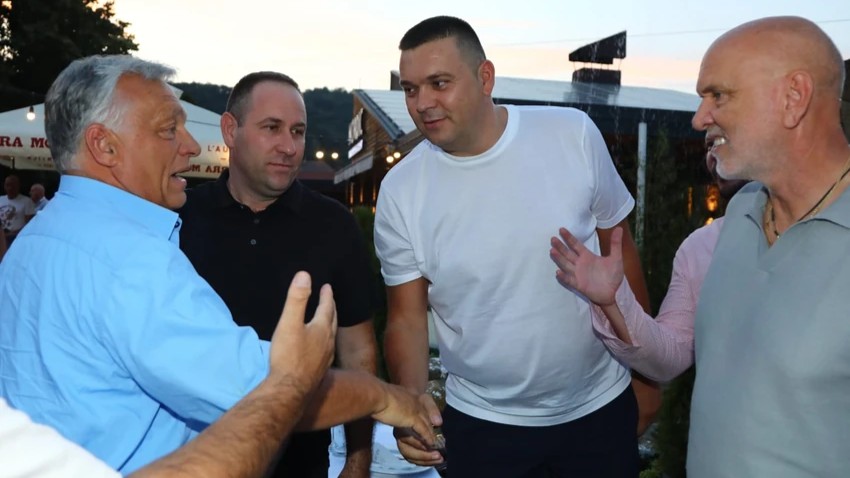
Cold beer, hajdučki ćevap and the sound of brass bands provided an unlikely backdrop for Viktor Orbán’s latest trip abroad. The former Hungarian prime minister turned up at the 65th Guča Trumpet Festival in western Serbia on Friday, sitting down with friends in the garden of Hotel Nordik, ordering a beer and asking to try the local culinary specialities.
Serbian coverage was almost celebratory. Glas Zapadne Srbije described Orbán arriving ‘without great pomp and protocol’, taking the first free table and posing as an ordinary festivalgoer. Visitors approached for photographs, while later footage showed him walking through Guča in good spirits. N1 Serbia independently confirmed with the hotel that Orbán had stopped there for a drink and lunch.
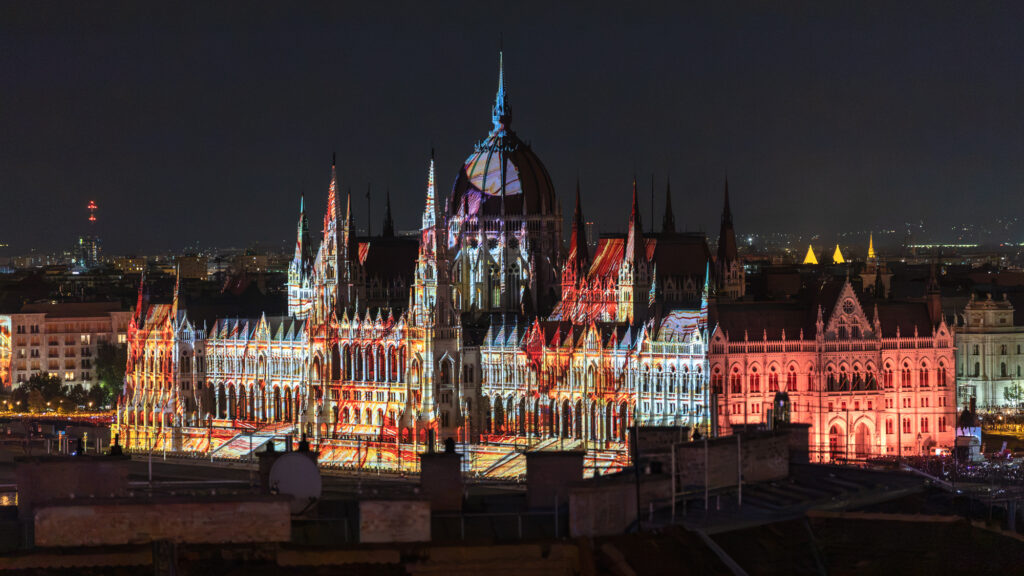
Back in Hungary, the photographs landed against a very different background. A record-breaking heatwave and drought had pushed the Danube to historic lows, crippling cooling at the Paks nuclear plant. The facility, which normally supplies nearly half of Hungary’s electricity, had fallen to around 10 per cent of capacity, forcing emergency conservation measures and greater reliance on imports, as well as significant social restraint during critical periods of electricity use.
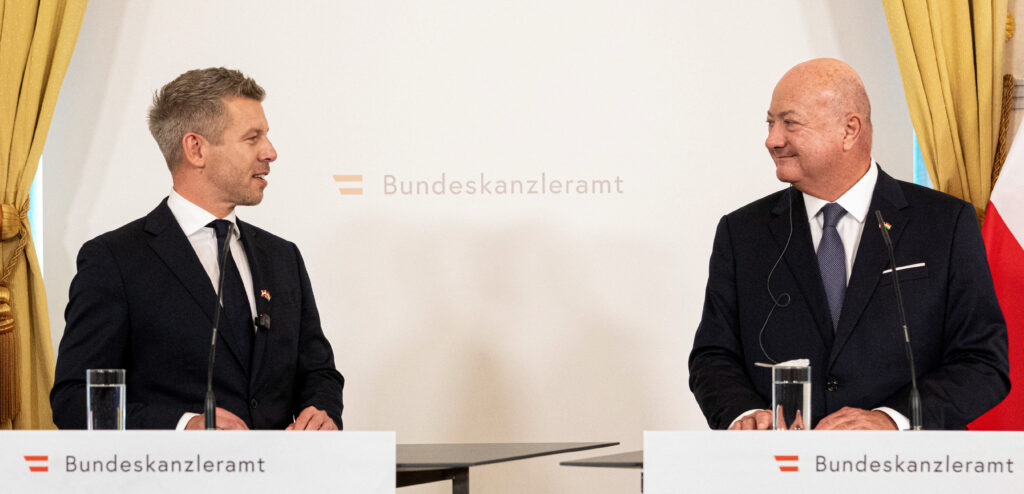
Prime Minister Péter Magyar had already attacked Orbán’s absence at a time of national crisis. On Friday, he said the Fidesz leader had not spoken during the crisis and was instead ‘moving his lackeys from behind’, arguing that a major party leader should have called for national unity. Critical Hungarian media sharpened the contrast further: the former prime minister was drinking beer and listening to trumpets, visibly having fun abroad while Hungary wrestled with an energy emergency. Meanwhile, his party’s communication attacked the new government’s crisis management, an argument significantly weakened by Orbán’s obvious absence.
It was not the first time this summer. Less than a month earlier, Orbán had left for the United States to watch the World Cup as Fidesz portrayed developments at home in near-apocalyptic terms. On 13 July, parliament voted on the constitutional amendment removing President Tamás Sulyok, Gergely Gulyás resigned as Fidesz parliamentary group leader, and the party denounced the day as a dark moment for Hungarian democracy. Orbán was meanwhile spotted at Frankfurt airport on his way to the tournament. Euronews reported that the contrast was causing irritation even among some supporters.
Unfinished Business
Taken at face value, the criticism was easy to understand. Within weeks, Orbán had twice left Hungary at moments when his party or the country faced massive challenges: first for football in America, then for food, beer and brass bands in Serbia.
Looking beyond the first impression, however, the visits and their perceived purpose begin to look far more complex. The Washington Examiner reported that Orbán visited both the White House and the State Department. It remains unclear whom he met and what was discussed; nevertheless, Orbán later acknowledged that although the trip was private and self-financed, he had conducted both ‘official and unofficial negotiations’.
One unfinished transaction makes those meetings particularly interesting: MOL’s attempt to buy the Russian-held majority stake in Naftna Industrija Srbije, or NIS, Serbia’s strategically important oil company and operator of the Pančevo refinery, which covers around 80 per cent of Serbian fuel demand. The deal is not simply a corporate takeover. Because NIS remains under US sanctions over its Russian ownership, completion depends on the US Treasury’s Office of Foreign Assets Control allowing the ownership restructuring to proceed.
Orbán had already been heavily involved personally in that process before losing office. At a joint press conference in Budapest on 16 February, US Secretary of State Marco Rubio said he and the then-Hungarian prime minister had discussed the Serbian refinery and ‘how NIS can be purchased by MOL’. The government already treated the acquisition as a national strategic investment.
‘On 7 August—the day Orbán appeared in Guča—MOL told investors that negotiations were “progressing to final stages with seller and authorities”’
After Orbán lost power in April, the deal appeared increasingly vulnerable. In May, a little-known Serbian company emerged with a €2 billion offer, outbidding MOL. Gazprom Neft, however, said it was negotiating only with MOL, and President Aleksandar Vučić rejected the rival bidder, questioning its lack of oil-industry experience. Serbia also had objections of its own to MOL’s initial terms, pointing to concerns that the country’s energy supply would fall too heavily into foreign hands and that MOL simply wanted to close Pančevo to eliminate a regional competitor.
Those differences were largely resolved in June. Under a shareholders’ agreement, Serbia would acquire another 5 per cent of NIS and gain stronger governance rights, while MOL committed to keeping Pančevo operating for at least ten years at output levels comparable with those before sanctions. The transaction still requires agreement with the Russian seller and US approval.
On 31 July, days after Orbán reportedly held meetings in the White House and the State Department, the US Treasury’s Office of Foreign Assets Control extended NIS’s operating waiver until 28 August. MOL separately announced that OFAC had allowed it to continue majority-stake negotiations until the same date. Vučić said he expected completion ‘in the coming days’ and would probably speak with Russian President Vladimir Putin and Hungarian Prime Minister Péter Magyar.
A week later, on 7 August—the day Orbán appeared in Guča—MOL told investors that negotiations were ‘progressing to final stages with seller and authorities’.
Two days later, Hungarian journalist Szabolcs Panyi identified one of the men walking beside Orbán in Serbian footage as Oszkár Világi, MOL’s deputy CEO and a long-time senior figure in the group.
There is no public evidence that he held any meeting with NIS officials in Serbia that weekend, and neither MOL nor the Serbian government has identified his trip as official business. Yet his presence beside Orbán is difficult to treat as irrelevant when one of MOL’s biggest strategic transactions, and one of the most important strategic investments initiated under Orbán, is approaching its decisive stage in the same country.
The wider history gives the coincidence more weight. After Russia invaded Ukraine, energy became a central pillar of the Orbán–Vučić relationship. Hungary receives Russian gas through TurkStream via Serbia; in 2022 Budapest agreed to store 500 million cubic metres of Serbian gas. The governments also agreed to build an oil pipeline allowing Russian Urals crude arriving through Druzhba to reach Serbia through Hungary.
An NIS takeover would deepen that integration. MOL would control Serbia’s only refinery while the planned pipeline could eventually provide another crude route into the country. For Serbia, the transaction removes the Russian ownership problem while preserving domestic refining. Washington gets Russian divestment. Moscow also appears comfortable with MOL: Foreign Minister Sergei Lavrov said in January that the deal would benefit Russia.
It’s Orbán’s World
That four-sided structure—US sanctions authority, Russian ownership, Serbian strategic interests and a Hungarian buyer—is precisely the type of transaction in which Orbán’s personal network could retain value after he lost office. He spent 16 years building close ties with Vučić, maintained unusually open channels to Moscow and developed direct access to Trump’s circle—the exact circles the new government now wants to break with.
The July Washington visit therefore creates an obvious question: did Orbán’s undisclosed talks include NIS or the OFAC authorization extended days later? There is currently no evidence that they did. OFAC had repeatedly extended negotiating licences throughout the spring, meaning the 31 July decision could simply have been another technical extension as the transaction progressed.
The Serbian trip raises the same question from the other direction. Did Orbán or Világi speak to Serbian or Russian actors about NIS while in the country? Again, no public evidence establishes that such talks happened in the first place so far. No meeting with Vučić has been reported; the Serbian president was also hosting Ukrainian President Volodymyr Zelenskyy during part of the weekend.
Still, the pattern complicates the domestic image of a defeated leader retreating into holidays. If Orbán remains useful to companies or foreign governments because of relationships built in office, he retains a form of influence independent of parliamentary power.
‘A relationship that once strengthened the Hungarian government could now constitute an independent asset belonging, in practical terms, to the leader of the opposition’
That is politically very significant. A relationship that once strengthened the Hungarian government could now constitute an independent asset belonging, in practical terms, to the leader of the opposition. If Orbán can still speak to people whom the new government cannot reach as easily—or can obtain a hearing in Washington, Belgrade or Moscow precisely because of relationships built personally over years—then the transfer of formal power does not necessarily mean a complete transfer of Hungary’s diplomatic influence.
NIS would be an unusually powerful demonstration of that. Securing Serbia’s dominant oil company for MOL would be a major strategic acquisition regardless of which party governed Hungary when the agreement was finally signed. But if Orbán were shown to have helped preserve the deal after leaving office, he could also claim something much broader: that some of Hungary’s most valuable foreign relationships still run through him. That would give him leverage over Péter Magyar’s government even if Orbán never publicly demanded credit for the transaction.
That does not require a secret mission or formal mandate. Nor does it prove that the two holidays were anything more than holidays with political meetings attached. But the chronology makes the simpler image incomplete.
If the July Washington meetings and his Serbian trip alongside a senior MOL executive eventually prove connected to the acquisition, they would suggest that Orbán is attempting to preserve a second source of political authority alongside his domestic opposition role: an informal foreign-policy network accumulated during 16 years in government and still capable of affecting strategic Hungarian interests after he has left office.
The public spectacle would then look very different from the criticism directed at him at home—not simply a defeated politician disappearing on holiday while crises unfold, but a former prime minister whose most consequential activity may no longer be taking place where Hungarian voters can see it, yet could still affect the country as much as when he was in power.
Related articles:
At a time when public debate is increasingly polarized and superficial, Hungarian Conservative remains committed to depth, intellectual honesty, and independent conservative thought.
Producing high-quality journalism requires resources. Your contribution helps us expand our coverage, reach new audiences, and keep our content accessible.

Please consider supporting our mission.