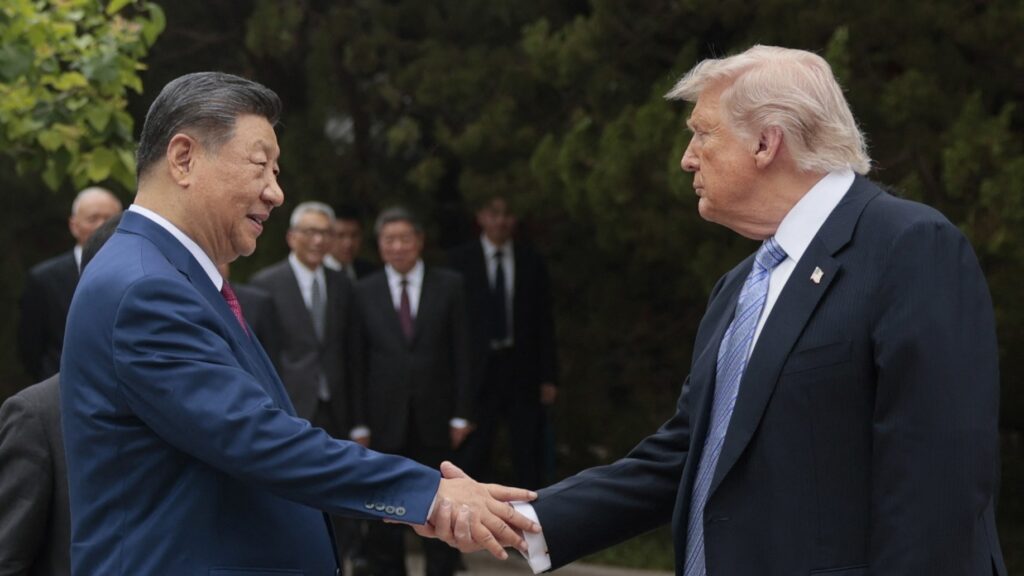
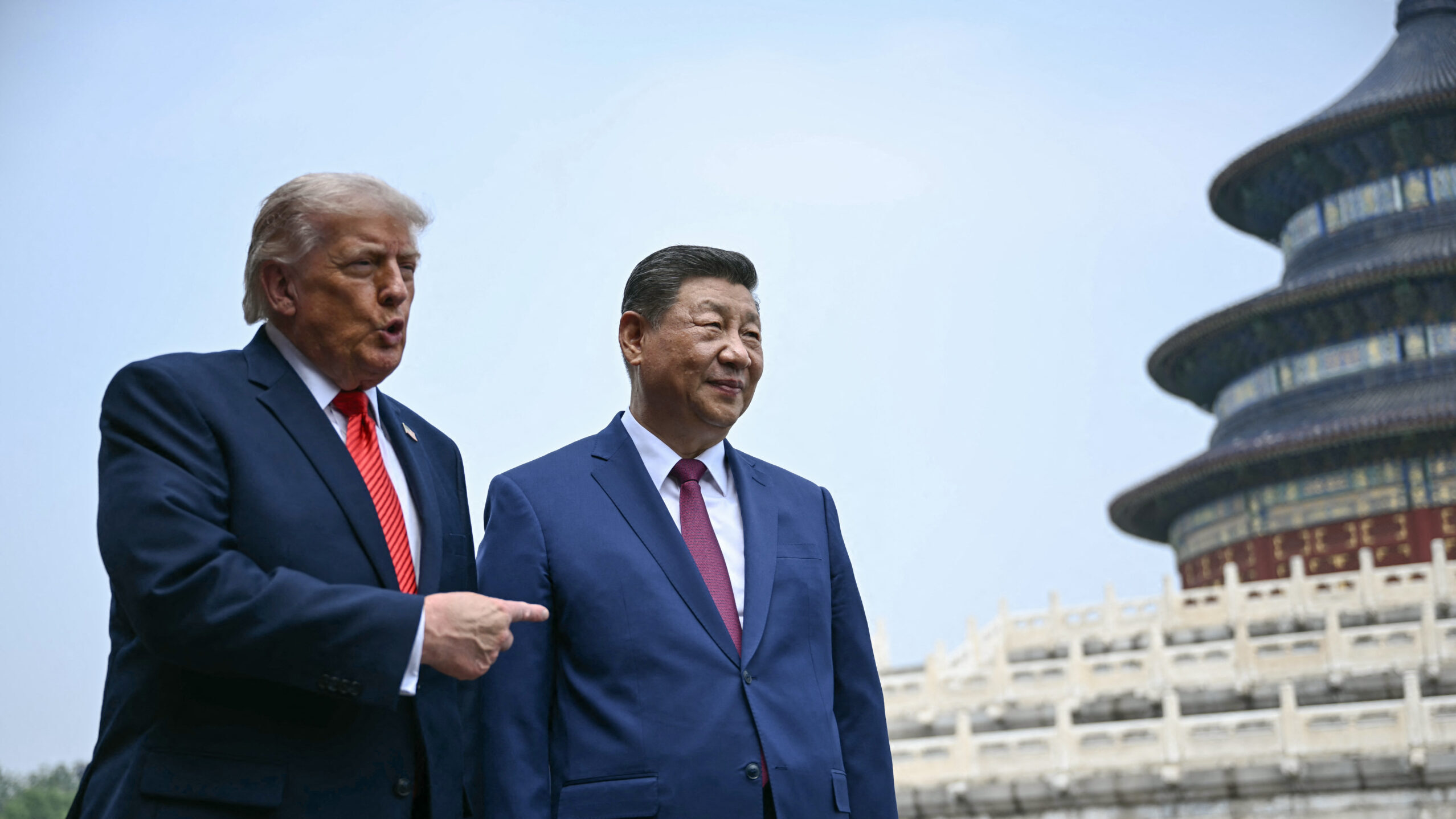
US President Donald Trump is already in Beijing for the highly anticipated two-day talks with Chinese President Xi Jinping. Arriving in the Chinese capital, Trump praised his Chinese counterpart as a ‘great leader’ and said that relations between the two superpowers are ‘going to be better than ever’ after his visit.
The American delegation, which includes senior government officials such as Secretary of State Marco Rubio, Secretary of War Pete Hegseth, and Secretary of the Treasury Scott Bessent, alongside major business leaders, will hold several rounds of high-stakes talks with their Chinese counterparts on 14 and 15 May. The agenda includes stabilizing bilateral ties, trade and tariffs, Taiwan, Iran, artificial intelligence, and semiconductors.
The Star-Spangled Banner plays as President Donald J. Trump is greeted by President Xi at the Great Hall of the People in Beijing, China. 🇺🇸🇨🇳 pic.twitter.com/ANPzR3WQmi
— The White House (@WhiteHouse) May 14, 2026
Trump and Xi have already held the main meeting of the visit. According to the Chinese foreign ministry’s readout, the two leaders agreed to pursue a ‘constructive, strategic and stable relationship’, while trade negotiators from both countries achieved what Beijing described as a ‘balanced and positive’ outcome in economic talks.
Xi also signalled that China would further open its economy to foreign businesses, while the two presidents exchanged views on the Middle East, Ukraine, and the Korean Peninsula.
The White House readout similarly highlighted discussions on ways to ‘enhance economic cooperation’, including expanding market access for US businesses in China and vice versa. According to the readout, Xi Jinping also expressed interest in ‘purchasing more American oil to reduce China’s dependence’ on the Strait of Hormuz in the future.
Game Changer Discovery?
One of the less discussed—but in the long term perhaps most important—aspects of the visit is the possible extension of the so-called ‘critical mineral truce’ agreed during the 2025 Busan summit, which helped stabilize escalating tensions over China’s export restrictions on rare earths and other critical minerals essential for semiconductors, EV batteries, artificial intelligence, and advanced weapons systems.
With China still dominating global refining and processing capacity, both Washington and Beijing reportedly seek to avoid another supply-chain shock, making critical minerals and rare earths one of the summit’s central strategic issues.
That is why a recent geological discovery announced by the US Geological Survey (USGS) at the end of April places the meeting in an entirely new strategic context. According to the assessment, the Appalachian region of the eastern United States may contain an estimated 2.3 million metric tons of economically recoverable lithium oxide—enough to replace roughly 328 years of current US lithium imports at last year’s levels. The deposits, concentrated mainly in the Carolinas, Maine, and New Hampshire, are embedded in lithium-rich pegmatite rock formations and could theoretically supply batteries for around 130 million electric vehicles.
‘Global lithium demand is expected to surge’
According to most analysts, global lithium demand is expected to surge due to the rapid expansion of AI infrastructure, semiconductor production, and electrification. While the United States imports most of its raw lithium from South America, China still dominates the global refining and battery supply chain, supplying roughly 60–70 per cent of America’s lithium-ion battery imports and maintaining a near-monopoly in several key processing stages. This gives Beijing a major strategic advantage and represents one of Washington’s most significant vulnerabilities in the emerging technological competition.
The discovery, however, does not automatically translate into immediate American strategic independence. Extracting and processing Appalachian lithium would require years of investment in mining infrastructure, environmental permitting, refining capacity, and transport networks. Moreover, many of the deposits remain either undiscovered or only partially mapped, while lengthy regulatory procedures could significantly slow large-scale extraction projects.
Washington’s Long-Term Strategic Signalling
Nevertheless, the Appalachian discovery could still strengthen Washington’s position in negotiations over critical mineral supply-chain stabilization. Although the United States remains highly dependent on China in the near term, the scale of the reserves signals that this dependency may not be permanent.
Trump’s foreign policy is already increasingly focused on securing American dominance over strategic energy and resource supply chains, as reflected in policies towards Venezuela and, partly, Iran. A major component of this strategy is the effort to build alternative critical mineral networks beyond China.
In recent months, the Trump administration has also pivoted towards Central Asia, a region with enormous and largely untapped reserves of rare earth elements and critical minerals. Washington is already engaged in negotiations with Uzbekistan and Kazakhstan, while also pursuing exploratory talks with the Democratic Republic of the Congo regarding access to Congolese critical minerals. Trump’s push for new investment initiatives tied to Greenland’s vast, untapped rare earth reserves also fits into this broader strategy.
‘The United States may eventually possess the domestic resource base needed to reduce its long-term dependence on Beijing’
From that perspective, the Trump–Xi summit is about far more than tariffs, Iran, or even Taiwan. There is a growing realization in Washington—particularly under Trump—that the next phase of great-power competition will increasingly be defined by control over the strategic raw materials underpinning technological and industrial development.
While China still maintains a dominant position in global refining and processing, the Appalachian lithium discovery suggests that the United States may eventually possess the domestic resource base needed to reduce its long-term dependence on Beijing. In that sense, the Trump–Xi summit is not simply about managing current tensions between the world’s two largest economies, but about shaping the industrial and geopolitical balance of the 21st century.
Related articles:
At a time when public debate is increasingly polarized and superficial, Hungarian Conservative remains committed to depth, intellectual honesty, and independent conservative thought.
Producing high-quality journalism requires resources. Your contribution helps us expand our coverage, reach new audiences, and keep our content accessible.

Please consider supporting our mission.