This article was originally published in Vol. 6 No. 1 of our print edition.
Revolutionary Violence from the Heretics to Antifa
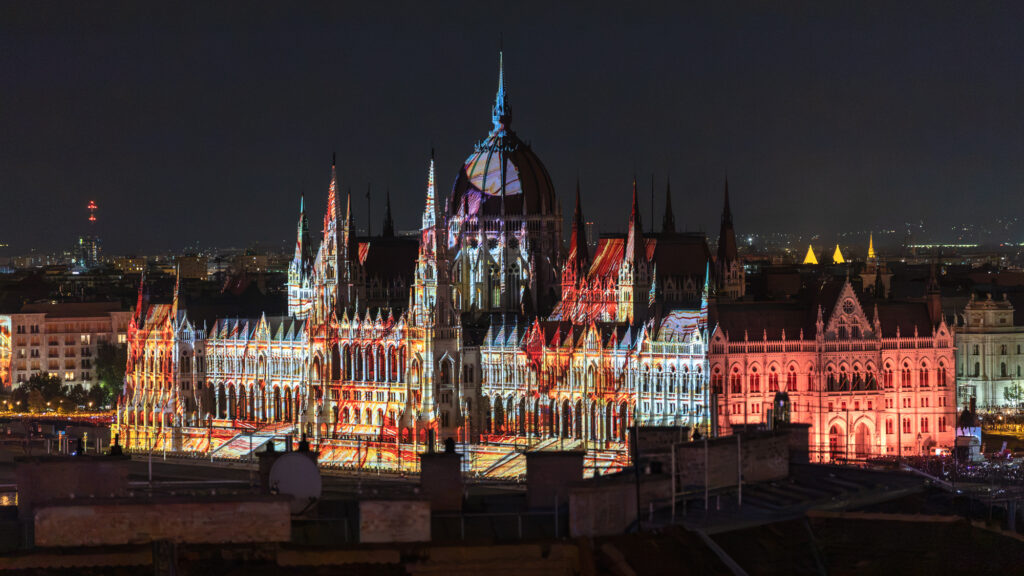
In 2023, Western European and Hungarian Antifa militants brutally assaulted people on the streets of Budapest.1 Although Joe Biden has claimed that Antifa is ‘an idea, not an organization’,2 the attacks seemed rather organized, even if the targets were apparently random. What accounts for this politically motivated violence, and how can it be that left-wing and liberal politicians and public figures defend Antifa, and sometimes even its violent actions?
The problem of violence is inextricably linked to politics. This is true even of political theories that appeal to discursive rationality: as a constantly looming negativity, the phenomenon of violence is always present in the background. Essentially, every contract theory, too, strives—implicitly or explicitly—to expel violence from politics and to institutionalize methods that at least limit the possibility of resolving political conflicts through violence.
The most obvious example of this is, of course, Thomas Hobbes, who held that in the state of nature there prevails ‘continuall feare, and danger of violent death; And the life of man, solitary, poore, nasty, brutish, and short’.3 The existence of public authority is justified by its capacity to protect citizens from the condition of bellum omnium contra omnes (the war of all against all). Other contract theories follow a very similar logic, even if in those cases the theory is supplemented by the element of the pactum unionis, which in principle also meant to protect citizens from political power itself.
The classic formulation of the intimate relationship between politics and violence naturally comes from Max Weber, who defined the modern state as follows: ‘Ultimately, one can define the modern state sociologically only in terms of the specific means peculiar to it, as to every political association, namely, the use of physical force. “Every state is founded on force”, said Trotsky at Brest-Litovsk. That is indeed right. If no social institutions existed which knew the use of violence, then the concept of “state” would be eliminated, and a condition would emerge that could be designated as “anarchy” in the specific sense of this word.’4 Alan Page Fiske and Tage Shakti Rai arrive at a similar conclusion: ‘The very idea of “the state” and “crime” is that the state assumes jurisdiction over the social relationships of its subjects and, in particular, reserves to itself the exclusive right to use violence to enforce those relationships.’5
Violence is a social phenomenon: it arises within interpersonal relations and therefore has political significance. Political action is thus, to a very considerable extent, directed towards limiting the possibility of such interpersonal violence. Violence is an inescapable problem in politics: either we accept the state as the legitimate wielder of violence—coercion—or we seek to eliminate violence altogether, which itself can only be achieved through violence.
Perhaps the least realistic and least grounded in common sense of all is progressive liberal moralism. According to this view, violence is a residue of the past, an inheritance from our uncivilized ancestors, which will disappear once we become sufficiently enlightened, rational, and morally refined.6
Since a decline in violence has been observable in the Western world over the past centuries,7 progressives regard their theory as vindicated. But does this mean that the phenomenon is universal? According to Fiske and Rai, ‘in most respects contemporary Western society and culture are unlike most other contemporary or historical human societies or cultures, and hence are poor foundations for understanding the sociality of Homo sapiens. Likewise, the psychology of Western, educated, industrial, rich, democratic (WEIRD) populations is quite atypical of the psychology of the human species.’8
‘Violence is an inescapable problem in politics’
I would add that even this is only a partial truth. It may well be the case that certain forms of violence are rarer in our part of the world than elsewhere, yet other forms of violence persist, and ‘traditional’ violence has also returned to our neighbourhood—most notably with the Russia–Ukraine War. Violence appears to be a force of nature, and, as with nature itself, if you throw it out through the door, it will climb back in through the window.
The Moral Causes of Violence
The use of violence is a risky enterprise. As Weber put it, whoever resorts to the means of violence ‘contracts diabolical powers’.9 There is no guarantee that the desired outcome will be achieved, and the likelihood of unintended consequences is very high. In Hannah Arendt’s words, ‘nowhere does Fortuna, good or ill luck, play a more fateful role in human affairs than on the battlefield’.10 Durable order cannot be founded on violence; such attempts will always be short-lived—unlike power, which is the hallmark of every stable political order.11
Since violence is inseparable from human social existence, it is crucial to confine it within boundaries, otherwise it will destroy our entire social world. Violence cannot be abolished or expelled from the human realm; it can only be dissolved.
One of the most common forms of unbounded violence is revenge. Every injustice suffered by one party is followed by retaliation, and so on without end. The archaic way of breaking this vicious circle is religious sacrifice; in modern form, it is the system of justice. As René Girard puts it, ‘The system does not suppress vengeance; rather, it effectively limits it to a single act of reprisal, enacted by a sovereign authority specializing in this particular function’.12 Fiske and Rai add that the judicial system is sufficiently abstract and impartial that it can carry out vengeance. Instead of abolishing it, it transforms private into public vengeance, while at the same time humanizing and moderating it. Laws restrict individuals’ right to regulate their relationships through revenge.13 This helps explain why ‘violence is more prevalent in the absence, inefficacy, or unruliness of police and judicial systems’.14
According to Girard, the judicial system is infinitely more effective than its alternatives; at the same time, however, it does not entirely replace religious sacrifice: ‘As soon as the essential quality of transcendence—religious, humanistic, or whatever—is lost, there are no longer any terms by which to define the legitimate form of violence and to recognize it among the multitude of illicit forms.’15 The religious aspects of revolutionary violence will become apparent later in this essay.
Contrary to the notion that violence is irrational, immoral, and atavistic, Fiske and Rai argue that most violent acts are committed for moral reasons: ‘The available evidence suggests that morally motivated violence is much more common than purely instrumental, amoral, coercive violence.’16 Violence is a tool for regulating social relationships—for reorganizing, rearranging, initiating, or ending them.
At first glance, people appear to be horrified by violence, but on closer inspection this is far less clear-cut. The vast majority of people, for example, feel a sense of satisfaction when the villain of a film receives his or her deserved punishment; just revenge is perhaps the most common theme in Hollywood blockbusters. What is more, there are cases in which violence seems to be the only just solution—as in the cases of Billy Budd or Michael Kohlhaas. As Arendt puts it, ‘that violence often springs from rage is a commonplace, and rage can indeed be irrational and pathological, but so can every other human affect…and under such conditions, not rage and violence, but their conspicuous absence is the clearest sign of dehumanization…there are situations in which the very swiftness of a violent act may be the only appropriate remedy.’17
The same psychological process applies to politics as well, even though in this sphere we are more typically dealing with collectives, whether states, institutions, churches, or groups of people. Even when we speak of an assassination, the target in such cases is still the embodiment of an ‘idea’ that symbolizes ‘evil’.18 Violence may also occur at political rallies, where opposing camps clash with one another; however, what concerns me here goes beyond this. Revolutionary violence aims at the eradication of political reality as a whole—a reality that revolutionaries regard as evil, corrupt, and impossible to redeem through ordinary pressure, agreements, or reforms. The purpose of revolutionary violence is not to rearrange certain relations within the existing order, but to destroy that order in its entirety, since it itself is seen as wholly illegitimate and violent.19 The foundation of political violence is moral outrage,20 which, as we shall see, has a religious character. Not only is it moral to use violence against these corrupt, depraved, and evil forces, it is positively immoral not to use violence against them.
Violence as an Instrument of Redemption: Chiliasm
Probably the first manifestations of revolutionary violence can be observed among sectarian heretics. Their moral impulse was drawn from chiliastic and millenarian interpretations of Christianity. The aim of chiliasm is to bridge the gulf between the experiential world, perceived as ‘anti-value’, and the religious world of absolute values—the summum bonum. For this reason, it offers an empirical form of redemption, to be realized within the secular world through collective human action. Chiliasm is therefore radical and revolutionary in outlook. It is, of course, universalist: redemption concerns everyone, albeit perhaps not in the same way. Chiliasts proclaim that the end—the Apocalypse, the Parousia—is near, and that the elect cannot remain idle and wait for it, but must actively hasten its arrival.21 This activity includes violence against the ‘godless’, who hinder redemption and sustain the reign of evil in the world.22 The elect have no need of corrupt institutions, whether ecclesiastical or secular, and nor are they obliged to accept their authority: they are accountable solely and directly to God. Evil in the world is attributed to the godless and to their institutions. Eric Voegelin presents this line of reasoning in the case of the Puritans as follows: by ‘attributing all fault and corruption, as it exists in the world because of human frailty, to the action or inaction of the government [they thereby] show the point that must be attacked if evil shall be removed from this world’.23 The actions of the chiliasts are not merely human: God acts through them. The violent destruction of the godless is thus not merely permissible, but a sacred duty with moral, ethical, and religious justification.
To illustrate this, it is worth examining the writings of Thomas Müntzer, who, as a supporter of the 1524–1525 Peasants’ Revolt in Germany, was an advocate of a doctrine of violent redemption: ‘All those who, through original sin, have become evildoers within common Christendom must be justified through the law, as Paul said [Romans 2:12], in order that the rigor of the Father can clear out of the way those godless Christians who struggle against the saving doctrine of Christ. In this way, the just may have the time and space to learn the will of God.’24 Müntzer leaves no doubt that ‘the sword is also necessary as a means to destroy the godless [for] the godless have no right to life except that which the elect decide to grant them’.25 The eradication of evil is necessary in order to return to a prelapsarian, pure state: ‘But, if they do take the contrary course, may they be strangled without any mercy… Otherwise, the Christian church will not be able to return to its source.’26 The path to redemption begins with an eschatological call to arms—a struggle that settles the score and finally decides the battle between good and evil: ‘At them, at them, at them! Do not be merciful…Pay no heed to the lamentations of the godless. They will bid you in a friendly manner [for mercy], cry, and plead like children. Do not let yourselves be merciful, as God commanded through Moses…And God has revealed the same thing to us. Stir up the villages and cities…We must sleep no longer.’27
The Terror of Virtue: The French Revolution
The French Revolution was the first major attempt to create an entirely ‘rational’ or ‘natural’ order—setting aside for the moment any possible tensions between the two—purged of the superstitions, traditions, and particularities of the past, and achieved, of course, through revolutionary terror. It was also the first revolt against the Christian conception of order, while at the same time bearing the unmistakable marks of earlier chiliastic experiments. It was no accident that Voegelin characterized the French Revolution as an endeavour to establish a ‘totalitarian theocracy’.28 This paradox is present in virtually all subsequent revolutionary movements.
Like earlier radical projects, the Revolution sought to rid the world of all the evil perceived as inherent within it. This may seem laudable, yet the destructive nature of the undertaking becomes evident in its practical application. As Jacob Talmon observed, ‘The totalitarian potentialities of this philosophy are not quite obvious at first sight. But they are nevertheless grave. The very idea of a self-contained system from which all evil and unhappiness have been exorcised is totalitarian. The assumption that such a scheme of things is feasible and indeed inevitable is an invitation to a régime to proclaim that it embodies this perfection, to exact from its citizens recognition and submission and to brand opposition as vice or perversion.’29
The brutality of the French Revolution is well documented. Without any claim to completeness: the Princesse de Lamballe was lynched and murdered; her intimate body parts were cut off and paraded through the streets in broad daylight; the head of one of the Bastille’s guards—who had in fact surrendered to the revolutionaries—was severed with a small kitchen knife; one young defender of the Tuileries was rolled in butter and roasted alive; pregnant women were beaten flat, people were baked alive in ovens, and lines of prisoners were placed in front of cannons.30 In Erik von Kuehnelt-Leddihn’s words, ‘The history of the revolution is a nauseating mixture of idealistic verbiage, of treachery and intrigue, of sentimental incantations and senseless butcheries, of envy and outbursts of sadism’.31
Maximilien Robespierre defended these methods in much the same way as earlier and later proponents of revolutionary terror. For Robespierre, revolutionary government exercised ‘liberty’s despotism against tyranny’. Terror was a necessary instrument in the practice of virtue, since ‘virtue without terror is fatal, [while] terror without virtue is powerless’.32
‘Revolutionary violence is a peculiar amalgam of ideas: a moralizing nihilism’
Perhaps it is worth quoting here the words of General François Joseph Westermann, the so-called ‘Butcher of the Vendée’: ‘There is no more Vendée, my republican fellow citizens! It died beneath our sabres along with its women and children. I just buried them in the swamps and woods of Savenay. According to your orders, the children were trampled to death beneath the hooves of our horses; their women were slaughtered so that they couldn’t bring any more soldiers into the world. The streets are full of corpses; in many places they form entire pyramids. In Savenay we had to make use of massive firing squads because their troops are still surrendering. We take no prisoners. One has to give them the bread of freedom; however, mercy has nothing to do with the spirit of the revolution.’33
The Apostle of Liberating Violence: Sorel
It is scarcely possible to discuss the idea of liberating violence without mentioning Georges Sorel. He does not share the optimists’ faith in progress; instead, he places his hopes in a purifying storm, a great catastrophe—in the myth of ‘purifying violence’—that will wash away the corrupt present: ‘if revolutionary syndicalism triumphs there will be no more speeches on immanent justice, no more parliamentary regime for the use of intellectuals.’34 To mobilize the masses for participation in a quasi-eschatological struggle, myths are required. Sorel explains that these serve the same purpose as religion once did: ‘it is not only religion which occupies the profounder region of our mental life; revolutionary myths have their place there equally with religion.’35 Myths are, in the final analysis, mobilizing ideologies, and syndicalism is a ‘truly proletarian ideology’ capable of bringing about the ‘salvation of the world’.36
Sorel places his faith in the general strike—that is, in proletarian violence.37 Its foundation is not some imagined, utopian Erlösungswelt, but the desire to destroy the existing moral-political reality in toto. The underlying impulse is essentially negative: a hatred of the petit-bourgeois world, of parliamentary democracy, of compromise, partial solutions, and the politics of the middle ground. As Thomas Molnar observed, this myth effectively became the foundation of virtually all totalitarian mass movements of the twentieth century:
‘It is no exaggeration to say that, on many points and for some time during the early 1920s, socialism and the fascist splinter groups had quite a lot in common, and that the bases of Marxist criticism of capitalism and democracy offered a platform on which extreme right and extreme left were able to stand together. Georges Sorel himself, the founder of Syndicalism, observed with sympathy and satisfaction the beginnings of both Leninist Russia and the Italy of Mussolini. These new, anti-capitalistic and anti-parliamentary regimes had been born from the same earth- shaking and mass-moving myth, proletarian violence…[Sorel] believed, as did Marx, that the proletarian revolution would destroy both economic liberalism and bourgeois democracy. It would produce a new juridical frame for the state and culminate in the establishment of a work-morality, indeed a religion.’38
Sorel firmly believed that the revolutionary socialist movement would create a ‘new culture’.39 This new culture would be heroic, and the morality of absolute revolution would stand higher than bourgeois morality. Indeed, it is precisely the violent nature of socialist syndicalism that Sorel regarded as its moral virtue. He fused the revolutionary hopes of socialism with the Nietzschean ideal of the Übermensch. What emerges is the heroic vision of the nonconformist envisioned by the romantic right from Friedrich Nietzsche to Ernst Jünger: a figure who stands in opposition to democracy, commercialism, and mass culture, combined with a faith in the collective revolt of the masses.40
Sorel draws a sharp distinction between violence and coercion. Coercion is the means by which a minority imposes a particular social order on everyone, whereas the aim of violence is the destruction of that order. It is worth noting that conservative or ‘reactionary’ thought arrives at precisely the opposite conclusion: coercion is seen as a beneficent principle that restrains evil, while violence is the force that lies behind evil itself.41 Coercion is essentially a restorative principle, whereas violence is destructive.
Bourgeois culture and parliamentary politics are hypocritical and petty according to Sorel.42 Since the conventional morality of parliamentary democracy and bourgeois capitalism is beyond redemption, a new morality must be brought into being. Rebellion and violence themselves serve this new morality. As Sorel expresses, ‘Proletarian violence, carried on as a pure and simple manifestation of the sentiment of class struggle, appears thus as a very fine and heroic thing; it is at the service of the immemorial interests of civilization; it is not perhaps the most appropriate method of obtaining immediate material advantages, but it may save the world from barbarism’.43 Moreover, for Sorel violence is not merely a by-product of this process, it is the very essence of this new morality: ‘It is to violence that socialism owes those high ethical ideals by means of which it brings salvation to the modern world.’44
Sorel’s contempt for parliamentary politics and bourgeois culture ran so deep that, in the appendix to his work—tellingly entitled ‘In Defence of Lenin’—he gave voice to the following wish: ‘but may I, before descending into my grave, see the humiliation of the arrogant bourgeois democracies, today shamelessly triumphant!’45 Sorel displays the same faith in the redemptive power of violence in worldly affairs—even if his belief in myth lends it a quasi-religious undertone—as Müntzer did in the redemptive character of the peasant uprisings, which he hoped would usher in the Apocalypse. As Jacob Taubes aptly observed, ‘The theology of revolution is the theology of violence [and] the philosophy of revolution is the philosophy of force’.46
Sorel remained an inspiration for anarchist and socialist advocates of revolutionary violence, yet it is also worth noting that right-wing revolutionaries likewise proved unable to resist his allure. The theorists of right-wing revolution—from Oswald Spengler and Ernst Jünger to Carl Schmitt and Martin Heidegger—were similarly enthused by the idea of completely destroying the West’s political, theoretical, and metaphysical order. Only after total Destruktion, they believed, could a new and healthy order be conceived and brought into being.47
Terror as a Necessity: Trotsky (and Marx)
The modern apostles of violence bequeathed to the modern age a secularized version of chiliastic eschatology. One of the most famous exponents of revolutionary violence was Leon Trotsky, who for a time represented a moral alternative to Stalinism for the Western left.48 In his debate with Karl Kautsky, Trotsky argued that terror was necessary to ensure the victory of the socialist revolution.
In opposition to Kautsky’s defence of parliamentarism and the legal path, Trotsky argued that terror and dictatorship were indispensable: ‘The dictatorship is necessary because it is a case, not of partial changes, but of the very existence of the bourgeoisie. No agreement is possible on this ground. Only force can be the deciding factor.’49 According to Trotsky, anyone who wills the end—that is, socialist victory—cannot reject the means; and if the socialist revolution requires dictatorship, ‘it follows that the dictatorship must be guaranteed at all cost’.50 Whoever denies the necessity of dictatorship is the gravedigger of socialism.
Whereas Sorel opposed parliamentarism on theoretical and ethical grounds, Trotsky’s perspective was practical. Parliamentary means are too weak to secure socialist victory. ‘History’ leaves no alternative but violent revolution if that victory is to be achieved. Against Kautsky’s arguments, Trotsky bluntly declares that ‘a revolution is not decided by votes’.51 For the socialists to seize power and defeat the bourgeoisie, violence and terror were necessary.
Revolution is war—indeed, it is total war. The enemy’s will must be broken, and the war will not end until the bourgeoisie as a class is eliminated. The question is not what constitutional arrangement will emerge, only who will prevail. Trotsky’s logic is wholly utilitarian. In ensuring the triumph of socialism, all means are justified. The enemy must be destroyed, and power must be both seized and held: ‘War, like revolution, is founded upon intimidation.’52 For Trotsky, considerations of everyday morality were of no interest. Reflections on rights and human dignity deserved no more attention than parliamentary rules and procedures: ‘As for us, we were never concerned with the Kantian-priestly and vegetarian-Quaker prattle about the “sacredness of human life”. We were revolutionaries in opposition, and have remained revolutionaries in power. To make the individual sacred we must destroy the social order which crucifies him. And this problem can only be solved by blood and iron.’53
It has become a commonplace to claim that communist violence represents a deviation from communist ideals, yet the evidence does not support this assertion. Karl Marx himself was fully committed to the use of terror as an instrument of the socialist revolutionary struggle. As he stated in his magnum opus, ‘Force is the midwife of every old society pregnant with a new one,’54 and as he emphasized elsewhere, ‘the weapon of criticism cannot, of course, replace criticism of the weapon; material force must be overthrown by material force’.55 He expressed himself even more openly in one of his essays, leaving no doubt as to his endorsement of violence as a foundational principle: ‘[T]here is only one way in which the murderous death agonies of the old society and the bloody birth throes of the new society can be shortened, simplified and concentrated, and that way is revolutionary terror.’56
The notion of total war between opposing forces, in which everything is permissible, has been a constant element of revolutionary socialist thought from its very beginnings, and is neither a deviation nor a later accretion to the corpus. It recurs again and again in the pages of the ‘classics’, from Vladimir Lenin to György Lukács.57
The Creative Passion for Destruction: Anarchism
Anarchism is often regarded as a gentler, more peaceful alternative to communism—an anti-authoritarian inversion of the communist lust for power. This perception may stem from the hostility between anarchists and Marxist orthodoxy, or perhaps from the fact that it was the communists who won this struggle and went on to establish totalitarian regimes,58 thereby lending anarchism an anti-totalitarian colouring. Yet if we turn to its classical texts, a rather different picture emerges. Anarchists were perhaps even more enthusiastic about the destruction of the existing order than their ideological cousins.
As Mikhail Bakunin emphasized, ‘democracy’ does not stand in opposition to particular constitutions or political or economic structures; rather, it entails the total transformation of the world—the creation of an order as yet unknown. Every existing relationship, even the most minute, must be changed. For Bakunin, ‘democracy’ understood in this way was a religion.59 It is therefore unsurprising that he conceived of the socialist revolution in eschatological terms. The aim of anarchism is the creation of ‘a new, vital, and life-creating revelation, a new heaven and a new earth, a young and magnificent world in which all present discords will resolve themselves into harmonious unity’.60 This closely resembles—in a modernized, atheistic form—Müntzer’s vision that ‘the people will be free. And God alone will be lord over them.’61 According to Bakunin, once the chains of our existing relations are torn apart, ‘harmonious unity’ will immediately emerge. Human beings are thought to harbour inherently cooperative impulses, and are thus primed to build a new society free of evil, oppression, and hierarchy, but in order to achieve this, the existing world must be destroyed in its entirety.62 In Bakunin’s reasoning we can discern Rousseau’s conviction of humanity’s original goodness, the ‘noble savage’ corrupted and reduced to servitude only by the institutions of civilization. To bring the new world into being, recourse must be had to violence. As Arendt observed, the ‘fraternal sentiments collective violence engenders’ led many people believe that ‘a new community together with the “new man” will arise out of it’.63
As we have already seen with Müntzer and Trotsky, the path to redemption leads through a decisive, all-or-nothing battle between good and evil, the godless and the elect, the bourgeoisie and the proletariat. Like Trotsky, Bakunin saw no possibility of compromise between the ‘wild, hungry proletariat’, determined to create a new world that is just, free, and equal, and the ‘well-fed, educated world of privileged classes’. There are only two sides in this battle: ‘the state on one side, social revolution on the other.’ As in the conceptions of Müntzer and Trotsky, this is a ‘war to the death’ that can be decided only by the final defeat of one side by the other.64
Despite Marx’s claims that his thought was strictly scientific, he too relied on a confrontation between the forces of good and evil, oppressors and oppressed, and on an eschatology in which exploitation appears as absolute injustice. As Karl Löwith observed, the Communist Manifesto is not an empirical or scientific study but a ‘prophetic document’.65 Paradoxical though it may seem, Löwith rightly argues that ‘the flame of eschatology was kept alive in the nineteenth century not by liberal theologians but by “atheists” like Pierre-Joseph Proudhon, Karl Marx, and Friedrich Nietzsche…’.66 The same holds true for Bakunin. While he imagines the Kingdom of Heaven without God, his logic remains tightly bound to eschatology.
The use of violence and the creation of a new, flourishing, free, and peaceful community are inseparable: you cannot make an omelette without breaking eggs. Bakunin’s dream is unrealizable unless the existing order is destroyed in toto: ‘Let us therefore trust the eternal spirit which destroys and annihilates only because it is the unfathomable and eternally creative source of all life. The passion for destruction is a creative passion, too.’67 This creative passion becomes a coup de force in the hands of the collective redeemer—the masses:
‘The masses are always ready for such sacrifices; they constitute a rude, untamed force, capable of accomplishing heroic feats and achieving seemingly impossible objectives, precisely because they have very little property or none at all and are therefore not corrupted by it. When it is required for defence or for victory, they will not stop short of razing their own villages and towns, and since property for the most part belongs to others, they frequently evince a real passion for destruction. This negative passion is far from sufficient for achieving the ultimate aims of the revolutionary cause. Without it, however, that cause would be inconceivable, impossible, for there can be no revolution without widespread and passionate destruction, a destruction salutary and fruitful precisely because out of it, and by means of it alone, new worlds are born and arise.’68
The new world sounds familiar: there is no want, no poverty; goods are distributed according to need; there is no hierarchy; every community is voluntary; the ‘universal brotherhood’ of humankind is realized; and the state fades into oblivion.69 Yet only the ‘new man’ can build Utopia—a figure freed from the convictions, routines, and moral habits of the old world. For this reason, the true revolutionary can have no plans of reconstruction.70 His sole task, according to Bakunin, is the complete eradication of the existing political, social, and economic order: ‘We are called to destroy and not to build; others better, more intelligent, and fresher than we will build.’71
‘The antifascist movement bears a strong resemblance to the nihilism of the very movement it claims to oppose—namely, National Socialism’
Whereas in Trotsky’s case the idiom of war against the bourgeoisie was primarily utilitarian, the anarchists’ posture is heroic and eschatological. There is no doubt, for them, that the goal of revolution is morally justified; yet anarchists go further and regard terrorism itself as moral. Terrorism is not merely something that must be undertaken reluctantly or as a last resort, but a moral act—a form of sacrifice in a double sense: the terrorist himself may perish, and innocent people may perish as well. ‘The terroristic act as a moralistic model is a symptom of the disease in which evil assumes the form of spirituality.’72 Or, as another figure in the anarchist pantheon, Peter Kropotkin, claimed, ‘we have to submit to necessity and justice, and to dedicate ourselves to permanent, relentless destruction up to a crescendo in which no existing social form is left to be destroyed…They will call it terrorism! But we must remain indifferent to all this howling and not enter into compromises with those who are destined to perish.’73
Johann Most, a German American anarchist and leading proponent of the ‘propaganda of the deed’,74 was perhaps the most outspoken defender of terrorism—which he nevertheless did not regard as murderous action. As he explained, ‘Murder is the killing of a human, but I have never heard that a policeman is a human…They are monsters to be exterminated.’75 In his violent verbiage, Most was probably unsurpassed: ‘We killed, we kill and we will kill as long as we can. We will kill to be free as you must kill to rule over us…The winner is right anyway! We say, murder the murderer! Save humanity with blood and iron, with poison and dynamite!’76
The impatience with which Bakunin, Kropotkin, and Most regard the world, and their longing for a crescendo of destruction, are traits shared by revolutionaries more generally. As Most emphasized: ‘It is perfectly clear that the social revolution cannot take place as a slow transformation from capitalism to communism to anarchism, but rather that everything must take shape immediately with inconsiderate violence in favour of our principles, so that the entire struggle would not have been in vain…Confiscation of all capital by the soldiers of the revolution, who act as a kind of world conquerors, and the immediate extermination of the bourgeoisie, aristocracy, and clergy—this or nothing should be the solution.’ In his view, a ‘regime of terror’ can be answered only with even greater terror, in the service of the ‘holy cause of the peoples of the world’.77 There can be no waiting: action must be immediate and decisive. As Molnar observed, revolutionaries exist ‘in a permanent state of metaphysical dissatisfaction’.78
Angelic Violence: Žižek
Revolutionary morality glorifies violence as a force of liberation. Slavoj Žižek argues that authentic emancipation is inconceivable without violence.79 He goes further still, identifying a ‘long tradition’—stretching, astonishingly, from Christ to Che Guevara—that ‘extols violence’ as a ‘work of love’. An ‘authentic revolutionary’, in his view, cannot be without this quality.80 It is cruelty and violence that render love ‘angelic’—one must ‘love with hatred’.81 Rather than projecting a peaceful, harmonious end-state for the revolutionary struggle, Žižek contends that it is disorder itself that can legitimately be called freedom:
‘[I]f the acts of revolutionary violence are “works of love” in the strictest Kierkegaardian sense of the term, it is not because the revolutionary violence “really” aims at establishing a non-violent harmony. On the contrary, the authentic revolutionary liberation is much more directly identified with violence—it is violence as such (the violent gesture of discarding, of establishing a difference, of drawing a line of separation) which liberates. Freedom is not a blissfully neutral state of harmony and balance, but the very violent act which disturbs this balance.’82
Žižek’s argument turns the morality of common sense on its head and coats nihilism with a moral glaze. Whereas ordinary understanding would set love in opposition to violence, Žižek binds the two together. Common sense would rather treat coercion as an element of love; Žižek, however, follows Sorel’s distinction and takes the side of violence against coercion. This is the basis on which he can argue that Mahatma Gandhi’s actions against the British Empire were ‘more violent’ than Adolf Hitler’s mass murders.83 The ‘system’ operates through coercion, whereas violence represents resistance to oppression.
A Note on the New Left: The Inspiration for Raf
It is morally right, according to this view, to destroy the ‘system’—capitalism, colonialism, the state—since the system itself is oppressive and violent. This line of reasoning underlies Rudi Dutschke’s concept of ‘counter-violence’.84 Revolutionary violence merely responds to a pre-existing violence that is inseparable from the ‘system’. It was capitalist imperialism that exercised violence first; radical left-wing violence is simply a reaction to it.
Dutschke may have borrowed this from Herbert Marcuse, who distinguished between repressive and liberating tolerance and argued that ‘in terms of historical function, there is a difference between revolutionary and reactionary violence, between violence practised by the oppressed and by the oppressors’.85 In a similar vein, Dutschke draws a distinction between oppressive (repressive) and liberating (emancipatory) violence. Dutschke himself did not oppose an armed uprising against the Federal Republic of Germany, provided matters escalated towards a social revolution.86 As long as capitalism exists, violence will exist as well—and violence can be abolished only by violence. As with religious fanaticism, violence here functions as a sacred sacrifice, one that revolutionaries are willing to offer.
The same logic of revolutionary, violent purification appears in The Wretched of the Earth by Frantz Fanon, and even more starkly in Jean-Paul Sartre’s preface to the book. As Sartre writes, ‘no indulgence can erase the marks of violence (that is, the violence caused by the colonialists): violence alone can eliminate them’. Only violence can bring violence to an end. Violence exercised by oppressed, colonized peoples is a liberating force— the moment of ‘man reconstructing himself’: the new human being who becomes free through violence. ‘For in the first phase of the revolt killing is a necessity: killing a European is killing two birds with one stone, eliminating in one go oppressor and oppressed: leaving one man dead and the other man free…’87 Liberation is only possible through violence. As Fanon writes, ‘For the last can be the first only after a murderous and decisive confrontation between the two protagonists. This determination to have the last move up to the front, to have them clamber up (too quickly, say some) the famous echelons of an organized society, can only succeed by resorting to every means, including, of course, violence.’88
Colonialism—like capitalism—is ‘naked violence’, and retreats only when confronted with ‘greater violence’.89 Uprisings are ‘acts of desperation’ in which people armed with ‘machetes or axes’ attain their ‘national identity’ in the vast clash between capitalism and socialism.90 Violence is the sole medium of liberation because colonized peoples liberate themselves ‘in and through violence’, and life can arise only ‘from the rotting cadaver of the colonist’.91
Smash Fascism: Antifa
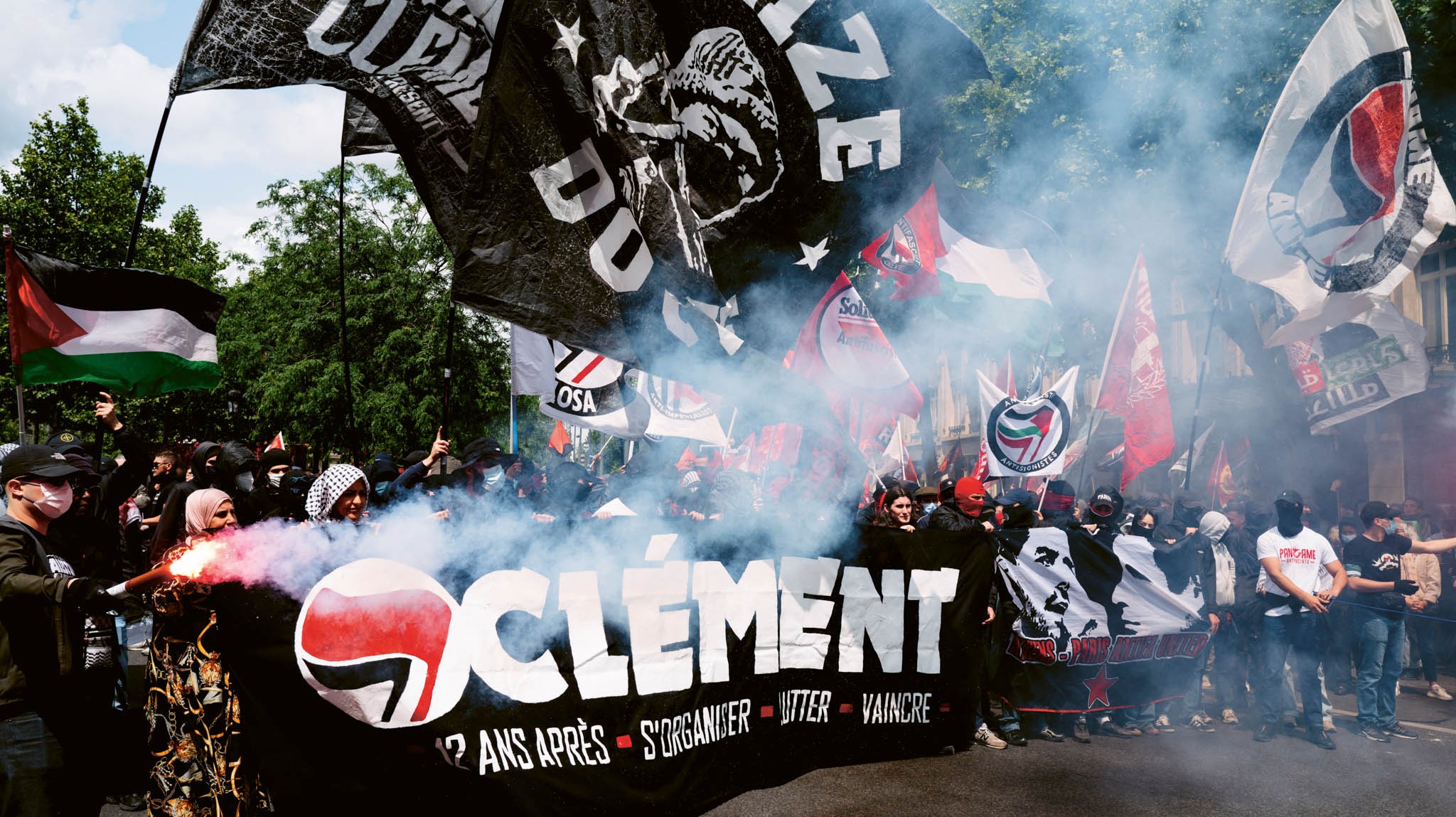
Antifascism is often understood as a kind of umbrella term—a seemingly respectable stance that merely denotes opposition to far-right movements and policies, whatever that may mean today. Reality tells a different story. The Antifa movement is a product of the German far left of the 1920s and 1930s, and it remains a far-left movement to this day.92 The events in Hungary in 2023 are entirely in keeping with this pattern: Antifa maintains an intimate relationship with violence. As Andy Ngo, a journalist who infiltrated Antifa circles and was brutally beaten by them, has written: ‘If it isn’t clear yet, violence is a feature, not a bug, of antifa’s ideology.’93
Mark Bray emphasizes that antifascism is a ‘pan-revolutionary’ or ‘pan-left’ movement, encompassing a broad coalition of socialists, anarchists, and communists united in their struggle against the far right.94 What is more, Bray stresses that Antifa is not a single-issue movement, but merely one face of a ‘larger revolutionary project’.95 The movement’s aim is not simply ‘fighting the right’, but the abolition of prisons, the state, citizenship, and capitalism itself.96 As Ngo observes, ‘They believe a communist-anarchist world utopia is possible. There would be no borders, police, prisons, racism, or fascism. All material needs would be met through community mutual aid, not through working in an exploitative capitalist system.’97
Antifa fights all forms of what it sees as oppression, aiming to suppress all racist, homophobic, sexist, and similar speech through intimidation, threats, doxing, getting people fired,98 and the physical assault of anyone deemed a ‘fascist’—a category broad enough to include supporters of Donald Trump, who are often described as ‘everyday fascists’.99 From the standpoint of ordinary morality, such actions may appear immoral, but antifascist ethics claim to be ‘deeper’ than everyday moral standards. As Bray argues, even if people are horrified by the ‘sight of looting and burning’, they are at least finally ‘forced to take note of the scale of injustice’.100 Antifascist violence is thus presented as an indispensable part of a sacred mission, the purpose of which is to open people’s eyes.
Antifa is ‘proudly illiberal’101 and rejects the liberal principles of freedom of speech, opinion, and assembly. From a revolutionary perspective, a legalistic approach to rights is not worthy of respect, since, in Antifa’s view, rights are not ‘inalienable’.102 For antifascists, the wellbeing of marginalized groups takes precedence over abstract liberal rights.103 Indeed, they argue that such rights are in any case already restricted on other grounds—for example, in the case of undocumented immigrants or young people caught using drugs. These liberal limitations on rights, antifascists contend, serve to sustain capitalism, militarism, nationalism, colonialism, and the ‘institutional racism’104 of the justice and immigration systems. Since fascist violence is said to thrive within capitalism, the institutions of the state and the capitalist system are regarded as ‘legitimate targets for widespread looting and property destruction’.105
According to Bray, antifascist actions constitute self-defence against ‘fascists’.106 As we have seen throughout other strands of revolutionary argumentation, there is no middle ground and no possibility of compromise between oppressors and the oppressed. Gudrun Ensslin, later a founder of the Red Army Faction, put it this way: ‘This fascist state means to kill us all…Violence is the only way to answer violence. This is the Auschwitz generation, and there’s no arguing with them.’107
Antifascism, like chiliasm, socialism, and anarchism, relies heavily on extra-legal means, since legality itself is part of the ‘system’ and therefore—from the perspective of eschatological warfare—carries no moral obligation. Revolution recognizes no laws. As Bray makes clear, ‘anti-fascists are, simply, revolutionaries…their revolutionary socialist ideology advocates the global expropriation of the capitalist ruling class and the destruction (or capture) of all existing states by means of an international popular uprising that most believe will necessitate violent confrontation with state forces. “If they are critical of ‘no platform’, wait ’til they hear about class war”.’108
The only possible response to ‘fascism’—and to that which supposedly nourishes it, namely capitalism, the state, and institutions—is violence. As we have already seen in the case of Trotsky, the aim is a reckoning, not debate or winning elections: revolutionary action does not belong to what is normally regarded as civilized political contest. This is a struggle of life and death in which, as Gottfried points out, antifascists—probably unconsciously—draw on Christian demonology, in which fascism assumes the role of Satan and must be defeated at any cost.109 Bray’s words could just as well have been written by Trotsky himself: ‘the question is not about establishing a neutral line beyond which right-wing politics cannot cross, but about entirely transforming society by tearing down oppression in all its forms. For revolutionary socialist anti-fascists, the question to ask is “who will win the political struggle?”’110
It is therefore not surprising that the antifascist movement bears a strong resemblance to the nihilism of the very movement it claims to oppose—namely, National Socialism. And, like National Socialism, this nihilism aims at the destruction of the corrupt civilization that preceded it. Both movements, Gottfried notes, engaged in street violence, and both benefited from the support of particular institutional networks and from public opinion.111 Yet this nihilism is far from being ‘relativistic’ in any strict sense. According to Gottfried, the radical left is driven by moralism just as much as any revolutionary movement of the past that sought the ‘reconstruction of humankind’.112 Reconstruction here simultaneously entails the abolition of the existing order—the nation state and capitalism—and the realization of its own utopia.113
Revolutionary violence is a peculiar amalgam of ideas: a moralizing nihilism. It is nihilistic with regard to partial actions that violate our most basic moral intuitions and civilizational principles, yet overtly moralistic with respect to ultimate ends and their justification.
Conclusion
Revolutionary nihilism—whether of the right or the left—finds its moral justification precisely in the idea of setting the existing order against an imagined ‘proper order’. Measured against this envisioned order, the existing one appears valueless, and violence directed against it does not warrant condemnation.
It is worth noting, however, that in contemporary radical left-wing movements—from Antifa to the environmentalists—utopia itself has begun to fade, and the primary aim has shifted towards averting an anticipated apocalypse. As Bray writes, even a single fascist or a small group of fascists must be interpreted as the first phase of a dangerous fascist movement, so that it can be stopped at the very outset.114 Gottfried identifies the same tendency: ‘the modern liberal democratic form of government has an aim at least partly determined by what it does not want to be.’115 This phenomenon appears in almost all forms of radical thought. Marx’s communism—but also Karl Popper’s ‘open society’—are things about which we can know relatively little in positive terms, while we are told a great deal about the horrific conditions they are meant to oppose and overcome.
Jürgen Habermas already noted the exhaustion of utopian energies in the 1980s.116 Revolutionary movements whose aim is not the realization of a positive utopia but the prevention of some impending catastrophe resonate with Judith Shklar’s notion of the ‘liberalism of fear’.117 In the writings of the revolutionary authors discussed above, these two positions oscillate: at times there is a utopian vision of a world free from oppression, inequality, authority, and hierarchies; at other times, what dominates is the image of a rearguard struggle, in which the task is to defend the status quo against an even more dreadful future. In Gottfried’s words: ‘An already well-established practice is depicting the antifascist multicultural order as perpetually in danger and requiring extreme measures, like the suppression of what remains of liberal freedoms, to check an ostensible fascist threat to our survival’.118
The middle ground between these positions might be the idea that the fight has already begun and has borne some fruit but remains unfinished. If the Promised Land is unattainable at the moment, the status quo is still better than possible damnation, and maintaining it is of upmost importance—by any means necessary.
Translated by Thomas Sneddon
NOTES
1 ‘German and Italian Far-Left Extremists Attack Innocent People in Budapest’, Hungary Today (13 February 2023), https://hungarytoday.hu/german-and-italian-far-left-extremists-attack-innocent-people-in-budapest/.
2 Sam Dorman, ‘Biden Clashes with Trump over Antifa: “It’s an idea, not an organization”’, Fox News (30 September 2020), www.foxnews.com/politics/biden-trump-antifa-idea-organization.
3 Thomas Hobbes, Leviathan, Ch. XIII (Penguin Classics, 2017).
4 Max Weber, Politics as a Vocation (Hassell Street Press, 2021).
5 Alan Page Fiske, and Tage Shakti Rai, Virtuous Violence: Hurting and Killing to Create, Sustain, End, and Honour Social Relationships (Cambridge University Press, 2015), 110.
6 Georges Sorel, Reflections on Violence (Cambridge University Press, 2004), 65.
7 Steven Pinker, The Better Angels of Our Nature: Why Violence Has Declined (Penguin Books, 2012).
8 Fiske and Rai, Virtuous Violence, 433.
9 Weber, Politics as a Vocation.
10 Hannah Arendt, On Violence (Houghton Mifflin Harcourt, 1970), 4.
11 Arendt, On Violence, 53.
12 René Girard, Violence and the Sacred (Bloomsbury Publishing, 2013), 28.
13 Fiske and Rai, Virtuous Violence, 85.
14 Fiske and Rai, Virtuous Violence, 52: ‘public vengeance is the exclusive property of well-policed societies, and our society calls it the judicial system’, and ‘our judicial system rationalizes revenge’. Also, see Girard, Violence and the Sacred, 28, 38.
15 Girard, Violence and the Sacred, 40–41.
16 Fiske and Rai, Virtuous Violence, 113.
17 Arendt, On Violence, 63.
18 See for instance the case of Charlie Kirk.
19 Fiske and Rai, Virtuous Violence, 175.
20 Fiske and Rai, Virtuous Violence, 176.
21 See Ladislaus Radvanyi, Der Chiliasmus: ein Versuch zur Erkenntnis der chiliastischen Idee und des chiliastischen Handelns (Chiliasm: An Attempt to Understand the Chiliastic Idea and Chiliastic Action) (Hungarian Academy of Sciences, Lukacs Archive, 1985).
22 All of this, of course, stands in sharp opposition to the Church’s official understanding of history and soteriology. Following the conception of Saint Augustine, the Church holds that visible history has no inherent direction or goal: within it, empires rise and fall, come and go. Redemption unfolds in invisible history, and salvation can come about only at its end, at the Second Coming of Jesus Christ. Humans can do nothing whatsoever to hasten or bring about this event. See St Augustine, City of God (Penguin Classics, 2004), especially Book XIV, Chapter XXVIII.
23 Eric Voegelin, The New Science of Politics (University of Chicago Press, 1987), 198; Michael G. Baylor, Revelation and Revolution: Basic Writings of Thomas Müntzer (Lehigh University Press, 1993), 145.
24 Michael G. Baylor, Revelation and Revolution: Basic Writings of Thomas Müntzer (Lehigh University Press, 1993), 145.
25 Baylor, Revelation and Revolution, 113, 114.
26 Baylor, Revelation and Revolution, 113.
27 Baylor, Revelation and Revolution, 191.
28 Eric Voegelin, From Enlightenment to Revolution (Duke University Press), 172.
29 Jacob L. Talmon, The Origins of Totalitarian Democracy (Secker & Wartburg, 1952), 35.
30 For a detailed analysis of what was probably the first modern genocide, conducted during the French Revolution, see Reynald Secher, A French Genocide: The Vendée (University of Notre Dame Press, 2013).
31 Erik von Kuehnelt-Leddihn, Leftism Revisited: From de Sade and Marx to Hitler and Pol Pot (Regnery, 1990), 75.
32 From a speech by Robespierre at the National Convention, February 1794, https://alphahistory.com/frenchrevolution/robespierre-revolutionary-terror-1794/, accessed 10 December 2025.
33 From a report by General Westermann to the Committee of Public Safety, 1794, https://gornahoor.net/?p=15, accessed 10 December 2025.
34 Georges Sorel, Reflections on Violence (Alpha Editions, 2020), 18.
35 Sorel, Reflections on Violence, 30.
36 Sorel, Reflections on Violence, 226.
37 Although, as Arendt notes, strikes nowadays ironically represent a non-violent form of political pressure. See Arendt, On Violence, 12.
38 Thomas Molnar, Bernanos: His Political Thought & Prophecy (Routledge, 1996), 122–123.
39 Sorel, Reflections on Violence, 32.
40 Thomas Molnar, The Decline of the Intellectual (Routledge, 2017), 181–182.
41 ‘[I]t would be a profound mistake to equate such inducement with violence…The very word “violence” already hides a negative assessment: “violence” is an arbitrary act, unreasonable, outrageous…Against “violence” we should protest…’ Ivan Ilyin, On Resistance to Evil by Force (Taxiarch Press, 2018), 25.
42 Parliaments represent ‘partial interests’ as opposed to the interests and will of a collective. Totalitarian movements thus—following Rousseau—despise parliamentarism. See Talmon, The Origins of Totalitarian Democracy, 45, 49.
43 Sorel, Reflections on Violence, 85.
44 Sorel, Reflections on Violence, 251.
45 Sorel, Reflections on Violence, 293.
46 Jacob Taubes, Occidental Eschatology (Stanford University Press, 2009), 86, 87.
47 Richard Wolin, Heidegger in Ruins (Yale University Press, 2022), 60–62.
48 The other was Mao Zedong, whose famous slogan was ‘Power grows out of the barrel of a gun’.
49 Leon Trotsky, Terrorism and Communism, Dictatorship and Democracy: A Reply to Karl Kautsky (Workers Party of America, 1920), 40.
50 Trotsky, Terrorism and Communism, Dictatorship and Democracy, 43.
51 Trotsky, Terrorism and Communism, Dictatorship and Democracy, 145.
52 Trotsky, Terrorism and Communism, Dictatorship and Democracy, 95.
53 Trotsky, Terrorism and Communism, Dictatorship and Democracy, 101.
54 Karl Marx, Capital: Critique of Political Economy, Volume One (Penguin Classics, 1990), Chapter 13.
55 Karl Marx, A Contribution to the Critique of Hegel’s Philosophy of Right (Cambridge University Press, 1970).
56 Karl Marx, ‘The Victory of the Counter-Revolution in Vienna’, Neue Rheinische Zeitung (6 November 1848).
57 See in particular György Lukács, Taktika és etika (Tactics ethika (Tactics and Ethics) (Közoktatási népbiztosság, 1919), www.marxists.org/archive/lukacs/works/1919/tactics-ethics.htm.
58 In any case, an ‘anarchist government’ sounds fundamentally absurd.
59 Mikhail Bakunin, ‘Die Reaktion in Deutschland’ (The Reaction in Germany) (Nemo Press, 1984), www.marxists.org/reference/archive/bakunin/works/1842/reaction-germany.htm.
60 Bakunin, ‘Die Reaktion in Deutschland’.
61 Thomas Münzer, ‘Letter to the People of Allstedt, 1525’, ResearchGate, www.researchgate.net/publication/380217909_Thomas_Muntzer_Letter_to_the_People_of_ Allstedt_1525, accessed 10 December 2025.
62 Voegelin, From Enlightenment to Revolution, 218.
63 Arendt, On Violence, 69. See also the idea of the ‘new man’ in Marx’s thought. Karl Löwith, Max Weber and Karl Marx (Routledge, 2016), 36. Although Sorel is basically hoping for a revolutionary catastrophe—meaning he shares some of the accelerationist instincts of the conservative revolution—and is not interested in utopianism, which he views as nothing but an accessory to reformism, he also sometimes reverts to at least semi-utopian sentiments: ‘[T]he whole revolutionary effort tends to create free men…’, Sorel, Reflections on Violence, 172.
64 Mikhail Bakunin, Statism and Anarchy, https://theanarchistlibrary.org/library/mikhail- bakunin-statism-and-anarchy.
65 Karl Löwith, Meaning in History (University of Chicago Press, 1949), 43.
66 Löwith, Meaning in History, 65.
67 Bakunin, ‘Die Reaktion in Deutschland’.
68 Bakunin, Statism and Anarchy.
69 Bakunin, Statism and Anarchy.
70 Voegelin, From Enlightenment to Revolution, 228–229.
71 Mikhail Bakunin, Confession (Cornell University Press, 1977), 93.
72 Voegelin, From Enlightenment to Revolution, 218.
73 Cited in Voegelin, From Enlightenment to Revolution, 230.
74 The term later reoccurs in the idiolect of the German New Left, especially in the works of Rudi Dutschke.
75 Tom Goyens, ‘Johann Most and Anarchist Violence’, presented at the 33rd Annual North American Labor History Conference, Wayne State University, October 2012, https://theanarchistlibrary.org/library/tom-goyens-johann-most-and-anarchist-violence, accessed 10 December 2025.
76 Cited in Klaus Schroeder, and Monika Deutz- Schroeder, Die Kampf is nicht zu Ende. Geschichte und Aktualität linker Gewalt (The Battle Is not Over: History and Present State of Left-Wing Violence) (Verlag Herder, 2019), 54.
77 Goyens, ‘Johann Most and Anarchist Violence’.
78 Thomas Molnar, The Counter-Revolution (Funk & Wagnalls, 1969), 52.
79 Slavoj Žižek, Trouble in Paradise: From the End of History to the End of Capitalism (Allen Lane, 2014), 259.
80 Žižek, Trouble in Paradise, 249.
81 Žižek, Trouble in Paradise, 250.
82 Žižek, Trouble in Paradise, 252.
83 Žižek, Trouble in Paradise, 261.
84 Rudi Dutschke, ‘Refusal Requires a Guerilla Mentality’. Speech delivered at the 22nd delegates’ conference of the Socialist German Students’ Union (SDS), 5 September 1967, https://illwill.com/refusal, accessed 10 December 2025.
85 Herbert Marcuse, ‘Repressive Tolerance’, in Robert Paul Wolff et al., eds, A Critique of Pure Tolerance (Beacon Press, 1969), 95–137.
86 Schroeder and Deutz-Schroeder, Die Kampf is nicht zu Ende, 114.
87 Frantz Fanon, The Wretched of the Earth (Grove Press, 2004), iv.
88 Fanon, The Wretched of the Earth, 3.
89 Fanon, The Wretched of the Earth, 26.
90 Fanon, The Wretched of the Earth, 38.
91 Fanon, The Wretched of the Earth, 50.
92 Antifaschistiche Aktion (Antifascist Action) was an organization of the KPD, the Communist Party of Germany. Even the contemporary logo of Antifa is virtually the same as the original German one. See Schroeder and Deutz-Schroeder, Die Kampf is nicht zu Ende, 16.
93 Andy Ngo, Unmasked: Inside Antifa’s Radical Plan to Destroy Democracy (Center Street, 2021), 12. Ngo was himself brutally beaten by a group of Antifa activists.
94 Mark Bray, Antifa: The Anti-Fascist Handbook (Melville House Publishing, 2017), xiv, 148; Ngo, Unmasked, 16.
95 Bray, Antifa, 148; and ‘at a certain point destroying fascism is really about promoting a revolutionary socialist alternative…’, 209.
96 Bray, Antifa, 130. As Paul Gottfried notes, ‘anticapitalism’ is an interesting position, ‘given the overwhelming presence of corporate capitalists among the revolutionaries’. Paul Gottfried, Antifascism: The Course of a Crusade (Cornell University Press, 2021), 28.
97 Ngo, Unmasked, 307.
98 Bray, Antifa, 86–87.
99 Bray, Antifa, 204.
100 Bray, Antifa, 186.
101 Gottfried, Antifascism, 3.
102 Bray, Antifa, 151. Also, it is believed that ‘historically, fascist and fascistic ideas have thrived in open debate’, so it is advised to shut them down on the spot. Bray, Antifa, 147.
103 Interestingly, the groups that revolutionaries like antifascists deem ‘marginalized’ rarely partake in the actual struggle. The majority of active antifascists seem to be at least middle-class, and overwhelmingly white. As Gottfried writes, ‘46 percent of protesters and rioters on US streets in the spring of 2020 were white, and an even higher percentage were Democratic. Only 17 percent (one out of six protesters) were Black and 22 percent Hispanic.’ Antifascism, 28.
104 Bray, Antifa, 153–154.
105 Bray, Antifa, 63.
106 Bray, Antifa, 169.
107 Schroeder and Deutz-Schroeder, Die Kampf is nicht zu Ende, 116.
108 Bray, Antifa, 159.
109 Gottfried, Antifascism, 17.
110 Bray, Antifa, 156.
111 Gottfried, Antifascism, 24.
112 Gottfried, Antifascism, 135.
113 Ngo, Unmasked, 14.
114 Bray, Antifa, 141.
115 Gottfried, Antifascism, 125.
116 Jürgen Habermas, ‘The New Obscurity: The Crisis of the Welfare State and the Exhaustion of Utopian Energies’, Philosophy and Social Criticism, 11/2 (1986), 1–18.
117 Judith Shklar, ‘The Liberalism of Fear’, in Nancy L. Rosenbaum, ed., Liberalism and the Moral Life (Harvard University Press, 1989), 21–38.
118 Gottfried, Antifascism, 154.
Related articles:
At a time when public debate is increasingly polarized and superficial, Hungarian Conservative remains committed to depth, intellectual honesty, and independent conservative thought.
Producing high-quality journalism requires resources. Your contribution helps us expand our coverage, reach new audiences, and keep our content accessible.

Please consider supporting our mission.