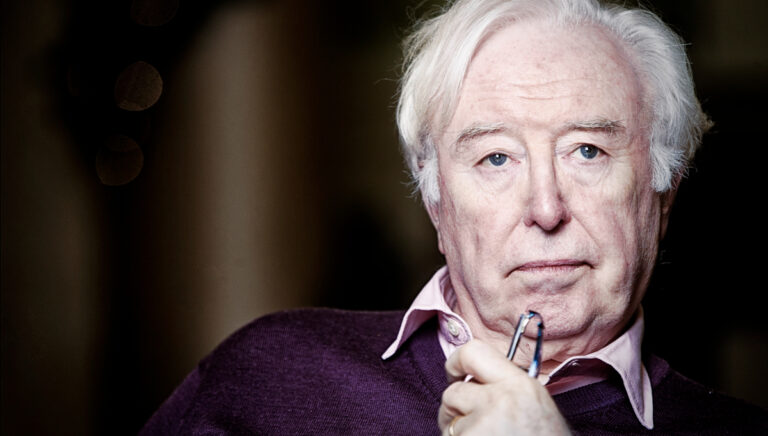
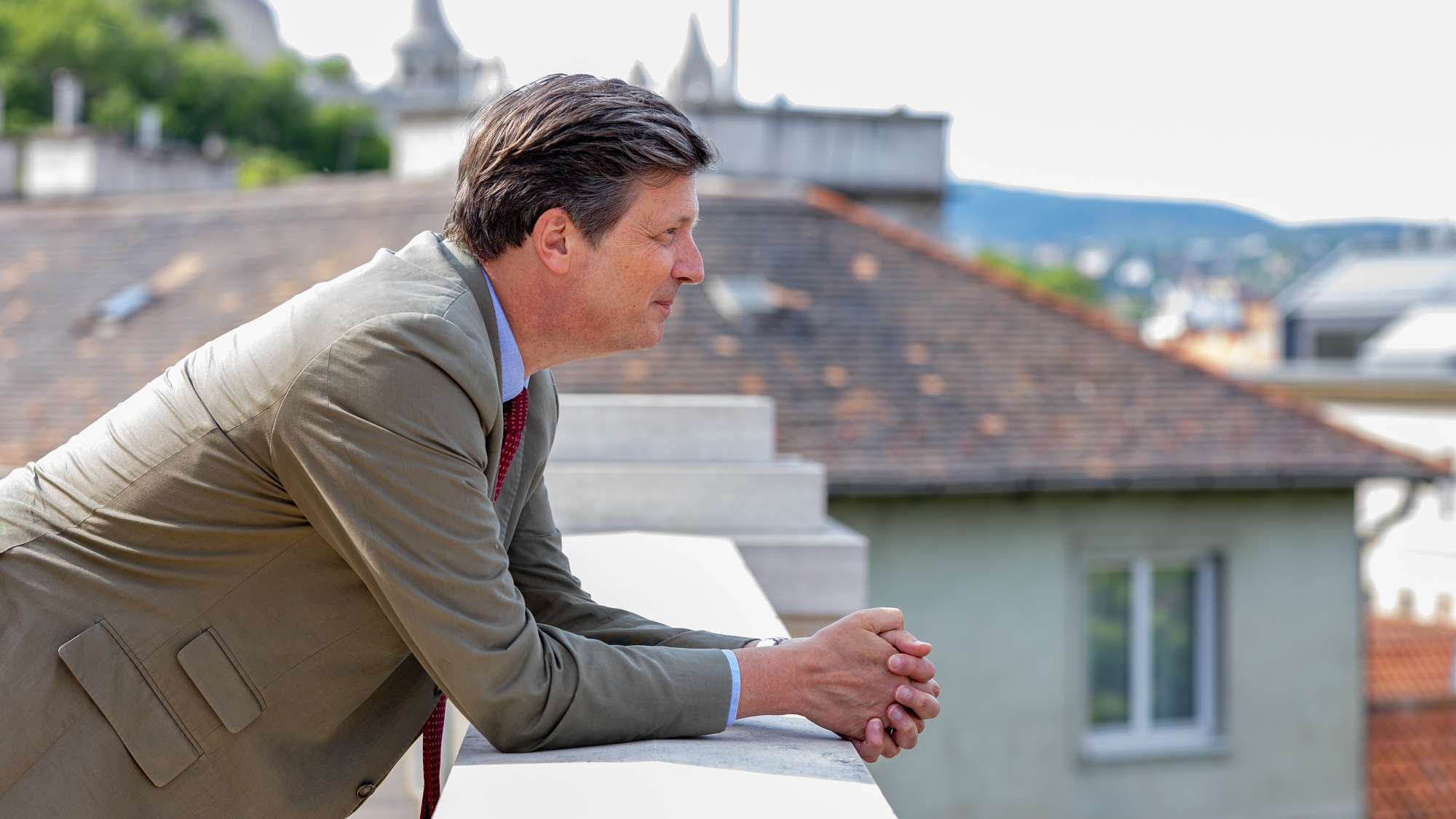
Eduard Habsburg-Lothringen was, between 2015 and 2025, Ambassador of Hungary to the Holy See and to the Sovereign Military Order of Malta. He studied philosophy and history at the Catholic University of Eichstätt-Ingolstadt, where he earned a doctorate in philosophy with a dissertation on the end of Neo-Thomism, and later pursued further studies at the University of Fribourg in Switzerland. Before his current position, he was a screenwriter, and a presenter in a TV series, and he worked for five years as the spokesman for Msgr Klaus Küng, Bishop of St Pölten. He has published several novels and books on history and family. His latest books are: The Habsburg Way, 7 Rules for Turbulent Times (2023); Building a Wholesome Family in a Broken World: Habsburg Lessons from the Centuries (2024).
***
What is the significance of being a Habsburg?
It’s quite cool to be a member of the Habsburg family. You are part of something larger, something that goes back very far in European history. Basically, people expect a Habsburg to be Catholic, to be international, working for peace between nations, and for values and tradition. And you have to decide, is this my thing or not? And if your parents passed on the family heritage to you in a good way, you will say yes to this.
For me, the moment where I realized I can’t just live my life was in school. Whenever they spoke about the Habsburgs, the teacher turned to me and said, that’s something that Mr Habsburg should know about. And I realized I have no idea. There is a rule in our family; our head of family, Otto von Habsburg always taught us a line, which is: ‘If you don’t know where you’re coming from, you don’t know where you’re going, because you don’t know where you stand.’ Living with your roots is a very strong part of the Habsburg heritage.
Do you know any Habsburg in your family who said no to the request of his father to continue the tradition?
I don’t know anybody. There were a few in the beginning of the 20th century, who just rebelled against Vienna, and against the very strong push to become a soldier. If I look around now in the family, most of them embrace the family tradition and enjoy standing up for the values we stand up for.
I’m among the most visible members of the family. I’m like the ambassador of the family to social media.
What obligations does the Habsburg name place on family members?
For instance, if I do something really bad, it will reflect onto the entire family. It’s a very heavy weight to carry that you have to censor whatever you say, whatever you do. You learn this from early on: what you do will be seen. You have to behave as a Habsburg. When you go to the first event where a marching band plays, and traditional people cry when they look at members of the Habsburg family, you realize that you stand for something, and people expect you to be something.
‘You learn this from early on: what you do will be seen. You have to behave as a Habsburg’
Did you have that mentality as a teenager too? Did you remind yourself after drinking three beers with friends that, oh goodness, I need to behave like a Habsburg?
I don’t know where the Habsburg ends and my character begins. If you’re the first-born in a family, you’re usually trying to be more responsible. It was always part of the Habsburgs; I watched my uncles and aunts, and they were very respectable people. I once met with Empress Zita when I was a young boy. I was deeply impressed by the mixture of great respect and at the same time incredibly humble and gentle way of hers. She didn’t just talk to my parents—she talked to every member of the family in the room, even the children.
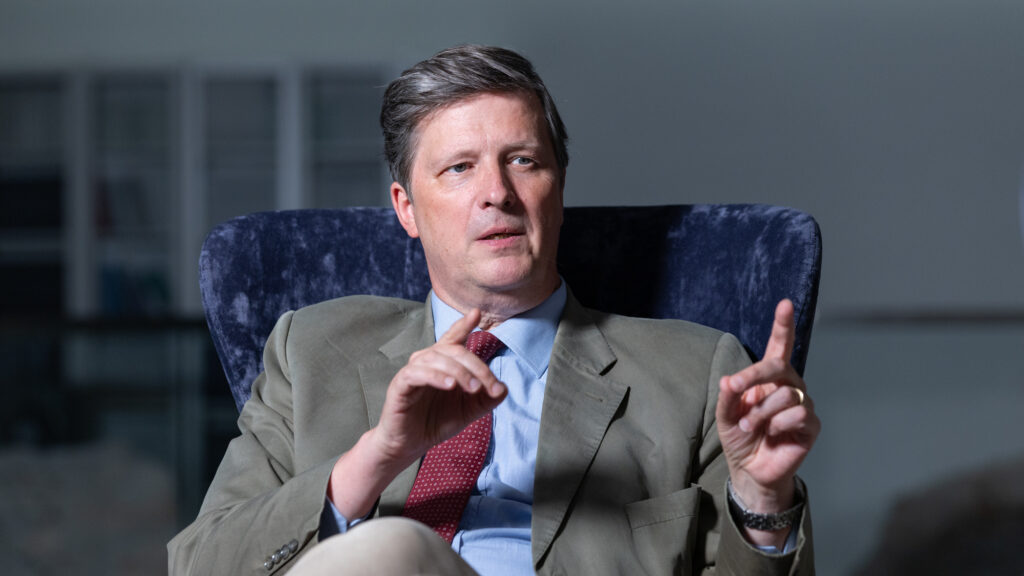
You have an official title: Archduke Eduard of Austria. What privileges do you have with it?
Well, the only privilege that I have is that if I use that title in Austria, I have to pay a fine, because there are no aristocratic titles in Austria. So I have to be careful, although the fine is not very high.
It’s a historic title; it doesn’t really win you anything, because it’s a title that only exists in our family. In 1273 we suddenly jumped into public consciousness by having the first king of the Holy Roman Empire, Rudolf, and then after that immediately we were gone for nearly 150 years from the whole game.
They sat in Vienna, sulking, and they spent their time developing family trees that went back to biblical times and discovering documents written by Caesar that gave the Duke of Austria a special title. And the Habsburgs said that this is the proof that we’re not just dukes, but archdukes. Sometimes on X, people say you are the Archduke of Austria, and I say that every member of the Habsburg family carries that title. This is history.
Your great-grandfather, Archduke Joseph August was the last Palatine of Hungary; you are in the Palatine Line of the Habsburgs. What role does Hungary play in your collective memory?
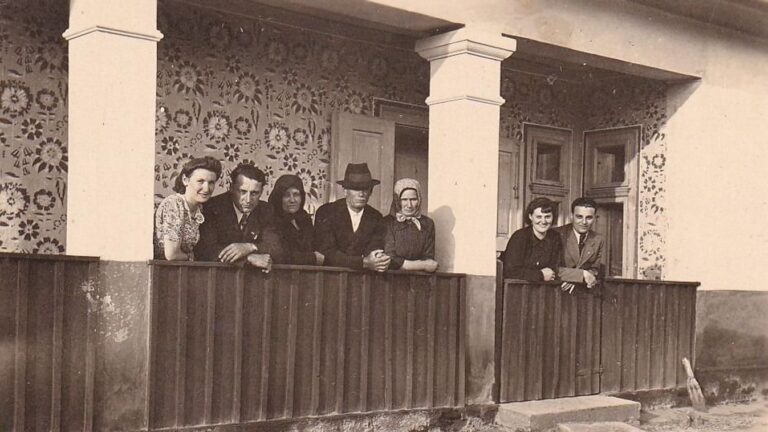
Our Hungarian branch of the family was founded by Archduke Joseph ‘nádor’, who went to Hungary in the 1790s and became the representative of the Emperor and later the Palatine of Hungary. He fell in love with Hungary: with Hungarian language, with Hungarian laws, with everything. From 1790 to 1944 my family was present here in Hungary, so much so that his son, Archduke Istvan (Stephen) was on the side of Hungary in the 1848 revolution, and brought the Hungarian demands to Vienna to his cousin, the Emperor.
The family stayed here until the Second World War, when they fled all through Europe, and my father began coming back here from the 1980s on. That’s when I began to learn a bit of Hungarian, and slowly rediscovered what my roots are.
‘Archduke Istvan (Stephen) was on the side of Hungary in the 1848 revolution, and brought the Hungarian demands to Vienna to his cousin, the Emperor’
So is your identity partly Hungarian?
Yes, definitely, I see myself as Hungarian. I also have German citizenship; I have a German mother, but my first citizenship is Hungarian. And I stand for Hungary, what Hungary is.
If you visit Hungary and look around, what are the specific buildings that really remind you of your family heritage?
Most of all, Alcsútdoboz, which used to be Alcsút. It has an arboretum, and there used to be our family castle, a beautiful castle, of which only the portal remains somewhere in the park. It was burnt down during the Second World War. Then my family had a little villa on the Rózsadomb. I think they used it later on as a hospital or something. Then, of course we had the palace of my great great-grandfather, which is being rebuilt face to face with the President’s palace. My father was baptized in that building. There is a picture at home in our family, where you see Angelo Rotta, a fantastic Vatican Nuncio, who saved thousands of Jews. He stands there with my father as a baby in his arm in that entrance hall with the staircases that they’re now rebuilding.
‘My first citizenship is Hungarian. And I stand for Hungary, what Hungary is’
Piliscsaba is an important place because Klotildliget was a village built by my great great-grandfather, Joseph Karl, and he named it after his wife, Clotilde ‘hercegnő’.
Do you maintain close contacts with other notable Habsburgs like Georg von Habsburg?
Yes, in a very practical way. At each Ambassadors’ conference in Budapest, we were seated side by side because it was alphabetical, so we spent five days in the same room, sitting side by side and talking to each other. He, our head of family Karl von Habsburg, and his son Ferdinand—we’re very close, as with many of my cousins. We have a WhatsApp group in the family, and we contact with our cousins in the world. We’re basically everywhere. And I would say every four to five years we have a family meeting. The last big one was in 2022 when we had the centenary of the death of blessed Emperor Carl, who died in 1922, and the whole family met in Madeira. I couldn’t go there because there was election and the ambassadors don’t leave their embassies at election weekend, but in 2016 we met in Rome and the entire family met with Pope Francis.
You have a family that was a ruling family in the Austro–Hungarian Empire, and it seems that almost every member of your family has felt the burden of taking on a political role. Do you have this burden as well?
I don’t think that we have a burden. We have very encouraging examples. We have Otto, for instance, who decided not to sit around and play the heir to the throne, because he was the son of Emperor Charles. He could have spent his life being the heir in a monarchy that will never come back, perhaps, but he decided to go actively into politics and to work for the European Unity, which he saw as the best way of carrying the Habsburg legacy into the 20th century; and that was a strong example for all of us.
The idea is that we should stand for the good understanding between countries. I always say a Habsburg is never just part of one nation—you are always somewhere between countries, and you understand different points of view. Diplomacy is part of our heritage. So it’s not a burden, but a strong invitation to engage in that.
‘I always say a Habsburg is never just part of one nation—you are always somewhere between countries’
Why did you take the job of being Ambassador to the Holy See?
Well, my idea of a diplomat was like, as most people imagine it a bit, standing around with a champagne glass at receptions and smiling all the time, and never being able to say what you think, because you don’t want to cause a crisis. But it’s so much more than that.
So I was approached. I would have never thought that I could be a diplomat. I was a script writer. I wrote scripts for TV and for animated cartoons. I wrote a zombie movie at the time. Then I realized, okay, I speak languages, I have worked for the church for five years, I was a spokesman of a bishop, I’m from a traditional family with traditional values, I’m Hungarian, so slowly I began to understand that I can bring something to the table. That’s how I became ambassador.
You wrote a book, The Habsburg Way, and in this book you mentioned that you were influenced by Otto von Habsburg, who was the father of the Paneuropean idea. What kind of political insights of him do you share?
The main influence was simply the privilege of being able to interact with him for many years. Since I was a small child, I went to his talks about Europe. I went to his political rallies for the European elections. I was with him in Germany, in Austria, in Hungary when he travelled. I, and his daughter Walburga, were the representatives of him at the Pan-European Picnic in Sopron, when the Iron Curtain opened for the first time.
But the most impressive moment was when he was already elderly, and we went to the Mátyás Temple, and he took me on a little balcony on the left, just above the altar. We looked down into the main altar area, and he showed me where his father was lying when he was ordained—when he became the King of Hungary, and he showed me how he looked down to his father; so that was living history.
‘He showed me where his father was lying when he was ordained—when he became the King of Hungary’
And he had a dry sense of humor. He tried not taking himself too seriously; he was very intelligent, and he had wide thoughts about Europe, and the idea that the countries behind the Iron Curtain were part of Europe.
What’s your assessment of the European Union’s current political directions?
I believe that the European idea is a very important one. I believe that we owe decades and decades of peace to the fact that Europe was unified. I believe that the European Union perhaps has lost a bit of perspective of subsidiarity, the respect for a single country. The temptations of centralism of Brussels are always very strong, especially if you have a huge bureaucracy that works there. And I believe that Europe has to rediscover what it is in a way. So my years working for Hungary have shown me the cracks somehow in the project, but the project itself is great and important.
Would Otto von Habsburg agree with this kind of federalization of the European community?
I believe not, but what do I know? Other family members perhaps say yes, he would. So, you know, that’s a debate that we cannot lead. I know that in Hungary, most people strongly believe in the European project, as do most Europeans, but perhaps there is still space for learning how to do it better.
‘I believe that the European Union perhaps has lost a bit of perspective of subsidiarity, the respect for a single country’
You have six children, you’re a grandfather, and you wrote a book about family values. What is the secret of the big family and being a married man with children?
The answer is one word: faith. I believe that family cannot be lived without faith. Having a large family is a gamble that you will take more easily if you have faith. I believe that men and women are very different physically, psychologically, from their background, from everything. What connects you is love and respect. If you have faith in common, your couple will be practically unbreakable. It is the bridge that keeps you together, even in very difficult times. That’s why the Habsburgs were always so strongly built on family values. They didn’t expand their empire by war and by conquest, but by marriage, and marriage politics is something that we have in our DNA.
Large family makes a difference. If you have one or two children, you can continue living like a student couple in a way. If you have six children, you can’t. Your priorities become the children, and around the kitchen table in a large family, you learn all the values and all the virtues that is needed for a citizen today. Having a lot of children is the greatest gift that the spouses can give to each other. If you grow up in a large family, you learn to care and to look out for the weaker members of the family, you learn that you’re not the centre of the world, you learn that you’re not entitled, but that part of what you are is giving. I think we’ve lost a bit of that.
Finally, in your opinion, what is the importance of personally believing in Jesus in this post-postmodern world?
You absolutely said it right, we’re living in a post-religious world. We came down from 1500 years of Constantinian era, a close encounter between churches and the state, and we now live in a time which is purely secular, at least in Western Europe.
‘Having a large family is a gamble that you will take more easily if you have faith’
I believe that the rebirth of faith in Europe depends on Christians who have a personal relationship with Christ. There are many people out there who are baptized, whose name is written in church registers, but we will make the faith come back into our world if people give testimonies of faith. Today, in the internet age, we have a possibility that we didn’t have even 20 years ago: influencers who speak about their faith can lead many other people to developing an interest in Christ. So, I believe, as what you said, it’s less about the institutional churches, it is about a personal decision for God, and this is coming back in a strong way in Europe. Many adults rediscover faith. And you don’t have to be Catholic to be a good Christian. I happen to be because I’m a Habsburg.
Watch the full podcast below:
Related articles
At a time when public debate is increasingly polarized and superficial, Hungarian Conservative remains committed to depth, intellectual honesty, and independent conservative thought.
Producing high-quality journalism requires resources. Your contribution helps us expand our coverage, reach new audiences, and keep our content accessible.

Please consider supporting our mission.