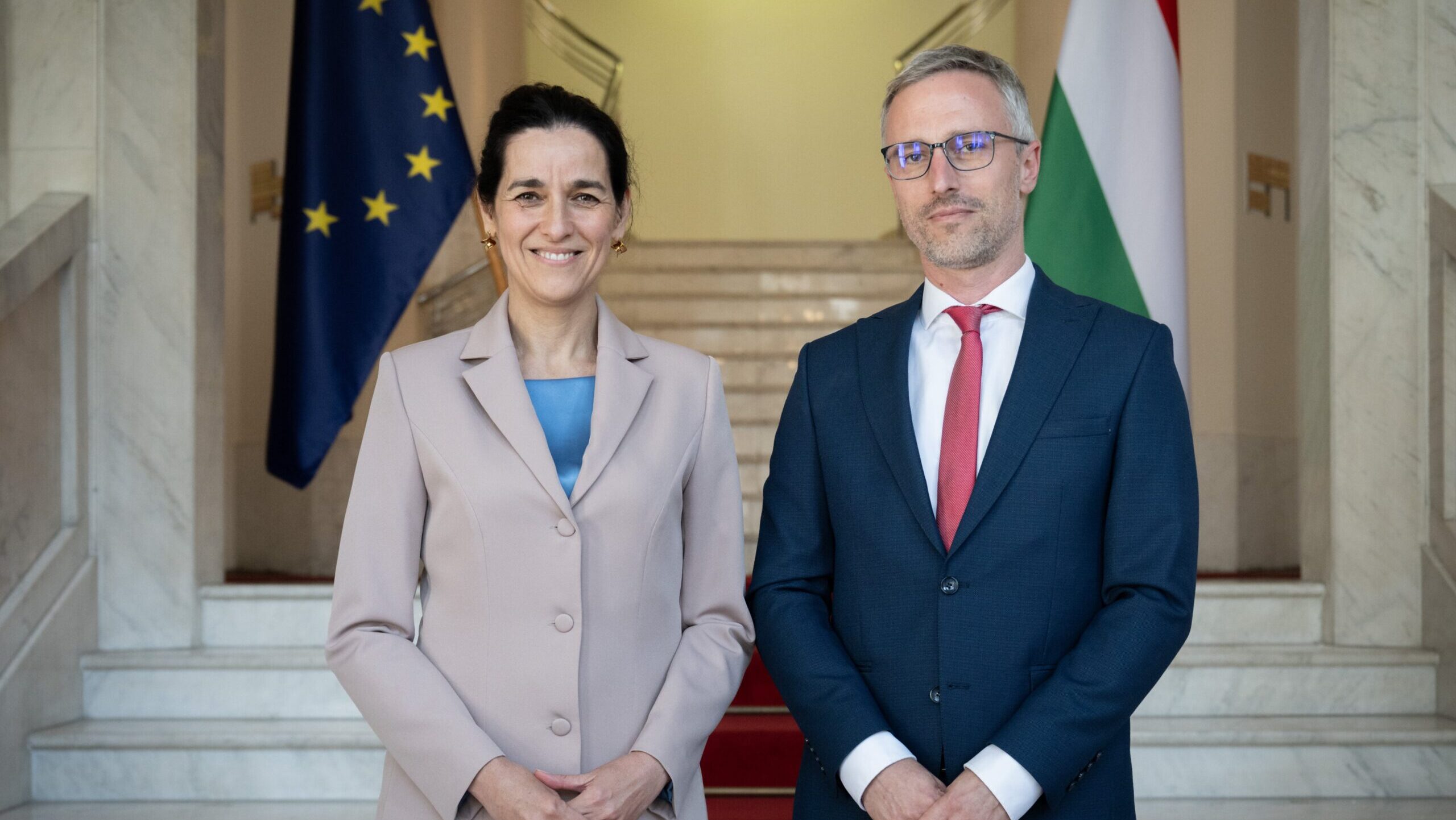
Hungary’s new foreign-policy establishment is preparing a ‘complete break’ with the ‘American-led, MAGA-oriented model’ built around former prime minister Viktor Orbán’s political director, Balázs Orbán, the new leadership of the Hungarian Institute of International Affairs (HIIA) has said, offering the clearest outline yet of Budapest’s post-Orbán diplomatic realignment.
Speaking in a joint interview with 444.hu, recently appointed HIIA head Botond Feledy and research deputy András Rácz said a new Hungarian foreign-policy strategy is being prepared and the institute will return to policy work for the Foreign Ministry rather than ideological positioning. Feledy said there would be a ‘complete break with the former American-led, MAGA-camp operation associated with Balázs Orbán’. He also put the European Union back at the centre of the institute’s work, arguing that Hungary is an EU member and ‘this is where interests have to be asserted’.
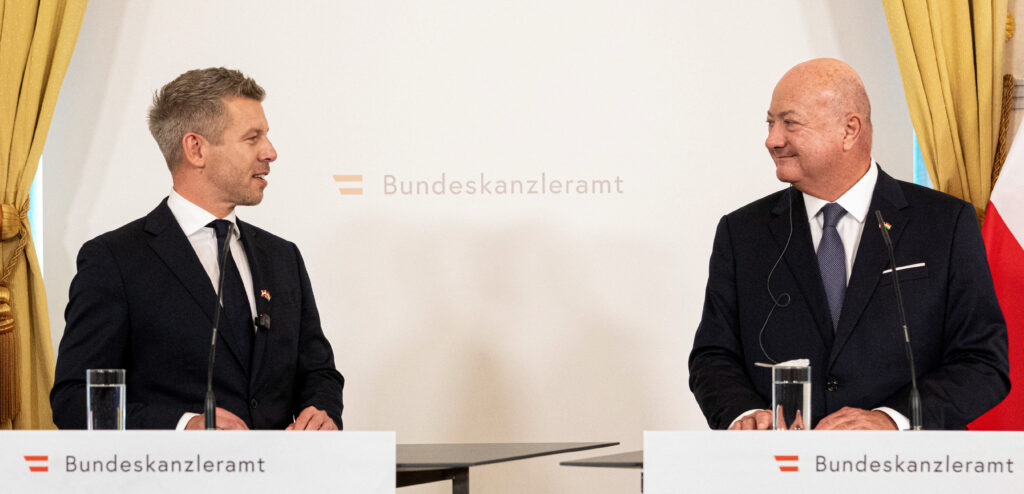
The shift was long visible, and equally anticipated, before Feledy and Rácz took over the helm of HIIA. Prime Minister Péter Magyar made Poland his first major bilateral destination after taking office, seeking to rebuild a Warsaw–Budapest relationship badly damaged during the final Orbán years by disputes over different positions towards Russia and Ukraine. In Berlin, Magyar promised that Hungary would again behave as a reliable European partner, while Chancellor Friedrich Merz welcomed Budapest’s return ‘to the centre of Europe’. Germany remains Hungary’s largest foreign investor and trading partner.
Budapest has also stopped blocking the EU’s €90 billion Ukraine loan and approved the opening of the first negotiating cluster of Kyiv’s EU accession bid after Budapest and Kyiv reached a comprehensive political agreement on restoring the rights of the Hungarian minority in Transcarpathia.
Meanwhile, Russian and Chinese relationships built under Orbán are generally receiving greater scrutiny. Foreign Minister Anita Orbán continues to advocate a ‘pragmatic relationship’ with Moscow because of Hungary’s energy dependence, but the government has launched a review of the Russian-led expansion of the Paks nuclear plant. Magyar has similarly promised to review major Chinese investments without seeking to dismantle them, while the government has since opened an investigation into decisions surrounding BYD’s Hungarian projects.
Feledy’s predecessor makes the reference to the ‘MAGA camp’ particularly significant. Gladden Pappin, the American post-liberal political theorist who headed the institute from 2023, was closely connected to the intellectual circles around Vice President JD Vance. The Atlantic reported that Pappin regularly had access to Vance, accompanied Orbán to Washington and was among the small group invited to an informal gathering at the vice president’s residence following Orbán’s White House visit. The magazine described Pappin as a ‘personification of the years of Hungarian investment in Trumpism’ that gave Budapest unusually strong access to the MAGA movement.
That relationship went considerably deeper than ordinary diplomatic cooperation. Orbán’s Hungary became an alternative political model for parts of the American right and particularly the post-liberal movement: restrictive migration policy, pro-family measures, resistance to progressive social policies and the willingness to use state power to promote conservative objectives all attracted attention. Patrick Deneen, one of the most prominent post-liberal thinkers, explicitly described Hungary as a ‘model’ for using the political order to advance conservative policies, while Vance repeatedly praised Orbán’s approach to migration and family policy.
Hungary has also hosted the Conservative Political Action Conference (CPAC) since 2022, a tradition that is also expected to be interrupted, as Magyar explicitly said during his first international press conference on 13 April that his government had no intention of organizing CPAC Hungary in the future.
Orbán was among the first European leaders to endorse Donald Trump back in 2015, when he first announced his presidential bid. The two maintained their good relationship while Republicans were in opposition; that relationship culminated during Trump’s second presidency.
Orbán met Trump at the White House on 7 November 2025 and secured relief from US sanctions affecting Russian energy imports. Five days before Hungary’s April election, Vance travelled to Budapest, openly urged voters to support Orbán and described the Hungarian leader as a defender of ‘Western civilization’. Trump repeatedly endorsed Orbán and, two days before the vote, pledged the ‘full economic might’ of the United States behind Hungary under his continued leadership.
Even after losing power, Orbán has tried to maintain those connections. During his July trip to the United States for the World Cup, he acknowledged holding undisclosed meetings and said he had conducted negotiations concerning Fidesz’s newly announced ‘constitutional resistance’ against the Magyar government. A separate US report said Orbán visited both the White House and State Department, although neither the participants nor the substance of those meetings has been officially disclosed.
Feledy’s break therefore does not necessarily imply a break with Washington itself, something Hungary could hardly afford regardless of who occupies the White House. Magyar said immediately after his election victory that ‘everything must be done’ to preserve strong relations with the Trump administration. The alternative was demonstrated under Joe Biden, when bilateral relations deteriorated sharply and Washington took the highly unusual step of sanctioning Orbán’s cabinet minister Antal Rogán for alleged corruption in January 2025. Trump removed the sanctions three months later.
Balázs Orbán nevertheless interpreted Feledy’s remarks as evidence of a much broader reversal. He accused critics of previously branding Hungary ‘MAGA-oriented’, ‘Russia-oriented’ or ‘China-oriented’ whenever they opposed its policies, and said the new doctrine meant a ‘complete break with the sovereign, realist, conservative foreign-policy approach’. In his reading, Budapest is returning to a ‘Brussels-centred, liberal foreign policy’ in which alignment with the EU replaces independent strategic thinking.
Related articles:
At a time when public debate is increasingly polarized and superficial, Hungarian Conservative remains committed to depth, intellectual honesty, and independent conservative thought.
Producing high-quality journalism requires resources. Your contribution helps us expand our coverage, reach new audiences, and keep our content accessible.

Please consider supporting our mission.