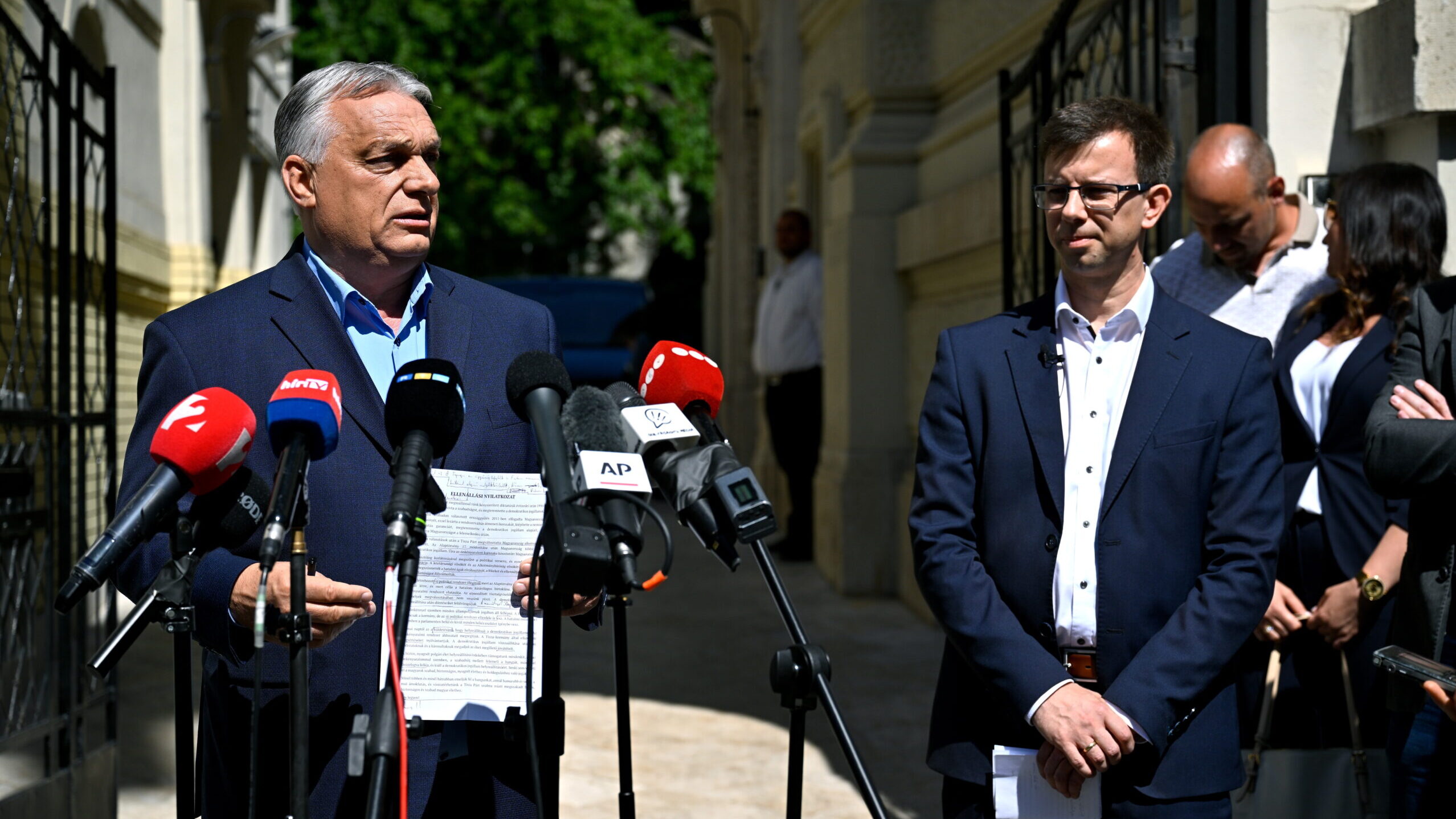
Former Hungarian prime minister Viktor Orbán accused Péter Magyar’s government of creating an ‘illegitimate authoritarian system’ at a press conference outside Fidesz’s Budapest headquarters on Wednesday, 22 July, less than 24 hours after the party published a ‘Declaration of Resistance’ pledging peaceful opposition to Hungary’s new constitutional order.
Appearing alongside János Bóka, former EU affairs minister and Fidesz’s newly elected parliamentary group leader, Orbán said the event had to be held outside because investigators had seized network equipment during Tuesday’s search of the data centre hosting the party’s servers. He alleged that the operation had disabled Fidesz’s systems and was intended to render the opposition incapable of functioning.
Orbán said Hungary had ‘ceased to be a democratic state’ following the 17th amendment to the Fundamental Law. Fidesz would refuse to participate in electing officials replacing those removed under the measure and would resist the alleged abuses peacefully inside and outside parliament. He said the party would become the ‘organizational centre of the resistance’, with further details expected in his Saturday address at Tusványos during his traditional agenda-setting speech.
Adopted by Tisza’s two-thirds majority on 13 July, the amendment ended President Tamás Sulyok’s mandate, imposed a cumulative 12-year term limit on MPs, and set a maximum age of 70 for Constitutional Court judges, forcing court president Péter Polt to retire. Sulyok signed the amendment but said it had inflicted a ‘deep wound’ on constitutional democracy, the separation of powers, and the rule of law.
The changes form part of Magyar’s wider ‘Operation Purgatory’, intended to dismantle what he describes as ‘the political and economic patronage network’ built around Orbán over the past 16 years and investigate the suspected misuse of public assets. Magyar says Tisza received a clear mandate for systemic reform in its April landslide.
While Fidesz’s declaration raises some legitimate concerns, it has nevertheless drawn criticism because it largely reproduces the language used by Orbán’s former opposition, EU institutions, and rights organizations during his 16 years in power—claims Fidesz routinely dismissed as liberal hysteria or foreign interference.
The historical parallels are indeed difficult for Fidesz. Orbán’s government similarly lowered the compulsory retirement age for judges, prosecutors, and notaries from 70 to 62 in 2011, a measure later ruled discriminatory by the Court of Justice of the European Union. It also prematurely ended Supreme Court president András Baka’s mandate, which the European Court of Human Rights found had violated his rights. In both cases, Fidesz, like Tisza today, justified the measures by referring to the popular mandate it had secured at the ballot box.
It is, however, also true that Orbán and Fidesz never went so far as to insert a tailor-made constitutional provision to remove a sitting president.
Criticism of the 17th amendment, however, is not confined to Fidesz. Amnesty International Hungary said Sulyok should be removed only through the existing constitutional procedure and with due-process safeguards. Amnesty, the Hungarian Helsinki Committee, and Human Rights Watch also criticized the targeted changes, the compressed consultation period, and the summary removal of senior office-holders.
Ironically, the same organizations were also persistent and vocal critics of Orbán, whom Fidesz portrayed as foreign-backed political actors and whose room for manoeuvre it significantly restricted.
Fidesz’s declaration was circulated on social media by long-standing Orbán allies, including French National Rally presidential candidate Marine Le Pen, who accused Magyar’s government of dismantling the rule of law in Hungary under the protection of the European Commission. Other politicians associated with Orbán’s Patriots for Europe (PfE), such as Austrian FPÖ MEP Harald Vilimsky, also shared the declaration.
After Fidesz boycotted the parliamentary vote on the amendment on 13 July and labelled it ‘the beginning of tyranny’, Orbán departed for the United States to attend the World Cup final, a decision that also drew criticism for appearing to turn his back on the party during a moment of crisis. Speaking about the trip on Wednesday, he said he had held undisclosed meetings but declined to identify the participants, adding that he conducted negotiations regarding the resistance.
A US report separately claimed that Orbán had visited the White House and the State Department, although the participants and substance of the meetings remain unclear. Previously, Fidesz communications director Bertalan Havasi had rejected reports that a meeting between Orbán and Donald Trump had been planned during the visit.
‘He claimed the investigation was being used as a pretext to seize Fidesz’s servers and legally incapacitate the party’
The press conference followed the raid connected to an investigation into suspected misappropriation at the National Cultural Fund (NKA). The case concerns more than HUF 17 billion (around €46 million) in grants allegedly distributed to performers and organizations linked to Fidesz, some of which campaigned for the party before April’s election. Six current or former officials have been charged and deny wrongdoing.
Orbán called the NKA case a ‘politically contrived proceeding’, saying it was ‘completely obvious’ that those involved in the fund’s decisions had done nothing wrong and had merely distributed money allocated by the government to Hungarian culture.
He claimed the investigation was being used as a pretext to seize Fidesz’s servers and legally incapacitate the party. Prosecutors have not published a full inventory of the equipment or data seized, and no public evidence has shown that Magyar or Tisza directed the operation.
Magyar has so far avoided a detailed response to Fidesz’s declaration. Regarding the server search, he said the government was awaiting information about the case and what had been seized. Tisza rejects accusations of authoritarianism, arguing that its reforms fulfil its electoral mandate to reverse democratic damage and restore accountability.
Related articles:
At a time when public debate is increasingly polarized and superficial, Hungarian Conservative remains committed to depth, intellectual honesty, and independent conservative thought.
Producing high-quality journalism requires resources. Your contribution helps us expand our coverage, reach new audiences, and keep our content accessible.

Please consider supporting our mission.