Argentina’s defeat in the World Cup final has not ended the campaign to punish Lionel Messi’s national team. Instead, at least three separate petitions are attempting to turn anger over refereeing, dangerous challenges, and alleged FIFA favouritism into sporting sanctions—including a permanent ban from future World Cups.
Arguably the most prominent campaign was the ‘Argentina Out’ petition, originally hosted at argentinaout.com. It was reported to have closed after the final with 23,316,108 signatures—just short of the Guinness World Records mark of 24,319,181 signatures for the largest hand-signed petition.
The sheer number of signatures—although, according to the campaign itself, unverified—propelled the initiative into international headlines. However, there are numerous red flags surrounding it: no independent audit has been published, no organizers have been identified or provided contact details, and several basic transparency standards expected of a legitimate petition are absent.
Moreover, the original.com website is no longer accessible, while an almost identical.org version now displays more than 28 million signatures—roughly five million more than the campaign reportedly had when it ended on 19 July.
If that were not enough, another campaign—argentine-out.org—has also emerged. It is significantly smaller but considerably more sophisticated than the first. According to the website, the petition was launched on the day of the World Cup final, and its live counter has already surpassed 660,000 signatures on its way towards a target of one million, indicating exceptionally rapid growth in just four days.
The website also contains an extensive dossier covering disputed refereeing decisions, dangerous challenges, comparisons of FIFA’s treatment of Argentina and other teams in similar disciplinary situations, and questions surrounding the governance of the Argentine Football Association. It calls for Argentina to be suspended from World Cup competition until FIFA publishes an independent review of officiating, on-field conduct, and AFA governance.
A third petition, launched by Omar Tamer on Change.org, has received far less attention, attracting approximately 10,400 verified signatures. It calls for an investigation and argues that Argentina should be disqualified if evidence of favouritism or cheating is established.
Argentina’s Bitter Past of World Cup Controversies
Those backing the petitions point to what they describe as a broader pattern rather than a single controversial decision: an overwhelmingly favourable VAR record, disputed goals and penalty appeals involving Argentina’s opponents, lenient punishment for repeated dangerous challenges, aggressive gamesmanship, and the belief that FIFA wanted Lionel Messi to win what was likely to be his final World Cup.
The most frequently cited example is Argentina’s comeback victory over Egypt. VAR disallowed an Egyptian goal, a late penalty appeal was rejected, and Argentina scored the winner almost immediately afterwards. Lisandro Martínez, Cristian Romero, and Nahuel Molina repeatedly committed dangerous fouls without receiving yellow cards. They further point to Messi’s studs-up challenge on Algeria captain Aïssa Mandi, for which he escaped without a booking, whereas US forward Folarin Balogun was later sent off for a similar challenge during the tournament.
The controversy surrounding Argentina’s ‘rigged’ World Cup run is not new. It dates back to the 2022 tournament in Qatar but intensified after another highly debated campaign by Messi’s side. Argentina’s five penalties during the 2022 World Cup remain the record for a single team in a men’s World Cup.
In fact, Argentina’s controversial reputation stretches back much further. Their triumph at the 1978 World Cup, hosted under the country’s military dictatorship, remains overshadowed by allegations of match-fixing, particularly regarding the 6–0 victory over Peru. Hungarians have particularly bitter memories of the national team’s opening game against the hosts, which they lost 2–1 in a brutally aggressive and physical battle marked by one-sided refereeing in favour of Argentina and two red cards for András Törőcsik and Tibor Nyilasi.
Eight years later came Diego Maradona’s infamous ‘Hand of God’ goal against England—the textbook example of picardía criolla, Argentina’s celebration of streetwise cunning and securing an advantage at the limits of, or beyond, the rules. In football, the concept means deception, provocation, calculated fouling, manipulating the referee and other ‘dark arts’ that they regard as cleverness, but most people see as simply cheating. It’s a tradition, a cultural trait deeply embedded in Argentine society, and in football as well.
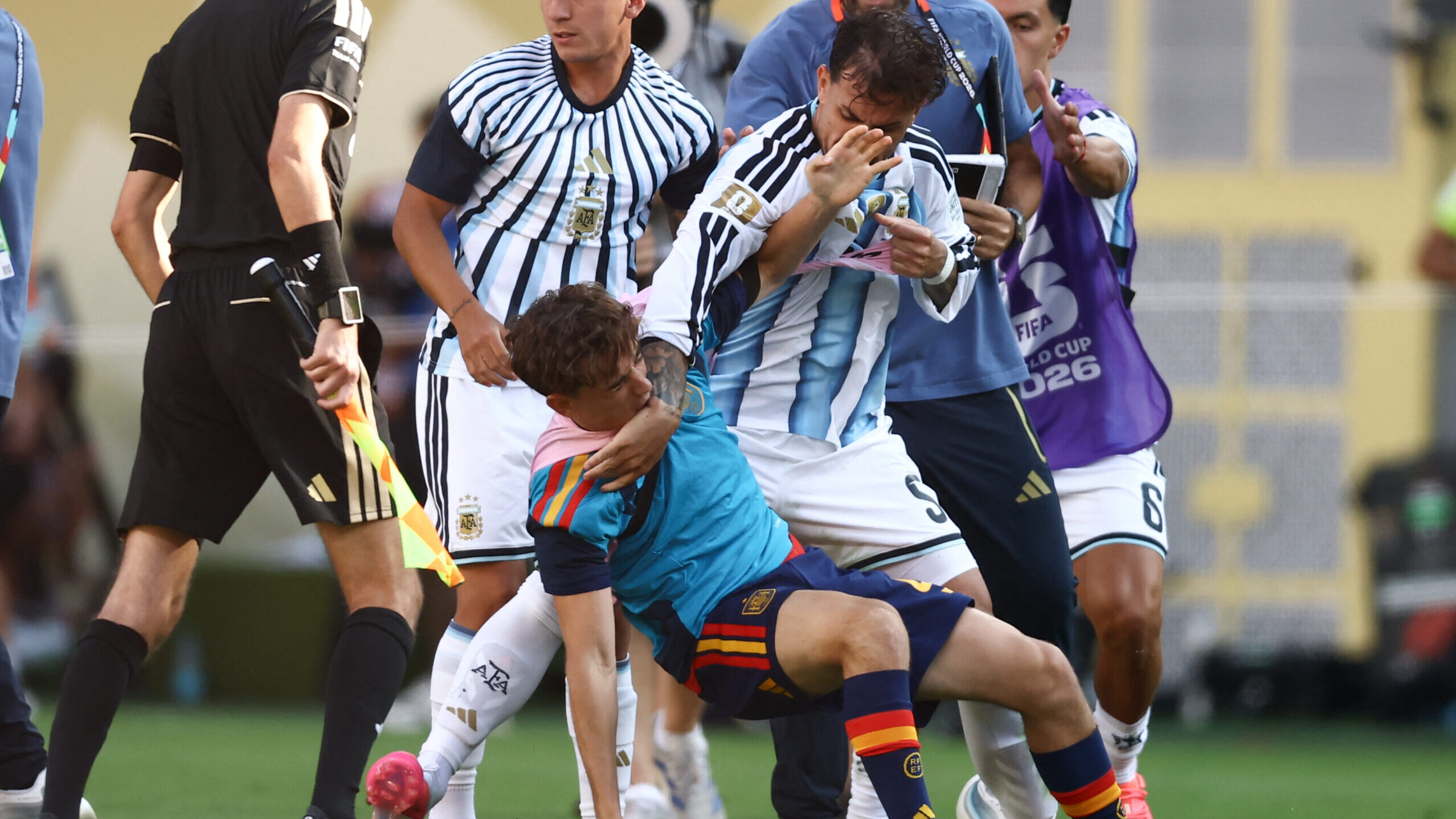
On 19 July, however, Spain ultimately delivered the result that many of Argentina’s critics had long awaited. La Roja won the final 1–0 after extra time thanks to Ferran Torres, but the narrow scoreline disguised Spain’s overwhelming dominance. They monopolized possession and territory, suffocated Messi, closed Argentina’s passing lanes through midfield, and delivered the match’s first 20 attempts on goal. Argentina failed to produce a shot until the 117th minute and finished with just 0.22 expected goals. They also committed 25 fouls, got booked seven times, including a red card for Enzo Fernandez in the 93rd minute. The rampage did not stop with the final whistle, as Leandro Paredes started an ugly fight that turned into a mass brawl. Paredes’ post-match red card raised Argentina’s total number of bookings to eight. With that, the team set the record for the nation with the most red cards in World Cup finals.
Argentine supporters have nevertheless launched a counter-petition of their own. More than 80,000 people have called for the final to be replayed, accusing referee Slavko Vinčić of making ‘corrupt’ decisions, although the campaign has not presented evidence capable of invalidating the result.
Related articles:
At a time when public debate is increasingly polarized and superficial, Hungarian Conservative remains committed to depth, intellectual honesty, and independent conservative thought.
Producing high-quality journalism requires resources. Your contribution helps us expand our coverage, reach new audiences, and keep our content accessible.

Please consider supporting our mission.