
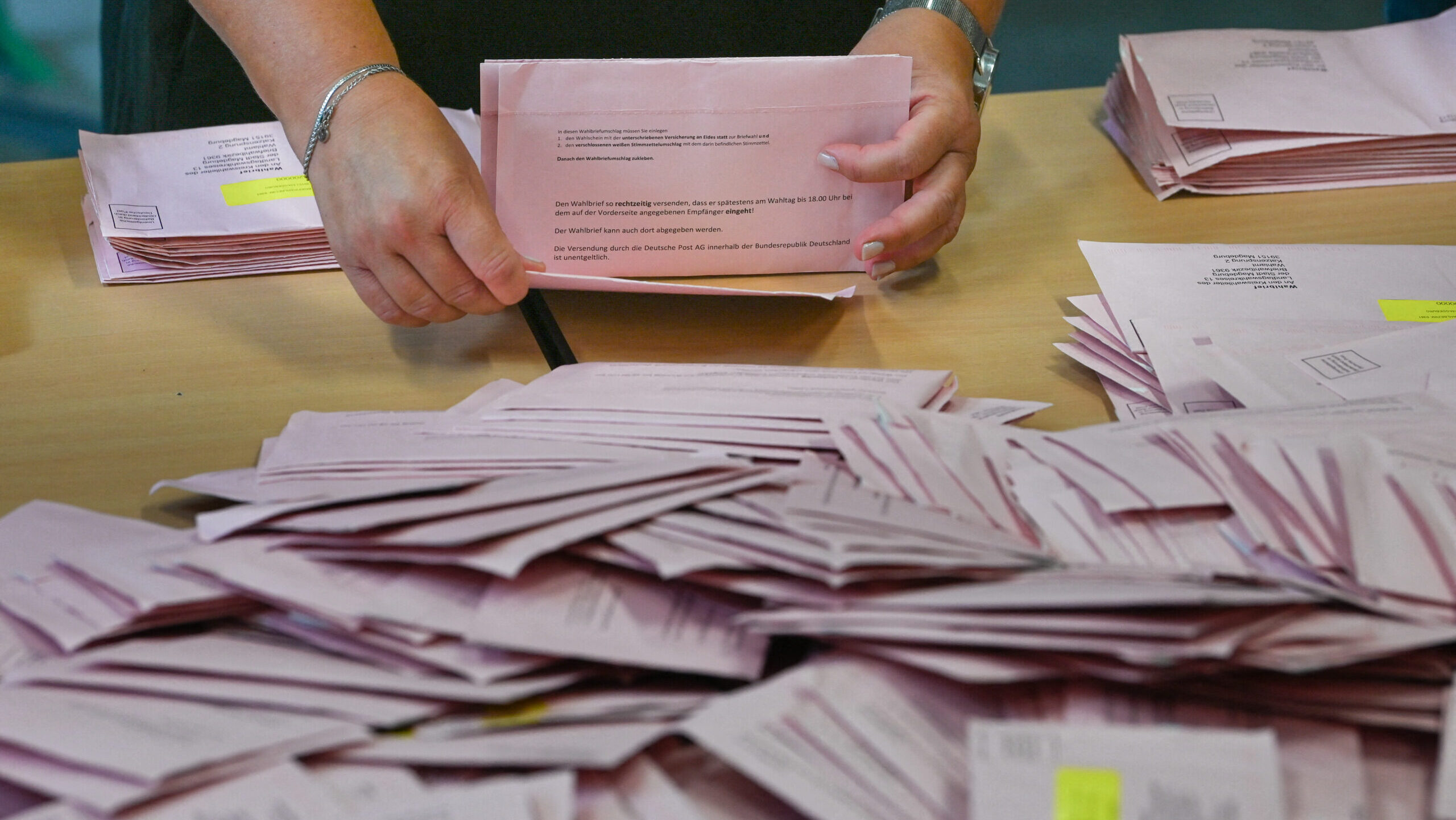
People are increasingly declaring Sunday’s Saxony-Anhalt state election ‘rigged’ after a major controversy erupted in Germany over in-person versus postal-vote data showing that the Alternative für Deutschland (AfD) received an outright majority among voters who cast their ballots in person but less than half that share among postal voters.
According to figures published by the Statistical Office of Saxony-Anhalt, the AfD won 51.2 per cent of second votes at polling stations, compared with only 24.3 per cent among postal voters. The CDU recorded the reverse pattern, taking just 14.5 per cent in person but 24.3 per cent by post. SPD, Greens, Die Linke, and BSW also all performed better among postal voters. Postal ballots made up 27.4 per cent of votes cast.
On top of that, the AfD’s share of postal votes was also higher than that of all the other parties except the CDU, which stood level with the AfD at 24.3 per cent in that category. The gap is extraordinary in scale. Had only in-person votes counted, the right-wing anti-immigration party could have easily won an absolute majority, finishing 36.7 percentage points ahead of the CDU.
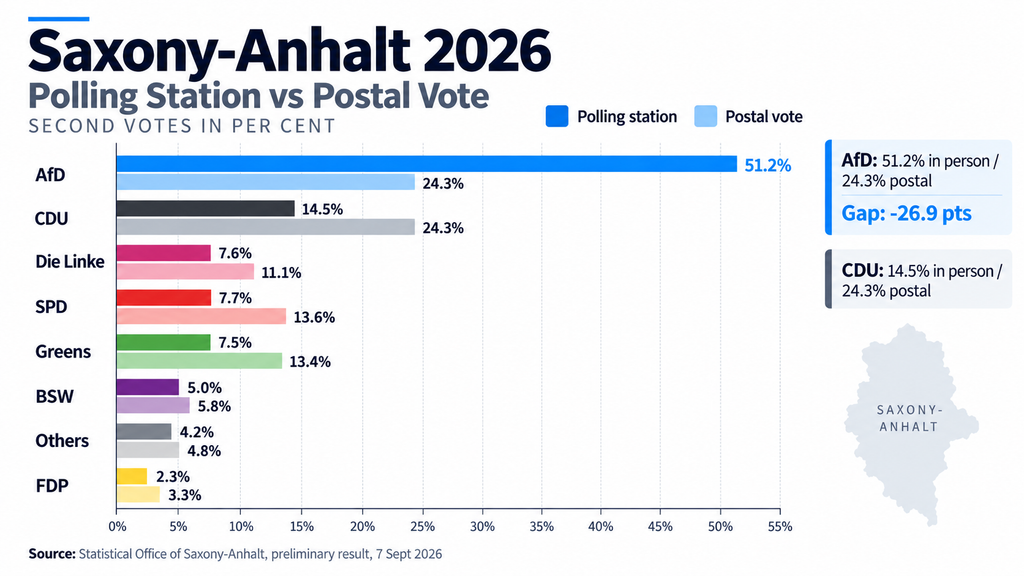
The trend, however, is not unprecedented, in the sense that the AfD has repeatedly performed considerably worse in postal voting in previous elections, and the party itself opposes postal voting.
Once postal ballots were included, the AfD finished on 43.8 per cent and 39 of the 83 seats in the Landtag, compared with 17.2 per cent and 15 seats for the CDU. As Hungarian Conservative reported on Monday, the CDU, SPD, Greens, and Die Linke together also hold 39 seats, while the Bündnis Sahra Wagenknecht (BSW) won five. With 42 needed for a majority, the landslide therefore produced a 39–39–5 deadlock and left BSW as kingmaker.
The postal split has nevertheless triggered a wave of outrage across Germany’s right-wing media and social media. Tichys Einblick described the divergence as a ‘dramatic deviation’, while political commentator Alexander Wallasch published lawyer Dirk Schmitz’s demand for all 511 mail-in districts to be recounted and investigated. Others have called for restrictions on—or the outright abolition of—postal voting.
Austrian activist Martin Sellner joined the backlash on X, writing that ‘without mail-in ballots, the AfD would have won 51% of the vote and secured an absolute majority’, before arguing that postal voting was ‘easily manipulated’ and should be banned.
That would not be without precedent. France abolished ordinary postal voting for political elections in 1975 following repeated cases of fraud. In a later official parliamentary answer, the French Interior Ministry said all political tendencies represented in parliament had condemned the system because it had generated ‘numerous frauds’, while there was no absolute guarantee that the ballot sent by a voter was the one eventually placed in the ballot box.
Mail voting has been similarly controversial in the United States, particularly since the 2020 presidential election. Donald Trump has repeatedly described the system as vulnerable to abuse, and in August 2025 said Republicans would ‘do everything possible’ to get rid of mail-in ballots before the 2026 midterms. His administration has since pursued tighter postal-ballot procedures, including new USPS verification requirements now caught up in federal litigation.
Mainstream media immediately pushed back against the fraud accusations. ARD’s fact-finder acknowledged that the 51.2-to-24.3 figures are correct but stressed that AfD underperformance among postal voters is a recurring pattern. Welt similarly pointed to demographic differences between the two electorates and the AfD’s own efforts to encourage supporters to vote in person.
Related articles:
At a time when public debate is increasingly polarized and superficial, Hungarian Conservative remains committed to depth, intellectual honesty, and independent conservative thought.
Producing high-quality journalism requires resources. Your contribution helps us expand our coverage, reach new audiences, and keep our content accessible.

Please consider supporting our mission.