
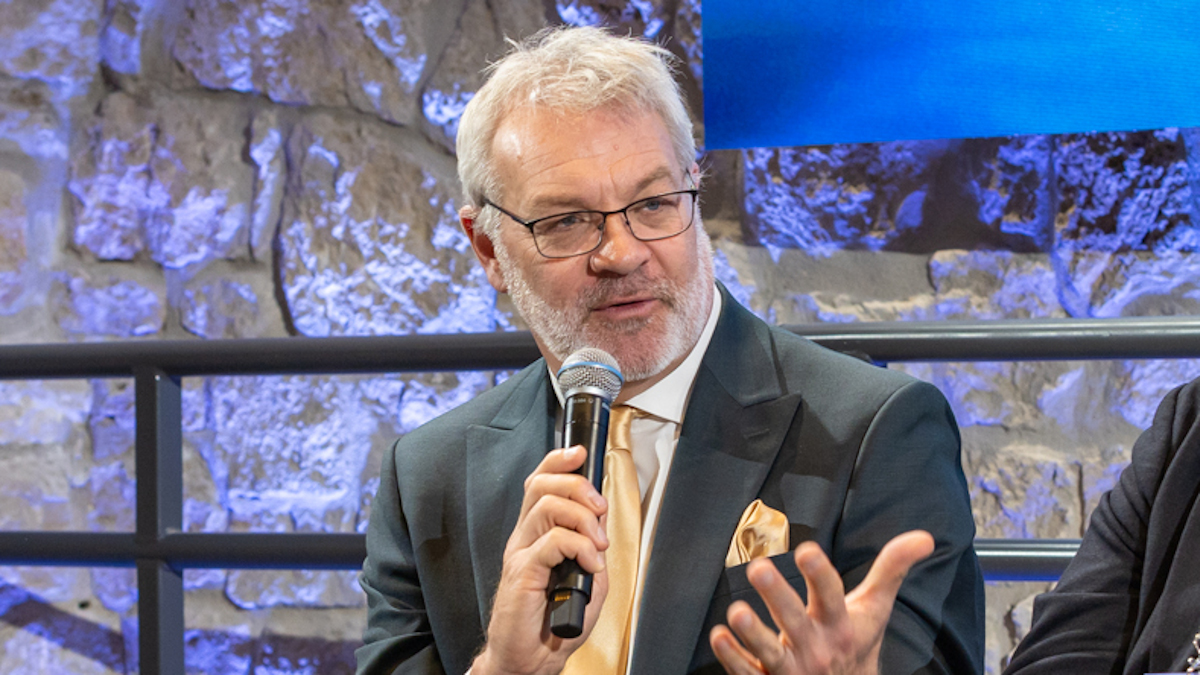
Scott Yenor is Director of the B. Kenneth Simon Center for American Studies at The Heritage Foundation. He is also Professor of Political Science at Boise State University, where he teaches political philosophy and constitutional law. He completed his undergraduate studies at the University of Wisconsin–Eau Claire and earned a PhD in political science and government from Loyola University Chicago. Yenor was a Visiting Fellow at the Simon Center from 2015 to 2016. He writes primarily on the family, higher education reform, and a range of related issues, and is the author of two books on family policy.
***
I have searched for your name on Facebook, and I was surprised that one video came up at least in 20 versions, all of them having similar comments about you as a rude man. Do you know which video I saw?
Yeah.
What was that?
That was a speech from the National conservatism conference in 2021, I think.
Exactly.
Where I spoke about how feminism is one of the obstacles to building healthy families and modern societies. The talk began with a line that great nations require great families, and you can’t have great families under conditions of feminism.
For a feminist’s ear, your speech was a bit toxic, as they call it. In this speech, you called professional or carrierist women ‘medicated, meddlesome, and quarrelsome’, and another quotation: ‘If we want a great nation, we should be preparing young women to become mothers.’
Both those things were said in the speech.
What did you want to emphasize in this speech?
Family life is a question of priority. There’s a lot of good things in the world, like working is good, using your faculties is good, being a great artist is good. But also being a good mother and good father are good. And most of our educational system, and basically the cultural messaging that we have, never emphasizes for girls that it’s important to be a mother and a wife. So, my hope would be that we could emphasize that being a mother, being a wife can be a priority in people’s lives. Someone has to call out the corrupt cultural messaging that we have, and that’s what I tried to do in the speech. And when you ignore the calls of nature and don’t prioritize building communities or relationships between men and women, women are less happy, and they look for replacements. That’s what I meant when I said that women are more medicated, meddlesome and quarrelsome than they need to be—that generally, the unhappiness is given some sort of medical explanation, and politics ends up being something that fills the void that is left in their lives. So, politics end up having a higher priority than family life, and avoiding family life ends up being something that is extremely important to them.
‘So, my hope would be that we could emphasize that being a mother, being a wife can be a priority in people’s lives’
Some comments under the video: ‘Misogynist, bigot, white Christian nationalist,’ ‘you humiliate women,’ ‘you see a woman’s role in society as secondary to men’s,’ ‘you undermine women’s autonomy and equal participation in public life.’ What is your reflection on this criticism?
There’s a powerful ideology that controls the commanding heights of America’s culture, and that ideology is feminism. And if you go after it; if you say that it’s not a complete picture of what a man or a woman is, then you’re going to be called names. And that, to me, suggests that my position is basically what every human being thought before the 1960s, and how many human beings still act. And to me, they’re the historical outliers. I think that the position where you can be an ‘and’ guy, where you can say working and motherhood, citizenship and wifeliness are both priorities for human beings is going to be vindicated. It’s the key to a good life in the modern world. So, I feel pretty good about what I’ve said.
Is the American mindset past the point of no return in terms of how the ideologies you mentioned shape thinking about issues such as family, gender, and social roles?
I think some changes are happening on the political right on this matter. Definitely, men seem to think that feminism has gone too far. Majorities of both Republican men and Democratic men think that feminism has not been, on the whole, a force for good in America, and, increasingly, women on the right agree with that. That’s not a majority, but something is happening. So, the way I would characterize it is that in America, there ends up being two different family ecosystems. There is a conservative one and a progressive one, and they live increasingly different kinds of lives with different priorities. And the gap is getting bigger.
In the 1980s, the way that Democrats and Republicans acted in their lives and what they thought about their lives weren’t that different. They had the same number of kids. They married at the same rates. They divorced basically at the same rates. That’s changed a lot. Democratic birth rates are like Japan type numbers, whereas Republican birth rates are like replacement type numbers. As for marriage rates: more people are more open to it on the right, and they get married a few years younger on average than progressives. So, the behaviour is starting to change, but I don’t think it’s the point of no return. I think that there’s a self-correcting going on, and it has a plus and a minus. The plus is that people are changing their behaviours, re-evaluating their priorities, and getting more conscious about how they have to swim against the tide in order to do this. The downside is that families become much more of a partisan issue. So, the Democratic Party is just kind of a non-family, and the Republican Party is becoming the pro-family party.
‘There is a conservative one and a progressive one, and they live increasingly different kinds of lives with different priorities’
The zeitgeist favours the Democratic view of life, doesn’t it? But some say there is a renaissance among the American youngsters to return to traditional family values. Which statement is true in America?
Actually, both of those things are true. There’s a segment of the people under 30 that are returning to neo-traditionalism when it comes to family life; it’s becoming more acceptable to question the premises of feminism. But one of the reasons it’s happening is that the spirit of the age is pointing in the other direction very strongly, and people are recognizing that they face a starker choice than they otherwise knew that they were facing.
Is the institution of the family in crisis?
Thinking about family policy, family crisis is that governments do not force people to marry, do not force people to have children. So, everything happens kind of indirectly. There’s support for family in nature: men and women are attracted to one another, and men gravitate towards certain roles in life, just like women gravitate towards certain roles in life. And things are cross cultural: they happen at all the places that human beings come together. The things in your political environment can either encourage or discourage your ability to act on the basis of those natural passions. And the definition of the family crisis is that there are obstacles in the way of people being able to act on the basis of those natural passions, which means other passions replace them, and people are drifting away from family life. The challenge of family policy is to remove obstacles and replace them with support. So, for instance, many think that social media is one of these things that misshapes people’s perceptions of themselves and their expectations for the other sex. It makes it difficult for women to prioritize relationships. Most countries want to do something about this; they’re trying to find alternative ways of supporting the family, like tax credits or ability to buy houses and things like that.
What are the obstacles that prevent women from fulfilling the role of a woman?
Formal education systems, mentors rarely raise the question: what do you want your life to be like when you’re 40? And then the follow-up question is: what are you doing to make that happen? Most people actually expect to be married, and most people actually expect to have children. They have fewer children than they expect to have, and fewer marry than want to marry. I think that’s because we’re prevented by respectable opinion from asking young girls how they are going to make their life goals achievable. What are they doing to make themselves ready for marriage instead of what are you doing to make yourself acceptable for law school or acceptable to work in human resources or something like that? I’m not against career preparation. But it should be like family preparation, it should be something that parents think about, the churches think about, and that schools do not ignore.
What are the obstacles that prevent men from fulfilling the role of a man?
It’s the flip side of the kind of preparation for girls that we have this idea of marriage, which is called the capstone idea of marriage—that is, that you’ve achieved all of the things that you need to achieve, and now that you’ve achieved those in the workplace, you can be ready for marriage. And that automatically means later marriage. You have to be established in your career, you have to own a house, and then you get married. Well, the old idea, I think, is a different model, which I call the foundational idea of marriage, which is that you get married before you arrive, and you arrive through marriage.
‘They have fewer children than they expect to have, and fewer marry than want to marry’
I got married at 22 and we started having kids at 24. You know, we arrived through it. It was a foundation of our life. We grew together, and we learned how to live together as we learned how to grow up. I do think that the other model is available, and people are feeling that this is part of the counter-cultural stuff that’s happening on the American right. So, when you look at polls in America, and you ask parents: what do you want for your daughters, being a wife and a mother almost always ranks near the bottom of priorities for parents. When you ask parents what they want for their sons, being a husband and a father is usually in the middle. When you ask the actual boys and girls, for girls, marriage and motherhood is really low, while for young men, it’s middle or high.
Some experts say that the crisis of the family is rather a crisis of marriage. It’s very difficult to find a partner, and to get married.
Yeah, it’s a big deal. Marriage among those with college degrees is not as healthy as it was in the 1980s, but it’s not bad. 70 per cent of college graduates marry, and the divorce rates are much lower among college graduates in the United States than they are among those without college. There are fewer spaces for men and women to get to know one another. At least the data never suggests that the bars were a big place, but churches were a big place, and civic organizations, schools and work places were all big places, and now those places all have shrunk in importance compared to internet ways of getting to know one another, which are alienating for both men and women in different ways. Eventually, men and women marry, though it’s later and later if they’re college graduates.
The bigger crisis is among those without college degrees. Their marriage rate is about 50 per cent in the United States. These guys don’t seem to have the virtues necessary for stability in life, to be providers; the opportunities have vanished. People without stable jobs, like in manufacturing and service industries end up having pretty low attractiveness. It takes two not to dance, and there’s equivalent feminine problems, and maybe these are cultivated by social media.
What can the government do to help families?
There are lots of obstacles that the state could really help remove. One of them, I think, is internet pornography. And internet pornography is one of these things that really became prevalent in the 2010s, about the same time that the dating crisis and the birth rate crisis happened. Internet pornography is easily accessible, young men consume a lot of it, and it’s the foundation for reasonable suspicion between the sexes. We’ve always had civilizational laws against obscenity, and as technological advances arrived, we’ve always adapted our laws to those advances in technology. When books became prevalent, we started regulating books for obscene material. Then when radio happened, and then television and cable television and movies, all of them had codes and regulations that were in place so that the obscene material, pornographic material wouldn’t warp the minds of mostly young men. Then suddenly, with the advent of the Internet, we had more pornography than we’ve ever had, with less regulation than we’ve ever had, and it is something that really affects sexual relations between men and women. And it’s as big of a deal for men as social media probably is for young girls. And it can be regulated in the United States. We’ve implemented in some states at least age verification laws. But we can go after the producers and distributors of hardcore pornography, we just choose not to do it.
‘We’ve always had civilizational laws against obscenity, and as technological advances arrived, we’ve always adapted our laws to those advances in technology’
What measures of Hungarian family policies can be noteworthy for an American?
I especially think the housing allowances are crucial. And I think they move the needle in big ways here in Hungary when it comes to increasing home ownership, which is one of these indirect supports for family life. I think some of the lessons from it is that it’s going to be difficult to have any kind of decent family policy without such support. But is that support enough? Can you do the support for families without removing more obstacles in the environment which misshape people’s passions and natural inclinations away from family life? That’s a long term project. Israel had very low birth rates and lower marriage rates in the 2000s, and they didn’t change any of their supporting policies. What happened in Israel is a change of spirit, and it was like a real spirit of nationalism about how important the state was. And that’s why I think that ultimately, the family’s future is connected to the nation’s future. Both of them rise and fall together as confidence and hope in your nation rises and falls. So will marriage. So, the support that Hungary has shown, and a lot of the spiritedness in defence of the country’s sovereignty, I think they go together, and they point toward the desire to have a future. And I think that’s the crucial aspect of turning the tide on these things. I think the spirit matters.
You can watch the full podcast here.
Read more of our interviews:
At a time when public debate is increasingly polarized and superficial, Hungarian Conservative remains committed to depth, intellectual honesty, and independent conservative thought.
Producing high-quality journalism requires resources. Your contribution helps us expand our coverage, reach new audiences, and keep our content accessible.

Please consider supporting our mission.