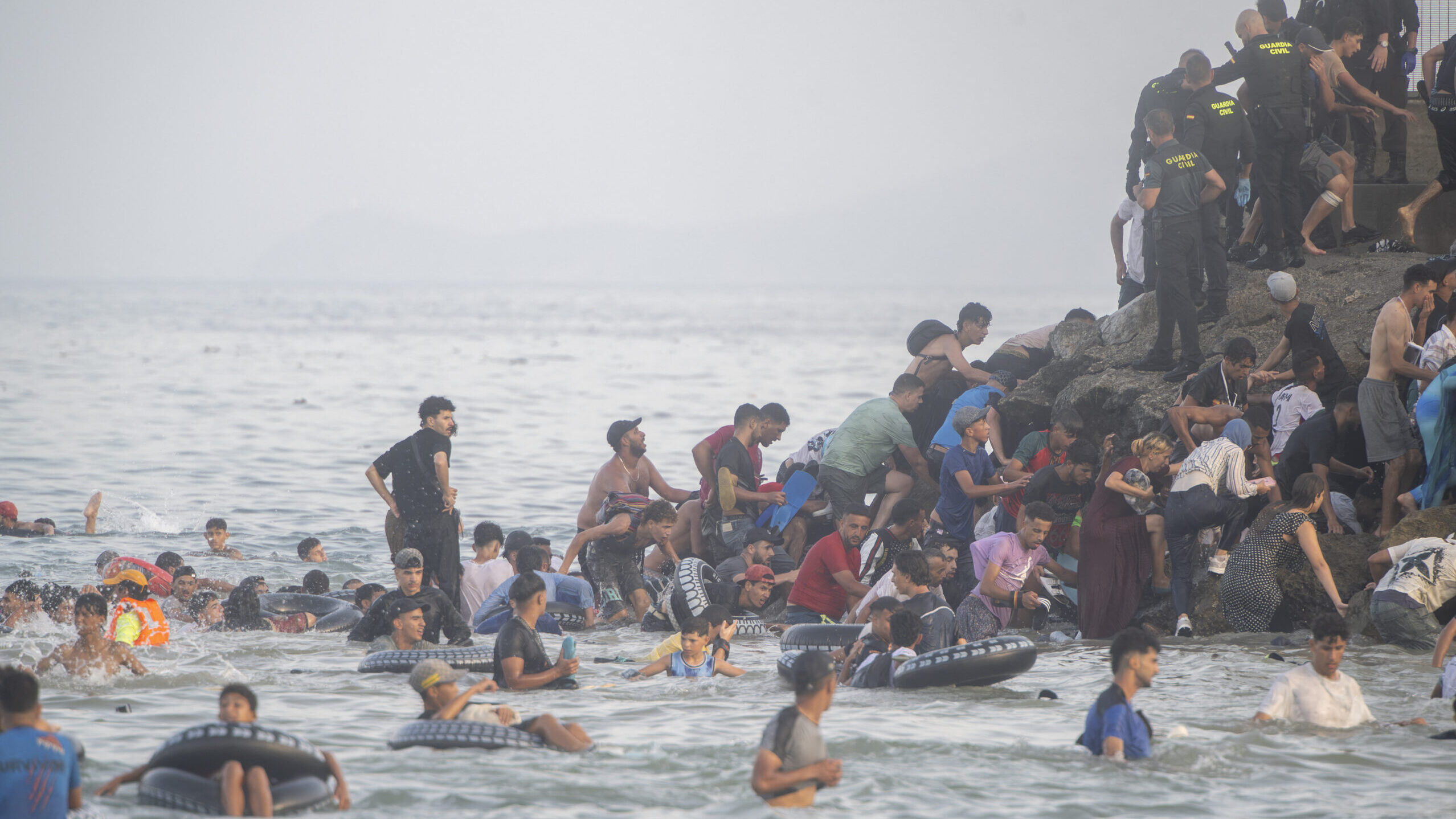
Italian intelligence has warned that another mass illegal invasion from Morocco into Ceuta could begin within days, possibly before the already widely circulated 15 August date, as security services track a reignited online campaign similar to the one that preceded the 30 July wave, when around 80,000 illegal migrants flooded the Spanish enclave of 84,000.
The report, drawing partly on information shared by Spain’s intelligence agency, CNI, says Italian services have detected what they describe as a ‘coordinating hand’ behind the new mobilization, although it has not been attributed to any specific actor. Private WhatsApp messages monitored by the services include calls to invade Ceuta on 10 August, while TikTok accounts are being used to funnel users into WhatsApp chats and Facebook groups.
The same networks are also being exploited by human smugglers, according to the report. The dossier separately describes the jihadist-security risk around Ceuta as ‘concrete’.
The warning follows a six-page assessment by Spain’s Guardia Civil, which concluded that the new call is real, active and ‘potentially mobilizing’. CNI separately told Cadena SER on 6 August that it gave ‘full credibility’ to the campaign and did not rule out organizers bringing the attempt forward after publicity around the 15 August date removed the element of surprise. The Guardia Civil said the movement is not demonstrably spontaneous, but stressed that neither its size nor its organizers have been established. It said Morocco could not be identified as having any role in the operation; nevertheless, during the first invasion wave, Moroccan authorities were suspected of at least loosening border security and allowing migrants to pass into Ceuta easily.
‘The aftermath has left Ceuta’s reception system badly overstretched, sparking chaotic scenes across the enclave’
The scale of the 30 July wave and its consequences are hard to ignore, yet the numbers coming from Pedro Sánchez’s government differ from those reported by the local administration and NGOs. Madrid estimates that 72,000 crossed into Ceuta, while the Mayor-President of the enclave put the number at around 80,000. How many of them remained is also disputed: the Interior Ministry claims that 70,000 returned almost immediately over the following days, while the city administration said that 6,000–8,000 migrants were still in Ceuta.
The aftermath has left Ceuta’s reception system badly overstretched, sparking chaotic scenes across the enclave. Many of those who remained are unaccompanied minors, with NGO estimates reaching as high as 7,000. The reception centre is operating at 2,600 per cent of its normal capacity, while additional emergency facilities have been set up in schools and churches. Prosecutors have already opened preliminary proceedings into alleged rapes involving at least five migrant girls, all of them aged 14 or younger, while police separately confirmed an investigation into one complaint in which the suspected perpetrator was believed to have entered during the 30 July wave.
As intelligence reports point to a potential second wave as soon as Monday, 10 August, evidence increasingly suggests that the first one was also organized and amplified online in a similar way. An investigation reported by El País concluded that it was a deliberately coordinated operation built through closed messaging groups, large Facebook networks and local recruiters.
Reuters found that viral posts falsely presented a Supreme Court ruling restricting immediate maritime pushbacks as meaning that migrants could not be returned, while other misinformation claimed that Sánchez’s mass regularization programme was still receiving new applicants. CNI also reportedly warned the Interior Ministry beforehand of a serious risk of mass entry, although the government denied receiving a warning about the eventual scale of the invasion.
‘An investigation reported by El País concluded that it was a deliberately coordinated operation’
Italy was already among the most vocal critics of Madrid’s handling of the crisis among EU member states, with Prime Minister Giorgia Meloni announcing the immediate restoration of temporary checks on non-EU nationals arriving from Spain on 1 August, citing security concerns. Madrid called the move ‘unjustified and discriminatory’ and, after Rome rejected an ultimatum to withdraw it, imposed reciprocal checks from 8 August. Meloni’s government says its controls will remain in place at least until 15 August.
Spain is now reinforcing Ceuta with additional riot police, Guardia Civil units, boats, drones and a helicopter, while the Guardia Civil says Moroccan action around Fnideq, roads and the coast will be decisive in stopping another mass movement before it reaches the border. Both the Commission and Madrid have proposed increased financial support for Rabat to reinforce its border protection ahead of the next possible wave.
Related articles:
At a time when public debate is increasingly polarized and superficial, Hungarian Conservative remains committed to depth, intellectual honesty, and independent conservative thought.
Producing high-quality journalism requires resources. Your contribution helps us expand our coverage, reach new audiences, and keep our content accessible.

Please consider supporting our mission.