Thirty-five-year-old Ulrich Siegmund enters Sunday’s state election in Saxony-Anhalt closer than any Alternative für Deutschland (AfD) politician before him to taking control of a German state government. Around 1.7 million voters are eligible to cast ballots between 8 am and 6 pm, with the AfD heading into election day on 41–43 per cent against just 22–23 per cent for the governing Christian Democratic Union (CDU).
First place, after an indeed remarkable shift since 2021, is therefore no longer in doubt: the question is whether the AfD’s wide lead can be converted into an absolute majority of seats.
In 2021, the CDU won Saxony-Anhalt with 37.1 per cent, while the AfD finished second on 20.8 per cent. The final major polls ahead of Sunday put the AfD at roughly double its previous result and the CDU around 14–15 points below its 2021 score. The latest ZDF/Forschungsgruppe Wahlen projection puts the AfD at 41, CDU 23, Linke 11.5, Social Democrats 8.5, Greens 6, BSW 4, and FDP 3 per cent; Infratest dimap puts the AfD at 42 and CDU at 22.
That makes the 5-per-cent threshold potentially decisive. According to the electoral law, parties below it are excluded from the proportional allocation of seats, meaning the AfD does not necessarily need 50 per cent of all votes to secure more than half of the Landtag. The greater the share cast for parties that fail to enter parliament, the larger the AfD’s effective weight among represented parties.
This is where Sahra Wagenknecht’s BSW becomes an unlikely hinge. All three final major polls place the party at exactly 4 per cent, just below the threshold, while the Greens sit precariously on 5–6 per cent. Under the ZDF numbers, if BSW and FDP, on 3 per cent, miss out but the Greens survive, the AfD’s 41 per cent becomes about 45.6 per cent of votes cast for qualifying parties. Under INSA’s 43 per cent figure, with the Greens on exactly 5, the equivalent share is about 48.3 per cent. If both BSW and the Greens fell below five, however, that same 43 per cent would amount to just over 51 per cent among qualifying parties.
‘AfD does not necessarily need 50 per cent of all votes to secure more than half of the Landtag’
BSW matters also for another reason. Its Saxony-Anhalt leadership has explicitly rejected the traditional anti-AfD Brandmauer. Under the ‘Magdeburger Weg’ presented in August, the party wants a non-party minister-president governing through shifting, issue-by-issue parliamentary majorities rather than fixed blocs. Lead candidate Claudia Wittig said on Friday that BSW would support neither Siegmund nor incumbent CDU premier Sven Schulze, but the party has also floated abstaining in a later minister-president ballot if the other parties reject its model.
That creates an unusual paradox. BSW entering the Landtag would make an outright AfD seat majority harder, but its presence could simultaneously weaken the firewall designed to keep the AfD from executive power. Under the state constitution, the first two ballots for minister-president require a majority of all MPs. If both fail and parliament does not vote for early dissolution, a subsequent ballot requires only a majority of votes cast, making abstentions potentially decisive.
Siegmund has nevertheless ruled out relying on such a manoeuvre. He said on 4 September that he would seek the premiership only if the AfD secures an absolute majority and can govern alone. The CDU, meanwhile, excludes coalitions with both the AfD and Linke, leaving Schulze facing a difficult minority or broader arrangement that would likely require some form of Linke support if current polling translates into seats.
Turnout will be equally important and equally uncertain. Saxony-Anhalt has historically recorded unusually low participation and large last-minute polling swings, with 26 per cent of respondents still unsure whom—or whether—they will vote for.
Another factor to watch will be the geographical distribution of the vote: the AfD dominated rural and small-town constituencies in the 2025 federal election, while its weakest results came in Halle and Magdeburg, where the Greens and Linke are strongest. Strong urban mobilization could therefore help keep the Greens above five per cent; weak turnout there, coupled with heavy AfD mobilization elsewhere, would make Siegmund’s route to an outright majority easier.
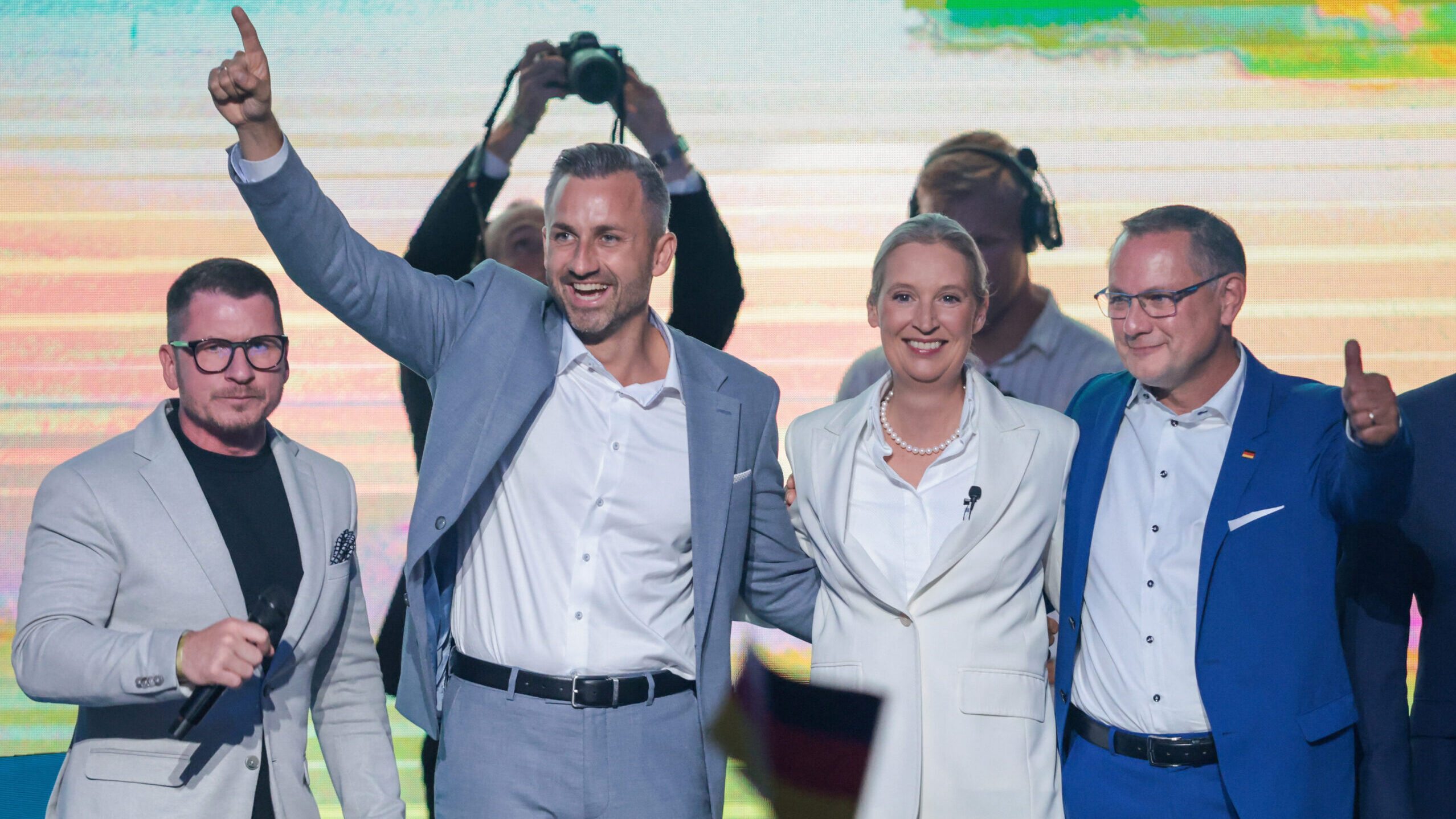
The AfD closed its campaign in Magdeburg on Saturday, with Siegmund joined by co-chairs Alice Weidel and Tino Chrupalla. In her final appeal ahead of the vote, Weidel cast the election as having significance far beyond Saxony-Anhalt, declaring that ‘the future of Germany’ was at stake and arguing that an absolute majority for Siegmund and the AfD was ‘almost the only chance’ to reverse course.
Related articles:
At a time when public debate is increasingly polarized and superficial, Hungarian Conservative remains committed to depth, intellectual honesty, and independent conservative thought.
Producing high-quality journalism requires resources. Your contribution helps us expand our coverage, reach new audiences, and keep our content accessible.

Please consider supporting our mission.