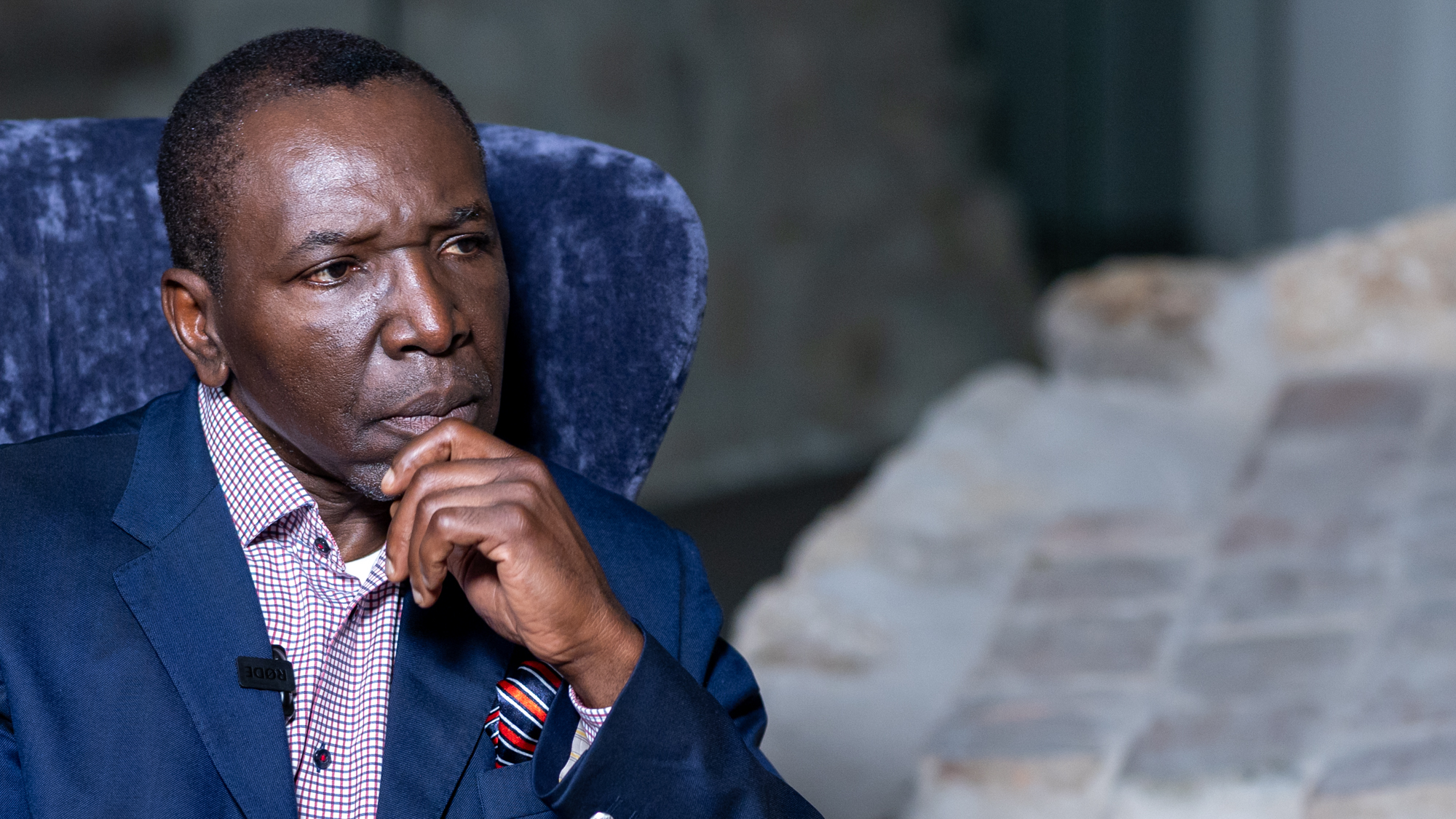
Rock Missamou is a water management expert at the Department of Water and Environmental Policy and a UNESCO Chair at the University of Public Service, Budapest. He holds an MSc in International Water Governance and Water Diplomacy, with expertise in water as a catalyst for peace-building, climate resilience, and sustainable development. His work bridges Europe and Africa, advancing water-based solutions to migration, youth empowerment, and conflict prevention. He is based in Budapest and holds dual citizenship in Hungary and the Republic of Congo.
***
According to Greenpeace data, 5.5 billion of the world’s eight billion people in 186 countries face some form of water insecurity today. How many people are affected by critical water shortages in Africa?
First of all, Africa is a bloc of 54 countries, each with its own specificities: cultural, economic, and traditional, and some of them have their own legislation. Secondly, it is very important to consider how African countries have been decolonized, because some have been formally decolonized, while others have been structurally decolonized. All these elements determine the way African countries handle water issues, and it is also important to consider the quality of their institutions. According to the World Health Organization and the Food and Agriculture Organization, roughly 500 to 600 million people in Africa suffer from limited access to drinkable water, although this figure may be higher; we would estimate it at around 800 million people.
What are the most affected regions or countries, and why?
My methodology consists of segmenting, fragmenting the countries and grouping them into clusters, because the geographical proximity triggers political and cultural proximity, and then it is very easy to analyse them that way. Africa has five clusters. To these clusters, I am going to apply three parameters for analysis. The first one would be empirical data, which provides an overview of the available volume of water for human use per year. The second one is the quality of the institutions in the country, and the third one would be how those countries have been decolonized. Can I start?
Yes.
Okay. The first is the Northern African cluster: very dry, plus-minus 50 degrees, poor vegetation, and there is a water scarcity. Institutions are not too strong, and not too weak. There is a water governance system in place, which is not strongly applied. These countries have been decolonized formally (except Morocco and Algeria), which means that they have existing institutions which have been established by the former colonial power. The population migrates: 70 per cent to the Middle East and 30 per cent to Europe.
‘Roughly 500 to 600 million people in Africa suffer from limited access to drinkable water’
The second cluster is Eastern Africa. It is influenced by the climate coming from the Indian Ocean, and they also have some areas which are very dry. Half of the area has water scarcity, and the other half has water stress. They have been decolonized structurally; they have their own institutional systems. They migrate, but it’s an intra-cluster migration; they don’t migrate out of the cluster.
The third cluster is Western Africa. Some of these countries are very close to the Sahel Desert, and they are suffering from water stress, and some of them from water scarcities, but those countries on the Atlantic Ocean have an excess of water, and they have rain. In those countries, there is an economic water scarcity, which means that the infrastructure is not adequate to distribute portable water to the population. They have been decolonized formally, and they migrate extra-cluster, 30 per cent towards Europe.
The next cluster is Central Africa. The Congo Basin has an excess of water, and it’s very green. The institutions are very weak and poor; the network distribution system is very obsolete and not maintained. They have been decolonized formally, and they migrate extra-continentally, towards Europe.
The last one is Southern Africa. The system is very stable, and the vegetation is very rich. They have been decolonized structurally, so they have their own institutions, which are very strong, and they apply strong water management policies. They almost don’t migrate, so it’s an intra-cluster migration.
Thank you, we have the big picture now. Is there a visible trend indicating that climate change really affects the cycle of water shortage, hunger, and diseases?
You know it’s very easy to single-point on climate change for explaining all the deficiencies that our societies are going through. Climate change is not a phenomenon that comes from the sky and then impacts people. Climate change interacts with the weakest point of the non-resilient societies. It interacts with poverty, with corruption, with poor governance, and with the boom of the population. So, when a society has not been resilient enough to create the right mechanism for stabilizing its social life, climate change will come and magnify those weak points. Climate change is not necessarily responsible for everything. We are responsible for the way we handle society.
‘Climate change interacts with the weakest point of the non-resilient societies’
In case of drought, the problem is that you will have a quick evaporation of water, and that would lead to the destruction of crops, which would lead to hunger. So, as long as you don’t develop sustainable and strong solutions to preserve your agricultural crops, climate change will destroy them. When you have an extreme flood, the flood will damage the dams and the sanitation systems, and if the sanitation systems are damaged, that will pollute the underground water, which will pollute the portable water, which will pollute the fresh water, and that will lead to the spread of disease. This is a chain of interactions.
What methods can experts use to ease the consequences of water shortages?
If we come to climate change as a complex problem, the complexity of the problem has to be solved by different types of experts with a multidisciplinary approach. There are certain areas where things are progressing well. What do we need to stabilize the situation? Number one, I see the intervention of water operation and water management experts, and environmental experts. We need them to intervene and also to preserve the aquifers somehow. Number two, I see the intervention of water governance experts. It’s important to ensure that for all transboundary rivers, there are transboundary frame agreements between those countries to ensure that the water allocation between countries is done properly. We need to solve the administrative cacophony because water institutions are fragmented across different layers, and those decisions can conflict. Number three, education—we have to understand that better education is key. We have to invest more in this. Number four, financial experts should be capable of bringing in the right bankable projects.
The last one: communities. The communities in Africa have to own the water problems. They have to be included in the decision-making process, so that decisions which are taken are adapted to the reality of the field. Communities have to protect the aquifers. Communities have to pass on to the young generation the messages about the sacredness of the water. In Africa, water is sacred; it’s something which has a spiritual dimension. But unfortunately, we have a new generation, which might be the digital generation, and they are less attached to those values.
Can you name some African countries that are the worst affected by this complex situation?
I’m not going to name countries as such, but I will give you the clusters.
Which cluster is that?
Central Africa.
‘In Africa, water is sacred; it’s something which has a spiritual dimension’
You are from there, right?
I am from there. Central Africa cluster, in terms of governance, and in terms of quality of the institutions, is the poorest, because this is the cluster of paradoxes. This is the richest cluster in water, vegetation, underground and surface water, but this is the driest cluster in terms of availability of drinkable water in those areas. This is a consequence of bad governance. It’s due to certain inconsistencies in the application of procedures, which would normally stabilize a society.
How does climate change redraw the demographic map of the African continent?
Broader climate change is impacting the demography in Africa. We need to understand the context. How do Africans migrate? They migrate from the remote areas where the economic opportunities are almost zero because of the exacerbation of climate change issues. They move to big cities, from that big city, they move to another big city. So, it is an intra-country migration. If the situation gets worse, they will migrate from that country to another, so it becomes an inter-country migration. If in that country the situation is still getting worse, then they will migrate to another cluster, and then it becomes an intra-cluster migration. And if in that cluster the problem is getting really disastrous, then they will move out of the continent, and it becomes an extra-continental migration.
We saw the 2015 migration crisis and what followed it. How serious is the situation now in 2026?
The situation did not change dramatically; it’s still almost the same. We need to understand that migrating is not easy; it’s very expensive, because people have to pay those gangsters living off that business. The biggest problem from my point of view is Africans who are migrating, trying to cross the Mediterranean Sea, losing their identity through that process. The second problem I have is that Africa is losing its children. Almost 60 per cent of the African population is below 25 years old. Such human capital, such a dynamic that we are losing. Number three, the flow of population to Europe is causing integration issues within European societies, safety issues, cultural issues, and it’s causing a kind of societal and political psycho drama within the European societies. We need to send a very strong message to African leaders to understand that the problem tied to migration is not due to water scarcity or global climate change.
‘Almost 60 per cent of the African population is below 25 years old. Such human capital, such a dynamic that we are losing’
The problem is that Africa is failing in transforming the excess of resources into drinkable, portable water, into job opportunities to retain our children within the continent. The root cause is the bad governance. It’s time to stop begging for support. We have everything. Africa is the richest continent in the world, and we have to be capable of internally retaining our people and restoring their dignity.
How is the water crisis fueling the conflicts between African nations?
We talk about two types of civil wars in Africa. The first one is a misunderstanding between internal political forces, but those kinds of conflicts are not long-term conflicts. Long-term conflicts in Africa are those which are handled by proxies, and then we come to the presence of hegemons or superpowers in Africa: the EU, the US, Russia, China, the United Arab Emirates, Qatar, and Turkey. Those superpowers would like to spread their global influence, and where do they want to spread it today? In Africa.
We need to understand that Africa is the future of global growth because of its resources and the dynamics of its population. So, everybody wants to be in Africa today. If Africa is not in the game, that means Africa is the subject of the game. Some of those superpowers would fight on the African continent for water resources, mineral resources, mining, and access to ports and strategic infrastructure.
But if you talk about water in general, there is no substantial war between two African countries because of water as such. In African culture, it is said that water is shared; water has a spiritual dimension, and Africans respect that in the same way that they respect the soil, which also has a spiritual dimension.
Now, coming back to migration, Africans don’t usually migrate; migration is not in their genes, because they are attached to the soil where the umbilical cord has been buried, so they will not move from there. If an African migrates, it means they have been pushed to the corner to such an extent that the only way for them to survive is to move. There will not be any flow of Africans migrating to Europe. This will not happen.
How serious is the drought situation in Hungary? What kind of water management techniques could help solve it?
Hungary is located within the Carpathian Basin, and it has a bowl-shaped topographical form, as a consequence of which Hungary becomes a transit country for water; 95 per cent of the water crossing Hungary comes from upstream countries.
If you look at the quantity of fresh water generated internally in Hungary, we have roughly six billion cubic metres per year. If you project that to the population of Hungary, which is nine to ten million, that would give you empirical data of 600 to 650 cubic metres per year per capita. That means Hungary is a water-scarce country.
The overall span of waters in Hungary is about 3,000 kilometres, which is very extensive. If you include all the water coming from upstream countries, we could talk about 10,500 to 11,000 cubic metres of water available for human use per capita in Hungary; this is extreme. Hungary is not a water-secure country, because most of the water is imported.
What are the root causes of drought? Global climate change, with a temperature increase of 1.5 degrees. It accelerates the evaporation of water; we are losing it from vegetation. In the 19th century, Hungary built channels to ensure that the land would not be taken away by water, so those lands were no longer covered by water, and in the long term, they became dry. There is a very extensive drainage system, but now we do not want to drain water, but to retain it.
The next problem is that Hungary is subject to the EU Water Framework Directive, which determines the mechanism of cooperation between Hungary and its neighbours. Hungary is a downstream country, and there is no control over the illegal extraction of water from those countries.
And the last one: there is no permanent shift in crop patterns within the agricultural sector, and what is the consequence? Loss of sediment, so the soil is no longer able to retain water
Watch the full podcast below:
Related articles:
At a time when public debate is increasingly polarized and superficial, Hungarian Conservative remains committed to depth, intellectual honesty, and independent conservative thought.
Producing high-quality journalism requires resources. Your contribution helps us expand our coverage, reach new audiences, and keep our content accessible.

Please consider supporting our mission.