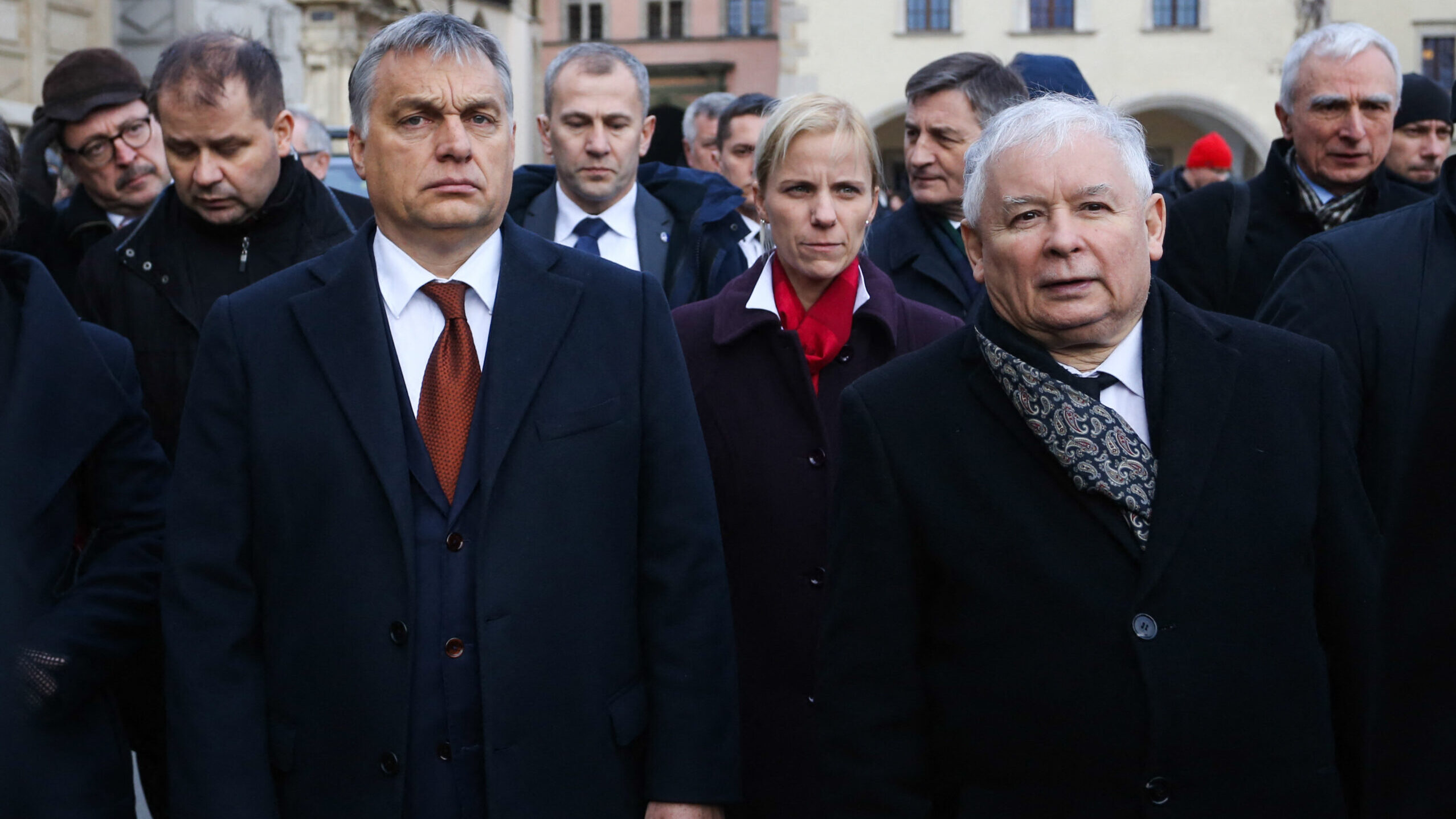
Poland’s long-time national-conservative Law and Justice (PiS) is witnessing its most serious internal conflict in recent years after leader Jarosław Kaczyński gave members of former prime minister Mateusz Morawiecki’s Development Plus association an ultimatum: abandon the platform or be forced out of PiS.
More than 30 PiS MPs refused to submit the declaration demanded by the leadership before Thursday night’s deadline. Members of Morawiecki’s group accuse Kaczyński of attempting to expel them without a formal disciplinary procedure. PiS, however, claims that refusing to sign amounted to resignation.
The party’s Political Committee is due to meet on Tuesday, 28 July, when it is expected to determine their status. Morawiecki says his bloc includes 40 MPs, one senator and three MEPs, although three of those MPs were already outside PiS. He has not announced any breakaway party or political movement.
Development Plus, established in April, is a separate association built around a faction within PiS, representing a relatively moderate, economically focused strand of the party. It emphasizes growth, modernization and outreach to entrepreneurs, younger voters and urban conservatives, whom Morawiecki believes PiS has increasingly struggled to reach.
That is precisely the opposite direction from where Kaczyński wants to take PiS as it faces some of its weakest polling in years. The leadership favours greater centralization and a more hardline approach to regain voters lost to Sławomir Mentzen’s Konfederacja and Grzegorz Braun’s breakaway Konfederacja Korony Polskiej (KKP). Kaczyński underlined that strategy by selecting former education minister Przemysław Czarnek, a staunch social conservative, as PiS’s prospective prime ministerial candidate for 2027.
The crisis comes almost three years after PiS lost power to Donald Tusk’s Civic Coalition but remained Poland’s largest party, kept its support broadly stable and later secured local and presidential victories. A recent CBOS poll, however, placed PiS at 19.1 per cent among declared voters, while Konfederacja and KKP stood at 15.2 and 8.2 per cent respectively, together outpolling PiS. Kaczyński’s personal unpopularity also places a ceiling on recovery, particularly among younger and centrist voters. A January poll found that 88 per cent believed he should hand control to a younger generation.
Looking through the Polish Mirror
That places Kaczyński in a similar position to his long-term ally, Viktor Orbán. PiS’s crisis should serve as a warning to Fidesz of what can follow when electoral defeat is not addressed with sufficient self-reflection, a credible reorganization, a clear programme and a transparent succession process.
Fidesz lost power after 16 years in April in a broadly similar way to PiS three years earlier, except its defeat was far larger. Péter Magyar’s Tisza Party secured a landslide, winning 141 seats and a constitutional supermajority. Magyar campaigned on a centre-right anti-corruption and anti-establishment platform, promising to hold officials and businessmen linked to what he called the ‘political and economic patronage network’ linked to Viktor Orbán accountable, restore relations with the EU, recover frozen European funds and rebuild the rule of law.
Magyar’s programme closely resembles Tusk’s, but with one crucial difference: Tisza faces no effective parliamentary or presidential veto over most of its agenda. PiS lost power mainly because it lacked coalition partners while the opposition secured a combined majority. It also retained a sympathetic president whose veto power slowed Tusk’s accountability programme, supporting PiS’s claims of political persecution and giving it time to establish a resistance narrative.
‘Tisza faces no effective parliamentary or presidential veto over most of its agenda’
Fidesz is in a far grimmer position. After three months in government, Tisza removed Orbán-era President Tamás Sulyok, accelerated the replacement of other public officeholders and introduced retrospective 12-year term limits for MPs and an eight-year limit on serving as prime minister. The measures exclude many senior Fidesz politicians from the next election and prevent Orbán from returning as prime minister under the current constitutional rules, leaving the party with fewer formal instruments to protect itself against what it calls the government’s ‘tyranny’.
PiS reacted similarly when Tusk took office in 2023 and began implementing his agenda of ‘holding evil accountable’. Kaczyński’s party and former officials denied wrongdoing and accused the government of attempting to destroy its largest opponent through politically motivated investigations. By August 2024, Tusk said 62 members of the ‘previous ruling elite’ had been charged, while further investigations targeted former ministers.
These processes moved slowly because Tusk lacked an aligned president and the parliamentary majority needed to override vetoes. That gave PiS time to fight investigations, retain its parliamentary strength and postpone the already frequently discussed succession of Kaczyński.
Choosing Resistance over Renewal
Orbán and Kaczyński have followed remarkably similar political trajectories. Both became inseparable from their parties and centralized authority. Both survived heavy electoral defeats before returning to power, strengthening their conviction that personal continuity, rather than resignation, was the route to recovery. When Fidesz won a supermajority in 2010, Kaczyński predicted that Warsaw would eventually ‘turn into Budapest’, presenting Orbán’s Hungary as the model to follow.
Orbán is now adopting elements of Kaczyński’s role as leader of a broader right-wing camp above parliamentary politics. In April, he announced that he would not take up his parliamentary seat but would remain president of Fidesz, promising to reorganize the party before eventually handing it over to a younger generation.
The promised renewal and self-correction, however, have instead been replaced by the resistance politics familiar from PiS. Orbán and Fidesz announced a ‘Declaration of Resistance’, promising peaceful action against the ‘illegitimate system’ and the Magyar government’s ‘tyranny’ inside and outside Parliament. At Tusványos, Orbán declared that ‘instead of opposition self-reflection, we must switch to resistance politics’, defined his task as organizing the broader national resistance and suggested that the constitutional restrictions preventing his return could eventually be removed. In doing so, he reopened the possibility of a comeback while delaying the promised succession debate.
Fidesz risks reproducing the same internal conflict without the advantages Kaczyński initially retained. Its support collapsed after April and has continued to erode. Medián placed Fidesz at 18 per cent among all adults and 21 per cent among certain voters. Europion found that only 60 per cent of its April electorate still supported the party in July; 17 per cent had become undecided, 11 per cent had moved to Our Homeland (MHM) and 10 per cent to Tisza. MHM rose to 8 per cent overall and 10 per cent among party choosers, profiting the most from Fidesz’s crisis.
Without genuine self-reflection, Fidesz risks turning that decline into a lasting credibility crisis. Orbán’s resistance strategy may preserve the remaining core, but it does not explain why former supporters should return or what the party would do differently in government. The stalled succession process also leaves renewal dependent on the leader most closely associated with the defeated government and the controversies of the previous 16 years. Tisza is already using its communications dominance to reinforce that association, while Fidesz’s unwillingness to confront it strengthens Magyar’s narrative.
Signs of withdrawal and internal repositioning are already visible. Péter Szijjártó has left Parliament for an executive position at BYD, while former ministerial commissioner Orsolya Ferencz has called for a new conservative political community extending beyond the existing party framework, a proposal endorsed by former minister Tibor Navracsics.
Continued erosion would sharpen the same strategic division now breaking PiS. One faction would argue that Fidesz must move further to the right to recover voters from MHM, while another would conclude that Orbán’s confrontational politics make it impossible to regain younger, urban and moderate conservatives. Moving right could slow defections to MHM but further consolidate Tisza’s control of the centre-right; moderation would expose Fidesz to accusations of abandoning the nationalist positions that sustained it in power.
‘Continued erosion would sharpen the same strategic division now breaking PiS’
Any successor capable of resolving that dilemma would need an independent programme and political authority—precisely the qualities most likely to threaten Orbán’s continued control. Kaczyński’s attempt to suppress Morawiecki’s alternative strategy shows how quickly an unresolved debate over direction can become a struggle over loyalty and leadership.
Fidesz’s current strategy may therefore delay an open rupture without restoring the party’s position. It relies on Tisza making serious governing or economic mistakes, but offers little guarantee that disappointed voters would return to Fidesz rather than abstain, remain with Magyar or move to MHM. If the increasingly popular theory that Hungary follows Poland by roughly one political cycle proves correct, Orbán and Fidesz could face the same sequence—defeat, resistance, competition from the right, succession paralysis and internal conflict—but in considerably less time.
Related articles:
At a time when public debate is increasingly polarized and superficial, Hungarian Conservative remains committed to depth, intellectual honesty, and independent conservative thought.
Producing high-quality journalism requires resources. Your contribution helps us expand our coverage, reach new audiences, and keep our content accessible.

Please consider supporting our mission.