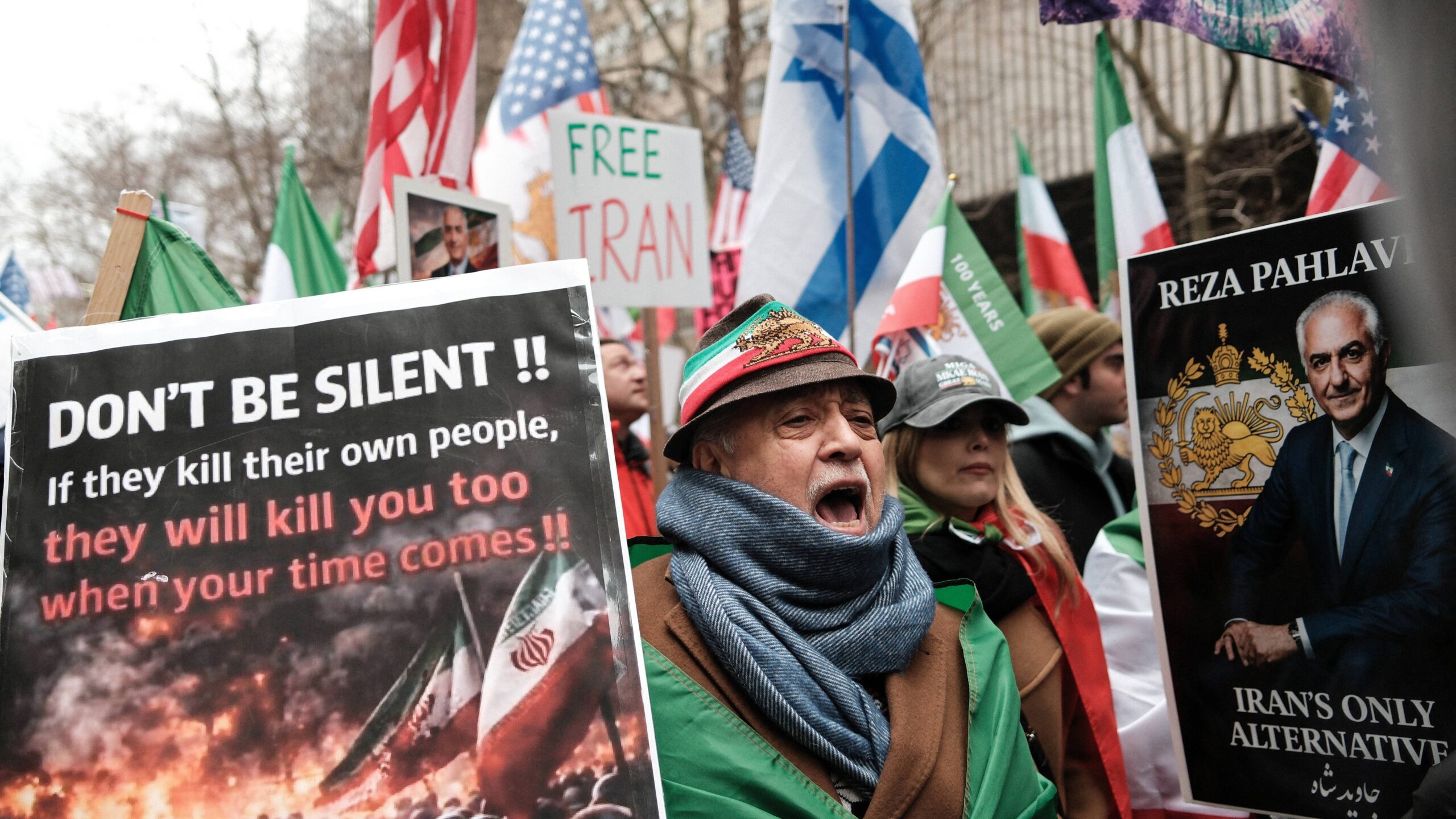
The exiled Iranian Crown Prince Reza Pahlavi stated last Wednesday that the Islamic Republic of Iran’s regime collapse is approaching, but the ‘final call must come at the right moment’. On the same day, National Intelligence Director Tulsi Gabbard, testifying at a congressional hearing last Wednesday, said:
‘The IC [intelligence community] assesses the regime in Iran appears to be intact, but largely degraded due to attacks on its leadership and military capabilities.’
It has now been three weeks since the U.S.–Israeli conflict with Iran commenced, aiming ultimately to dismantle its theocratic regime. Although it is undeniable that Iran has incurred significant losses, including the assassination of its Supreme Leader and other high-ranking officials, its illegitimate government seems to remain stable. This stability can be attributed to fundamentally flawed yet dangerously outdated strategic assessments that suggest the political landscape of Iran is still largely influenced by its Islamic ideology—that of the 12th Imam, Muhammad al-Mahdi, who is foretold to return in the end times to establish peace. Despite its support for terrorist groups, Iran’s main goal is not expansionism, especially considering that they represent only 4.7 percent of the global Muslim population, but rather the safeguarding of national security.
This phase came about as a result of the Iran–Iraq War (1980–1988), in which the U.S.-backed Iraqi dictator, Saddam Hussein, miscalculated how Iranians would come together to defend their homeland. The war, as Professor of International Studies at Johns Hopkins University, Vali Nasr, explained, compelled Iran’s first Supreme Leader, Ayatollah Ruhollah Khomeini, ‘to abandon…Islamic universalism and focus on the patriotic goal of defending Iran. Even as rhetoric remained steeped in religious language, Khomeini quickly transformed into a leader of an Iranian nation under siege. The main task before him was no longer ensuring the triumph of Islam but instead Iran’s very survival.’ A reason why, in what is known as the Iran-Contra Affair, he purchased millions of dollars of U.S. weapons from the Reagan administration.
Today, in order to protect itself from declared adversaries, the regime has adopted a mosaic defense, which is a military capability that is not structured around a singular decision-making core, the elimination of which would trigger a systemic failure, but on a decentralized distribution of command, capabilities, and operational initiative among numerous interconnected tactical centers. In this arrangement, the strategic decapitation of its leader, as the Trump administration found out, does not result in the breakdown of the military system; rather, it tends to spread the confrontation throughout the operational landscape.
‘This system ensures that multiple levels of leadership are ready to assume authority if senior figures are killed in a conflict’
In like manner, another great miscalculation on the part of Washington’s regime-change war is underestimating Iran’s ‘mosaic governance’. Also referred to as the ‘Fourth Successor’, this system ensures that multiple levels of leadership are ready to assume authority if senior figures are killed in a conflict, and it no longer relies on decision-making at every single juncture. At its core, it is a framework in which everyone understands the objectives and functions autonomously, aligned with those goals. It was established in the event of a bombing or decapitation, where there is a predetermined successor who will immediately assume control and fulfill specific responsibilities.
This individual, in turn, promptly designates a successor to take his place should he be killed. Consequently, the system, facilitated by the Islamic Revolutionary Guard Corps (IRGC), can replicate itself rapidly without needing to halt in order to address a decapitation, as it has by naming Khamenei’s son, Mojtaba Khamenei, as his successor. And even if the new ayatollah is killed, the IRGC, which functions as a parallel state, like the old Praetorian Guard of Rome, will keep the regime going as long as they remain in power.
Iran has now restricted access to the Strait of Hormuz, through which roughly 20 percent of global oil trade and liquefied natural gas exports pass daily. Despite a considerable portion of Iran’s naval forces being destroyed, the threat from the IRGC Navy is expected to persist. This force has consistently aimed to disrupt traffic in the strait through a mix of mines, missiles, drones, so-called midget submarines, unmanned surface vessels, and armed speed boats. Each of these assets is already deterring most shippers from entering the Gulf, which explains why the U.S. Navy has chosen not to provide tanker escorts. However, if these capabilities are combined in a mutually supportive and synergistic way, they could create an Iranian gauntlet in the strait that would be time-consuming, costly, and difficult for the U.S. to dismantle.
A most draconian form of Islam may be at the core of Iran’s theocracy, which is, for lack of a better term, unadulterated evil that must be irradiated. Yet, its body politic and its military prowess go beyond that, for the time being, at least.
Related articles:
At a time when public debate is increasingly polarized and superficial, Hungarian Conservative remains committed to depth, intellectual honesty, and independent conservative thought.
Producing high-quality journalism requires resources. Your contribution helps us expand our coverage, reach new audiences, and keep our content accessible.

Please consider supporting our mission.