
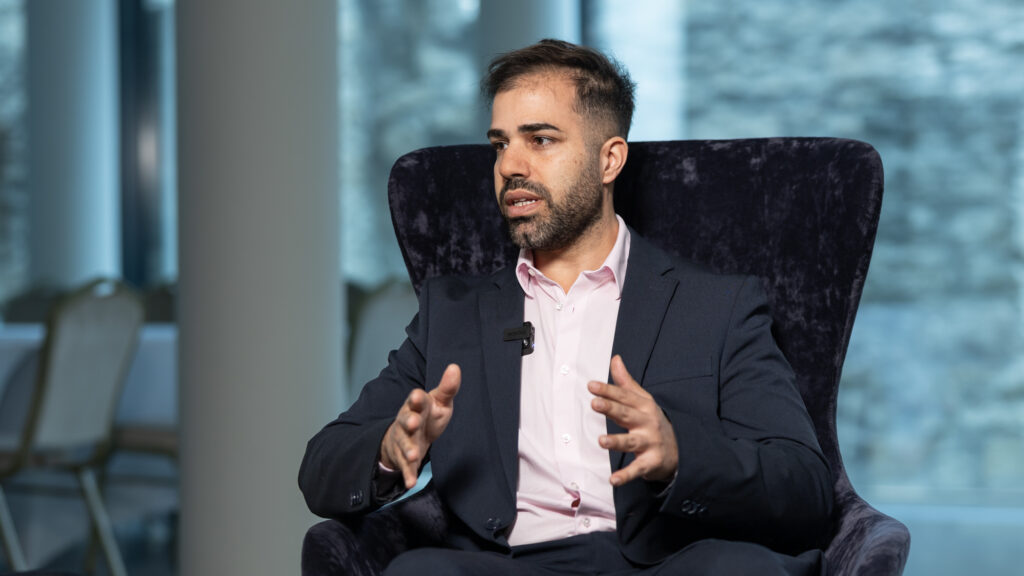
Or Yissachar is an Israeli national security and Middle East researcher and an Iran expert. He serves as a Senior Fellow at the David Institute for Security Policy and is a member of the IDSF management. He graduated from Tel Aviv University with a bachelor’s degree in arts and music, focusing on piano performance and musicology, and from Sciences Po’s Paris School of International Affairs with a master’s degree in international security. He has worked for several think tanks, including Israel’s INSS, and has also worked as an analyst in the Israeli high-tech industry for companies such as Wix, Meidata, and ActiveFence. He served in Unit 8200 of the IDF’s Intelligence Corps as an intelligence analyst and regularly briefs Israeli decision-makers, cabinet ministers, senior IDF figures, and members of the Knesset.
***
Iran considers the attack on Iran an act of aggression, Israel considers it a pre-emptive war. Which one is it?
I’ll start by saying that the West initially wanted to solve the Iranian issue by offering a shot at diplomacy, but the Iranian regime had very little intention of compromising, and instead sought to buy time. The Iranian regime always commits to one thing on paper and then continues to do something completely different in practice.
By five key elements we measure the metrics of this war. The first is the nuclear programme. Indeed, last year Israel and the US attacked the country’s nuclear facilities and really set it back by years, but they have since resumed and tried to dig even deeper underground bunkers that will be very hard to attack from the air. Next is the missile industry. The head of the CIA himself said that Iran is on the verge of developing missiles capable of reaching Budapest and Brussels. They are launching missiles at innocent civilians today. Drone capability is next: they have used them on Dubai airport and hotels. Then there is terrorism around the world: they are trying to assassinate people on European and American soil. And lastly, the protests that triggered today’s war. According to reports, over 30,000 demonstrators were shot to death on the streets of Iran.
So I would say that it is not a uniquely Israeli perspective to view the Iranian regime as a threat. It is the United States that has designated Iran as the world’s leading state sponsor of terrorism and a destabilizing force in the Middle East, and it was the European Council that designated the IRGC as a terrorist group. I would say we are not starting a war, but rather closing the war that the Iranian regime has been waging on the West for almost 50 years.
How is the war going on now? Trump said some days ago that it’s going according to schedule, but the Iranian regime didn’t collapse.
Well, we can see that the Iranian leadership is decimated. Ali Khamenei, the Supreme Leader; Ali Shamkhani, the senior adviser on the nuclear folder; Ali Larijani, the leader in practice; the IRGC commander or the army commander—dozens of key regime figures have been eliminated. Nuclear, missile and drone sites are decimated. The Navy and the Air Force are gone. So I would hardly call it that Iran is winning.
‘It is not a uniquely Israeli perspective to view the Iranian regime as a threat’
I would say that just because not everything is said publicly, it doesn’t mean that nothing is being done. And I would refer to Israeli assessments that this will indeed trigger an all-out protest in Iran to topple the regime. The Israelis and the Americans are saying that, no matter what happens, this will not be the same Iran after the war. And I think the Iranian people have every right to reclaim their country. These people have been suffering for almost 50 years.
Some analysts say that Israel dragged the US into this war, and that it was a strategic mistake by the US to join yet another long and never-ending Middle East war. Could there be a scenario where America and Israel are shaken by a protracted war?
It is not the intention to drag it into a forever war, certainly not an attrition war. Not all wars are the same. There was a 12-day war last June; there was the 42-day First Gulf War; and, of course, the Iraq and Afghanistan wars. I think the United States has learned a lot from past experiences; it does not want to be dragged into forever wars. Looking at President Trump, I would hardly say that anyone can drag him into anything. The narrative that Israel has dragged the United States into war is an old antisemitic theme: Soviet outlets also said that Zionists were whispering in the ears of Roosevelt at the time of the Second World War, and Hitler and Goebbels also claimed that this was a Jewish war—otherwise, how could one explain that Soviets, capitalists, and imperialists alike, the Russians, the Americans, and the British, were all going to war against Germany?

As I said before, it is not a uniquely Israeli perspective that Iran is a threat. The IAEA, the UN watchdog for nuclear activities said just last year that Iran was inches away from getting its hands on ten nuclear bombs. So, I would say that Western Europe, in particular France and the United Kingdom, probably want to say thank you to Israel and the United States. Just like German Chancellor Merz said, Israel is doing the dirty work for us. They know they probably cannot do this work by themselves, but I think they also are thankless in their reaction to this, when the United States, for example, asked them to help with the opening of the Strait of Hormuz. It’s a combination of thanklessness and appeasement, and it’s never a good recipe to win over world hegemony.
Why was it time to prevent Iran from getting stronger?
Israel is far from being happy to go to war, I can assure you. My family has rushed to the shelter over three times and spent hours there last night; overall, Israelis have been going to shelters over the past three weeks, and IDF soldiers are risking their lives on the front lines. Israel is the first victim of this war. There is no war frenzy in Israel. The question is: what are you going to do about the threats?
On the Iranian side, it would have been best if the Iranians had not sponsored terrorism around the world, had not tried to assassinate their political dissidents in Europe and in the United States, and had not overtly developed nuclear weapons. Overtly, they are saying that they will wipe Israel off the face of the earth. Overtly, they are saying they are developing missiles to reach the homeland of the United States. Overtly, they are saying their goal is to replace the Western-led world order. So we should take them at their word as seriously intending to do so. Not doing anything about it, I think, means the risk outweighs the cost in that regard.
And I think that there is a great benefit in being a trend-setter: in seeing the threat in front of you, trying to solve it in a diplomatic way, and then, when that fails, having a credible military force to act.
‘Overtly, they are saying that they will wipe Israel off the face of the earth’
What was Israel’s strategy behind this swift attack on Iran?
I think the lesson learned from 7 October is that you need to tackle a danger in time. Of course, I would say that the aggressor is the first to be blamed. Had Iran not developed nuclear weapons or tried to assassinate Masih Alinejad, the famous Iranian activist with a flower in her hair in Brooklyn, or had not tried to assassinate President Trump twice, it would be easier to deal with Iran. The real risk here is the combination of nuclear weapons and a fanatic, fundamentalist regime.
Israel has made a lot of mistakes. One of our former IDF Chiefs of Staff said recently that, thanks to the Second Lebanon War, we gained 17 years of silence in Lebanon. I would argue that Israel sat in silence while the other side was preparing for war. This is exactly the risk here. In those 17 years, instead of taking preventive steps against Hezbollah, we ended up with a far more dangerous Hezbollah in Lebanon, with over 150,000 missiles and drones, ready to conquer northern Israel.
They usually say that a smart man can find a way out of a problem, but a wise man would not enter in the first place. I can see that Western Europe has this appeasement or strategic passivity. They would rather not take action than take risky action. And as I said, no one wants war, but Israel has been a rule maker, not a rule taker, by showing the world how to deal with danger. I think Western Europe has a lot to learn from Israel.
In Hungary’s case, you are a small, landlocked country with relatively modest military capabilities, traditionally serving as a bridge between East and West. Naturally, you do not want to be involved. But I would say that the nuclear powers of Western Europe have much more to contribute in this case.
‘I think the lesson learned from 7 October is that you need to tackle a danger in time’
What are Israel’s ultimate war goals? To overthrow the Iranian regime, or just to weaken its military capabilities?
I would say the narrow goal is to deny the capabilities across all five metrics that I mentioned. Israeli intelligence reportedly said, and the CIA openly confirmed, that they were digging the nuclear bunkers even deeper so that they cannot be eliminated from the air. And I think the larger goal is to encourage the Iranian people to take to the streets and overthrow the regime. Can Israel or America guarantee that it happens? No. We have very bad experience in dictating the rules in the Middle East, in telling people who their leaders should be, or in installing puppet leaders. So it is time to give them the stage, let them take to the streets. But right now, it is too dangerous—they would be heavily harmed if they did. In Iran, we see the IRGC just firing indiscriminately at civilians on the streets. But as time goes by, as IRGC, Basij, and army positions are being attacked.
Some say that there could be a worse scenario for Iran after the Islamic regime falls: chaos. What’s your opinion about that?
There is certainly a scenario, but I would not call it the leading one. I think there is very little chance that the Iranian regime gives up power willingly, but it depends on the cost. In Shiite Islam, they say that humiliation is worse than death. So to go out there and just willingly pass the baton to someone else is unlikely. However, if the conditions are met, and the table is set so that they understand it’s over for them, some in the Iranian regime will prefer humiliation to death. Some would prefer an orderly transition with some elements of the regime. Let’s take President Pezeshkian or others in the regime, together with Reza Pahlavi, for example—an opposition leader living in the US, the Crown Prince of the last Shah—together with some opposition figures in Iran, and lead the country, let’s say, like the Venezuelan model, toward elections, a referendum, and a new constitution. This is not 10 steps, but 100 steps down the line. But I would not say it is impossible.
‘I think the larger goal is to encourage the Iranian people to take to the streets and overthrow the regime’
I think we should give it a chance, because to just surrender to reality, saying nothing can be done, is a very defeatist attitude to life.
What percentage of Israelis supports Netanyahu’s war policy, and how many do not?
I would say there is almost unanimous support for the war. We see it in public opinion polls: while Israelis rush to shelters over a dozen times a day, while people are being injured and killed, while houses are being demolished, Israel remains one of the top ten happiest countries in the world. I would say that Israelis understand the cost of war. I would not conflate it with support for a certain government party or politician. If you take President Trump, I would say he has somewhere around a 40–45 per cent approval rating, but if you ask Americans whether they want to deport illegal aliens who are criminals, it’s 90 per cent. And I would say it is advisable that Europe takes militarization more seriously. It does not mean that there has to be a militarized society like Israel, but you should invest more in defence.
Israel wages a multifront war. How is the southern Lebanese front, and what is currently happening in the Gaza Strip?
Israel’s position is that Hezbollah should no longer exist in southern Lebanon. And the ground operation just started. I know that there are players around the world who are not happy about it. I am surprised that someone like President Macron says we should stop, de-escalate and bring the situation back to where it was before. Well, before it wasn’t good enough, was it? So we want to improve the previous situation by erasing Hezbollah from southern Lebanon. The main beneficiaries of that are the Lebanese people themselves, who are, of course, are suffering greatly from Hezbollah. Israel wants to hit Hezbollah in order to give the tools to the Lebanese people, the Lebanese Government to get rid of Hezbollah. I hope that it would transpire into a scenario in which Lebanon becomes party to the Abraham accords and makes peace with Israel.
‘I would say it will take a very short time. There is no intention to get into a war of attrition or a forever war’
On Gaza: there should not be any armed or governmental form of Hamas there. You cannot control it unless you deradicalize a population, which I think would take at least two generations. But right now, no arms, no weapons—nothing that can threaten Israelis themselves. I would also not advise any other country to place boots on the ground in Gaza. I think the IDF knows what it is doing to neutralize Hamas, but the following step would be, with the help of nations around the world, led by the United States, to allow Gazans to rebuild their cities. I would not say that Gaza should remain one political unit; it will probably split into little Emirates or city-states, while allowing people to choose to emigrate to other destinations around the world. There is no perfect solution there. But as for 7 October, I think Israel finally understood that the policy of rounds and rounds of conflict cannot be reinstated.
This is an ongoing conflict between Iran and its proxies and Israel for decades, and now an open war has been raging for three weeks. When do you think the open-war phase will finish?
I would say very soon—days or weeks. The opening phase is about decimating Iran’s capabilities, and we see that it has been done with great success. The IDF is not only attacking Iran on the Persian Gulf, but also the Navy in the Caspian Sea, and across areas close to the Afghan and Pakistani borders, right in the east. So certainly, there is aerial supremacy even in Iran.
Pete Hegseth, the US Secretary of Defense, said that when the IRGC looks up at the sky, they can only see the Stars and Stripes and the Star of David—meaning the US and Israeli air forces, which he said, when combined, are the most powerful in the world.
I would say it will take a very short time. There is no intention to get into a war of attrition or a forever war. But after that, indeed, we should allow Iranians to rise up and topple the regime. I would say it is worth trying, more than appeasing or succumbing to the pace of history. I think we should be rule makers, not rule takers.
Watch the full podcast below:
Read more of our interviews:
At a time when public debate is increasingly polarized and superficial, Hungarian Conservative remains committed to depth, intellectual honesty, and independent conservative thought.
Producing high-quality journalism requires resources. Your contribution helps us expand our coverage, reach new audiences, and keep our content accessible.

Please consider supporting our mission.