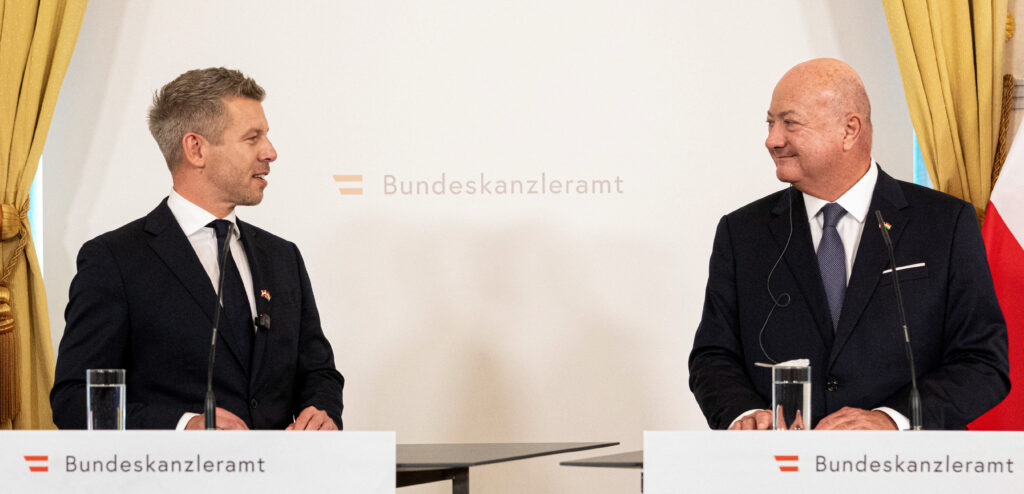

Robert Preuhs, PhD, is the chair of the Political Science Department at Metropolitan State University of Denver. He was featured at one of the panels at Ludovika Fest 2026 in Budapest, Hungary in May 2026. At the event, he was gracious enough to give an exclusive interview to our website.
***
MSU Denver and Ludovika University have a partnership. Can you tell me how this came about and what benefits each party has with this project?
I’ll tell you in the general sense because I’m not the specialist. We started in 2023, two years ago, with the exchange of faculties and students in criminal justice and policing. And then that allowed us to have about six students, maybe a dozen students, to study abroad, come out here to visit and study in Ludovika. We had a faculty exchange as well with Dr Christián, one of our faculty members, who came here to teach and study. And we’re now exploring ways to expand those opportunities, both in the study of water disciplines as well as political science and international affairs.
You are a professor of political science.
I am, yes.
This is an election year in the United States—not a presidential election, but midterm elections. What I noticed is that, despite there being these high gas prices due to the Iran war, Republicans are actually doing fairly well in the national polling average. I checked it today [on 8 May], a couple of hours ago, and the Democrats are up by 5.3 percentage points in the RealClearPolitics average of all polls for the generic ballot, which has actually been favouring the Democrats in the past cycles. It typically underpolls Republicans. This is a promising sign, I believe, for the GOP, because even though the economic situation is not very good for the American consumer with the gas prices, they’re still faring pretty well in the polling.
I mean, I think for Democrats, they’re happy that they’re above, but maybe not as happy as they could be. Though keep in mind that in line with the expectations over history, over our contemporary history, that is still a pretty solid lead. We don’t see margins of 10 to 15 to 20 points nationally ever, really. So I think they are still generally on track to win a substantial amount of votes in the House.
And then the other thing that’s tougher about the congressional polling is that a lot of folks still don’t know. And then the third part, though, is that President Trump’s core supporters are still his core supporters. So among Republicans, for instance, above 80–85 per cent, depending on the policy issue, support and approve of his policy positions. So he hasn’t lost his ‘base’ base, and it’s really going to come down to who and where comes out and votes and the extent of voting. But we also anticipate a fairly high voter participation in November.

Do you think there’s any chance that the Iran standoff between the closure of the Strait of Hormuz by Iran and the US naval blockade of Iranian ports would still be ongoing during the midterms? Because that would be catastrophic for Republicans. Is there any chance of that?
Sure, there’s a chance of it.
Oh my God.
I don’t know, but it’s probably a fairly small chance. But I don’t know if I assumed that we would see it go even this long either. I think this administration, and the United States, is in a difficult position right now because the administration is in this standoff with the Iranian government that is essentially controlled by much harder hardline factions than they might have been prior to our attack. And then that makes the Trump administration back down here and there on some of the promises of annihilation, for good or bad, which has emboldened Iran as well.
So it’s not clear to me when this standoff will end. I don’t know if it’s clear to the world where the standoff will end. I think it mostly needs to go through September to have some effect on the election. By mid-September, most Americans have made up their mind in terms of who they’re going to vote for.
In 2022, there was a similar, even higher gas price hike under President Biden, and it didn’t really affect him and the Democratic Party during the midterms; they performed pretty well.
Yeah, they overperformed.
Although, probably a Republican voter may be more swayed by gas prices than a Democratic voter, who’s more green policy-conscious.
Well, I think so too, but also remember that there were probably about 10 per cent of the voters in November of 24 that were really voting for a change as much as anything else.
There were lots of reasons for the government and Biden not to win that election. And Harris still only lost by 1.5 percentage points. So this is not so much about pure swing voters that go back and forth, but about the level of enthusiasm and folks that would be maybe willing to change their vote or maybe vote for the Democrat within their local elections. I think it’s more about the turnout of folks who are opposed to the Republicans.
We’ve seen widespread protests fairly consistent with a wide demographic range of folks that have been joining the No Kings protest, for instance. And I think those are indications of a good amount of concern about this administration. We have to remember that we’re not voting for President Trump, but that we’re essentially voting either to maintain a dual majority, which has been less than popular in some ways; or adding one check to this system by giving Democrats control of the House of Representatives.
So the Senate is not really in play for the Democrats? I know that they would have to win Texas, Alaska, or Iowa, some of those states.
It’s going to be a Democratic pipe dream, yeah. But it’s possible, right? And again, up through September, October, folks will be making up their minds, and mostly they’ll be deciding how important it is to go to the polls. So turnout’s going to matter quite a bit. But yeah, Texas is going to be a hard one. And I don’t think we’ve seen enough evidence in some smaller state legislative and sub-national government elections, and a few special elections flipping.
But Texas would not be enough for them. They would have to go for Ohio, Iowa, Alaska—these double-digit Trump wins from 2024.

So, this is probably not the year for the Democrats to pick up the Senate. But, you know, if they can get close, there are enough elements of the filibuster that some policies can be passed, but really, all they need to do is control the House.
Let’s talk about higher education because the panel you took part in at the Ludovika Festival was about the Hungarian and American higher education systems. What kind of changes did the Trump administration make to the American higher education system in this about two years since they came back in power?
Well, in a couple of ways, and much of it was fairly dramatic. On one hand, it was through threats of lawsuits and through threats of removing grants and major research grants. The President fundamentally changed some of the structures within higher education, particularly those related to diversity and equity training, and he is trying to bring in and address a wider variety of the American public. So racial ethnics, civil rights, and equity issues, which have been growing over the last decade.
‘The President fundamentally changed some of the structures within higher education, particularly those related to diversity and equity training’
That’s a fundamental shift from two years ago, where many institutes of higher education were worried about diversity, equity, and inclusion, and had policies and language which were intended to be as inclusive as possible, although they were contentious at some level. So that shift has changed in a lot of the way how we go about interacting with students, the language that we use and the grants that we seek, and how we go about getting that federal funding. The other side, though, has been in threats regarding funding for students.
So, in the United States, of course, we have essentially a much more decentralized education system. We have both private institutions and large state institutions, all of which rely to some extent on tuition dollars from students and the federal support system, whether it’s in student loans or for low-income individuals, Pell Grants, which is essentially some amount of money based on income that students can get in order to provide some equity in terms of who can go to college. Those have been used as leverage to change educational outcomes and policies for the most part. In terms of the feel at the level of higher education, early on, it was fear and a lot of capitulation to the preferences of the President and the administration. Now I think it’s less fear, more trying to navigate what seems to be this new set of regulations and how we can still maintain our operations under a different regime. And on top of that, he’s gotten rid of the Department of Education, which has been generally the overseer of lots of both funds and other mechanisms to provide institutions of higher education with opportunities to help students.
Related articles:
At a time when public debate is increasingly polarized and superficial, Hungarian Conservative remains committed to depth, intellectual honesty, and independent conservative thought.
Producing high-quality journalism requires resources. Your contribution helps us expand our coverage, reach new audiences, and keep our content accessible.

Please consider supporting our mission.